Clematis brachiata
Thunb.

no rights reserved, uploaded by Riaan Stals
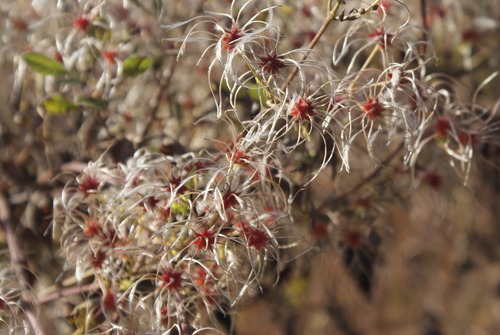
(c) Arista Botha, some rights reserved (CC BY-NC-SA)

(c) Arthur Chapman, some rights reserved (CC BY-NC-SA)
What to Eat
Edible parts: Leaves - flavouring
The leaves are used for flavouring and as a preservative.
Where to Find It
It is a subtropical plant.
Africa, Angola, Botswana, Eswatini, Madagascar, Malawi, Mozambique, South Africa, Southern Africa, Swaziland, Zambia, Zimbabwe,
How to Identify
A woody climber. It grows 4 m long. The leaves have 5-7 leaflets. These are 45 mm long by 30 mm wide. There are many flowers in a group. They are white with a yellow centre. They have a sweet scent.
How to Grow
Prefers a well-drained but moisture retentive soil. Grows best where the roots can be in shade, but the plant can reach up into the sun. Plants seem to be immune to the predations of rabbits. A greedy plant, inhibiting the growth of nearby plants, especially legumes.
Propagation: Seed - best sown as soon as it is ripe. Sow stored seed as soon as it is obtained. Pre-soak the seed for 12 hours in warm water and remove as much of the tail and outer coat as possible. The seed germinates in 1 - 9 months or more at 20°c. Prick out the seedlings into individual pots when they are large enough to handle and grow them on until large enough to plant out. Internodal cuttings of soft to semi-ripe wood, late spring in sandy soil in a frame. Layering of old stems in late winter or early spring. Layering of current seasons growth in early summer.
Medicinal Uses
The leaves are used in the treatment of skin diseases.
Wikipedia
Source ↗Clematis brachiata, commonly known as traveller's joy, is a hardy, deciduous Southern African liana of the family Ranunculaceae. It tends to clamber to the tops of trees and shrubs, sprawling over the crowns. Leaves are compound with from 1 to 7 leaflets. Attractive, highly fragrant flowers appear in summer. Achenes are covered in fine silky hair. This species is common in the northern parts of South Africa and kwaZulu-Natal and was first described by Carl Peter Thunberg (1743-1828), the celebrated Swedish naturalist. "Clema" is Greek for a liane, and the Latin specific name "brachiata" means "provided with arms" since the right-angled and opposite branching habit resembles arms sticking out of a torso.
Names & Synonyms
References (3)
- Ruiters-Welcome, A. K., 2019, Food plants of southern Africa. Ph.D. thesis. Univ. of Johannesburg p 93
- Welcome, A. K. & Van Wyk, B.-E., 2019, An inventory and analysis of the food plants of southern Africa. South African Journal of Botany 122 (2019) 136–179
- World Checklist of Useful Plant Species 2020. Royal Botanic Gardens, Kew


