Nemesia caerulea
Hiern.

(c) Brendan Cole, some rights reserved (CC BY-NC-ND), uploaded by Brendan Cole
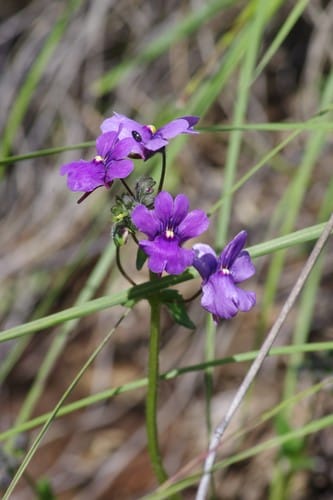
(c) Craig Peter, some rights reserved (CC BY-NC)
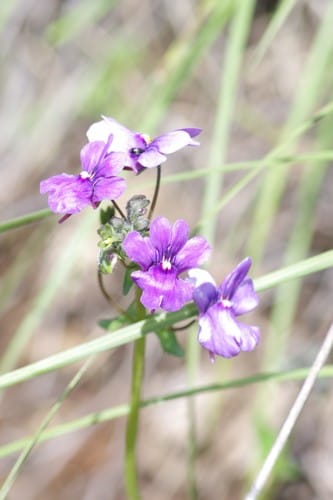
(c) Craig Peter, some rights reserved (CC BY-NC)
What to Eat
Edible parts: Leaves, Plant
Both the leaves and the entire plant are edible.
Where to Find It
It is a subtropical plant.
Africa, South Africa, Southern Africa,
How to Identify
A herb. It grows 50 cm tall. It has many small flowers that are pink, blue or white.
Wikipedia
Source ↗Nemesia caerulea is a blue- to purple- flowered herbaceous perennial member of the family Scrophulariaceae. The plant is native to the Cape Floristic Province of southwestern South Africa, where it grows at low elevations on fully exposed north-facing and northwest-facing slopes in association with other native grasses and forbs. Its chromosome number is 2n=18. It produces many small flowers in shades of pink, blue and white (the Latin caerulea means "dark blue"). The flowers are two-lipped, the upper lip with four lobes and the lower lip with two lobes. In cultivation the two lips are often different colours. In temperate regions it is usually grown as an annual. The cultivar 'Sea Mist' has gained the Royal Horticultural Society's Award of Garden Merit.
References (2)
- Ruiters-Welcome, A. K., 2019, Food plants of southern Africa. Ph.D. thesis. Univ. of Johannesburg p 102
- Welcome, A. K. & Van Wyk, B.-E., 2019, An inventory and analysis of the food plants of southern Africa. South African Journal of Botany 122 (2019) 136–179