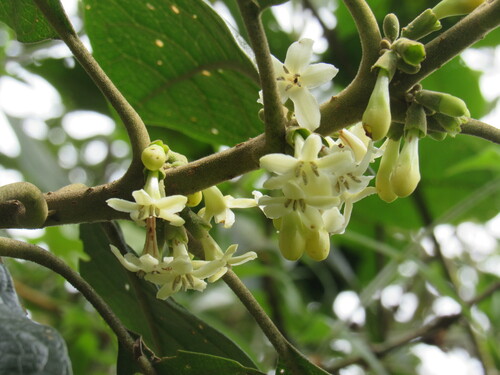
Mentha royleana
Wall. ex Benth.

Wikimedia Commons - Dinesh Valke from Thane, India

Wikimedia Commons - Dinesh Valke from Thane, India
What to Eat
Edible parts: Leaves
The leaves are used in cooking, for chutney, and as a herbal tea.
Where to Find It
It is a subtropical plant.
Asia, Pakistan,
How to Identify
A slender subtropical herb in the mint family (Lamiaceae) with narrow leaves.
Medicinal Uses
Mentha royleana has been assessed as a plant with a "high use value" in traditional medicine. It has been used to treat a variety of ailments. It is said to be used as a treatment for vomiting, diarrhea, dysentary, and cholera, as well as a general carminative. In the Margalla Hills, part of the Himalayan foothills, it is ground with the fruit of Zanthoxylum armatum and combined with salt as a stomach ache cure. Herbal medicine practitioners in Batakundi mixes the leaves of M. royleana into green teas, with cooling and gas relief properties. In Parachinar, the leaves of the plant are sewed into cloth pads and wrapped around babies' chests to relieve flus and chest problems. In the Haramosh valley in Gilgit District, M. royleana is combined with pomegranate, ginger and garlic to produce a juice intended to treat diabetes and heart issues. Combined with Thymus linearis (Himalayan Thyme), it is used to treat high blood pressure and abdominal worms. Aside from medical use, M. royleana is used to freshen the breath and in the preparation of sauces and salads. The floral shoots of M. royleana are also used in religious ceremonies in Hinduism.
Wikipedia
Source ↗Mentha royleana, is a species within the Mentha (mint) genus, native to eastern Afghanistan, Pakistan, the Himalayas and Kashmir. A polymorphic perennial herb, M. royleana has seen diverse uses in traditional medicine.
Names & Synonyms
Chitta podna, Jangli podina, Sofaid podina
References (2)
- Ahmad, K., et al, 2018, Ethnobotanical investigation of wild vegetables used among local communities in northwest Pakistan. Acta Soc Bot Pol. 2019;88(1):3616.
- Majeed, M., et al, 2021, Gathered Wild Food Plants among Diverse Religious Groups in Jhelum District, Punjab, Pakistan. Foods 2021, 10, 594.