Crocus speciosus
M. Bieb.
Purple crocus, Bieberstein's crocus

(c) AnneTanne, some rights reserved (CC BY-NC)
(c) Krylenko VV, some rights reserved (CC BY-NC)
What to Eat
Edible parts: ?
Where to Find It
It is a temperate plant.
Azerbaijan, Caucasus, Iran, Middle East, Turkey, Türkiye,
How to Identify
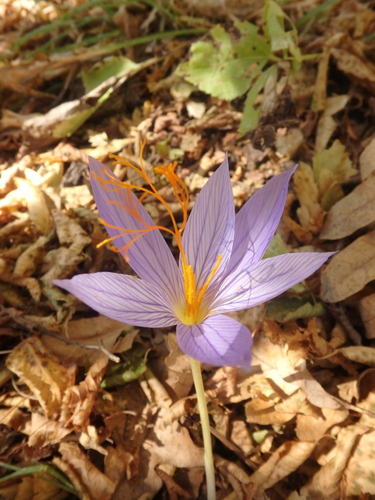
A plant with a corm and it keeps growing from year to year. It grows 10-15 cm tall. It produces many small corms. The flowers are purple and lighter in the centre. The leaves develop after the flowers. The leaves are narrow and usually have a silver stripe down the middle.
How to Grow
It can be grown by seed or by small corms.
Wikipedia
Source ↗Crocus speciosus, with common name Bieberstein's crocus, is a species of flowering plant in the genus Crocus of the family Iridaceae. The plant is native to northern and central Turkey, the Caucasus, northern Iran, Crimea and Bulgaria. Crocus speciosus is a cormous perennial growing to 10–15 cm (3.9–5.9 in) tall. The lilac flowers with paler coloured throats and dark veins appear in autumn (fall). The orange styles are much-divided. The specific epithet speciosus means "showy". It is cultivated as an ornamental plant. As it increases rapidly, it is suitable for naturalisation in grass. The species, and the white-flowered cultivar 'Albus', have gained the Royal Horticultural Society's Award of Garden Merit.
Names & Synonyms
References (1)
- Ibadullayeva, S., et al, 2011, Protection of some rare and endangered vegetable plants in the flora of the Nakhichevan AR. International Journal of Biodiversity and Conservation Vol. 3(6), pp. 224-229


