Vitex pinnata
L.
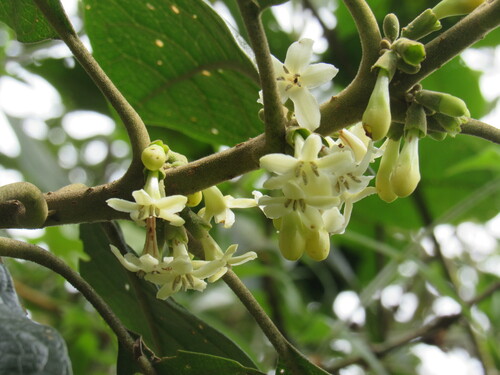
(c) Steven Chong, some rights reserved (CC BY-NC), uploaded by Steven Chong

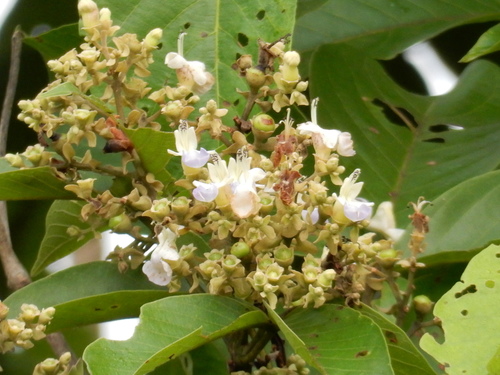
(c) Kevin Faccenda, some rights reserved (CC BY)

(c) Kevin Faccenda, some rights reserved (CC BY)
What to Eat
Edible parts: Leaves/bark - medicine.
No edible uses are known for this plant.
Where to Find It
It is a tropical plant.
Asia, China,
How to Identify
A tree. It grows 20 m tall. The bark is grey brown, cracked and flaky. The leaves have 3-5 leaflets. The outer 2 are usually smaller. The leaves are 3-25 cm long by 1.5-10 cm wide. The leaves have a scent. They taper to the tip and are rounded at the base. The flowers are in groups at the ends of the branches. They are whitish-blue. The fruit are 5-8 mm across.
How to Grow
Vitex pinnata is common in comparatively dry regions in lowland forest, where it can be found at elevations up to 1,000 metres. It is found in areas where the mean annual rainfall is within the range 590 - 1,500mm, and the mean annual temperature 20 - 32°c. Young trees grow moderately slowly, with a mean annual diameter increment of 0.6 cm and slightly over 1 cm in Myanmar and Java respectively. One year-old seedlings may reach 2 metres in height, mean annual height increment for the first 15 years after planting is about 1 metre. Planted trees start to flower after 11 - 12 years in Java. Planting should be done early in the rainy season. Generally at m x 3 metres , occasionally at 1 x 1 - 2 metres on very fertile soils. For charcoal production, stands planted at densities of 2,500 trees/ha have yielded 16 - 18 tonnes of charcoal in 4 years. Moderately fire resistant.
Propagation: Pre-soaking seeds in hot water for 15 seconds stimulates germination and improves rates. Seeds begin to germinate 10–40 days after sowing, with a germination rate of 60–80%. Seed can be stored for one year after depulping. Germination is completely inhibited under dense forest canopy, but seeds remain dormant and viable for more than 6 months in those conditions. Under light shade, seed separates into two fractions: one that germinates within 2 months, and another that remains dormant until exposed to full sunlight.
Medicinal Uses
A decoction of the bark is used to treat stomach-ache. A poultice of the leaves is applied to treat fevers and wounds.
Other Uses
The tree has been used in replanting schemes to reclaim imperata grasslands in Asia and is among the recommended trees in its native range for use as a shade tree. The yellow-brown to dark-brown wood is fine-grained, heavy, very hard, and durable. Though not commercially important due to its small dimensions, the timber is favoured locally for construction, household goods, tool handles, boats, and implements. The wood produces a high-quality charcoal that is compatible and competitive with mangrove charcoal in international markets.
Wikipedia
Source ↗Vitex pinnata is a tree of the family Lamiaceae. It is native to south and south east Asia. It grows slowly, ultimately reaching 20 metres in height with 1–3 m. circumference trunk. It features a grey-brown-yellow bark. Its leaves are scented.
Names & Synonyms
keleban
References (1)
- World Checklist of Useful Plant Species 2020. Royal Botanic Gardens, Kew