Adenophora verticillata
(Pall.) Fischer
Southern shashen

(c) zxchang, some rights reserved (CC BY-NC)

(c) zxchang, some rights reserved (CC BY-NC)
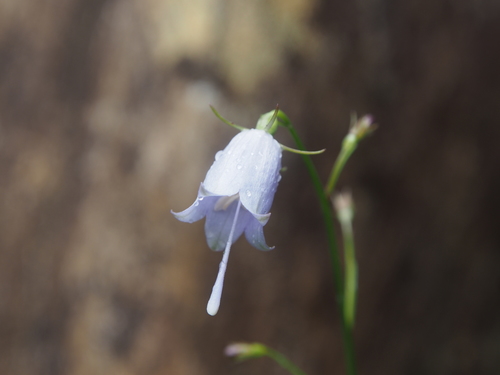
(c) Keita Watanabe, some rights reserved (CC BY-NC)
What to Eat
Edible parts: Leaves, Root, Bulb
The root can be eaten raw or cooked and has a sweet flavour. Leaves are edible when cooked.
Where to Find It
It grows best in a light rich slightly alkaline soil. It needs a sunny position.
Asia, China, Indochina, Japan, Korea, Laos, SE Asia, Siberia,
How to Identify
A perennial plant. It grows 1 m high. The leaves are broadly oval and have teeth along the edge. The flowers are small. The roots are thick and fleshy.
How to Grow
Plants can be grown from seed. Seeds germinate in 1-3 months at 10°C. They can be transplanted or sown direct. Plants can also be grown from cuttings.
Propagation: Seed is best sown in a cold frame as soon as it is ripe, though spring sowing also works. Surface sow 2–3 seeds per pot in spring to avoid the need for transplanting. If transplanted when very small, seedlings establish without difficulty. Germination takes 1–3 months at 10°C. Plant out into permanent positions while young. Basal cuttings can be taken in spring. Division in spring is possible but very difficult, as the plant dislikes root disturbance.
Medicinal Uses
Widely used in traditional Chinese medicine, the root is antidote, antifungal, cardiotonic, expectorant, febrifuge, sialagogue, stomachic, and tonic. It is applied in the treatment of women's diseases, chronic bronchitis with dry cough, pulmonary infections producing cough and thick yellow sputum, and dry throat.
Other Uses
None known.
Wikipedia
Source ↗Herbaceous perennial reaching 1 m tall with hermaphrodite flowers appearing in June and seeds ripening July to August. Hardy to UK zone 7. Grows in light sandy to medium loamy soils with mildly acid to basic pH. Tolerates semi-shade in light woodland conditions and prefers consistently moist soil.
Notes
There are about 40 Adenophora species. They are temperate plants.
Names & Synonyms
Froth shen
References (8)
- Bircher, A. G. & Bircher, W. H., 2000, Encyclopedia of Fruit Trees and Edible Flowering Plants in Egypt and the Subtropics. AUC Press. p 10
- Hu, Shiu-ying, 2005, Food Plants of China. The Chinese University Press. p 713 (As Adenophora tetraphylla)
- Hwang, H., et al, 2013, A Study on the Flora of 15 Islands in the Western Sea of Jeollanamdo Province, Korea. Journal of Asia-Pacific Biodiversity Vol. 6, No. 2 281-310
- Mem. Soc. Imp. Naturalistes Moscou 6:167. 1823
- Plants for a Future database, The Field, Penpol, Lostwithiel, Cornwall, PL22 0NG, UK. http://www.scs.leeds.ac.uk/pfaf/
- READ,
- UPHOF
- Williams, D., 2017, Ainu Ethnobiology. Contributions in Ethnobiology. Society of Ethnobiology. p 122


