Ceriops decandra
(Griff.) W. Theob.
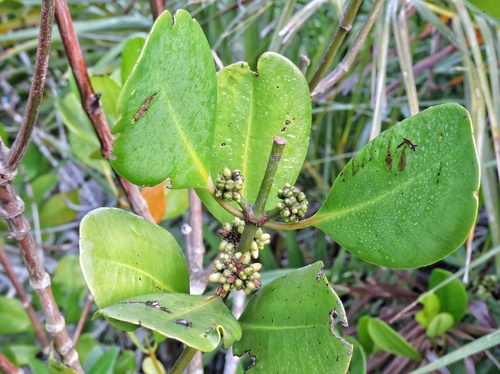
(c) Subhajit Roy, some rights reserved (CC BY-NC-ND), uploaded by Subhajit Roy

(c) Adrien Jailloux, some rights reserved (CC BY)
What to Eat
Edible parts: Medicine
Where to Find It
It is a tropical plant. In grows in the mangroves. It can grow in salty soils.
Asia, Bangladesh, India, Malaysia, Myanmar, SE Asia, Thailand,
How to Identify
A shrub or small tree. It grows 15 m tall. The trunk is 30 cm across. The bark is pale brown. The flowers are white. The fruit are cone shaped and 1.8 cm long
Nutrition Score: 45/100
| Part | Moisture | kJ | kcal | Protein | Vit A | Vit C | Iron | Zinc |
|---|---|---|---|---|---|---|---|---|
| Fruit | 54.3 | — | — | 19.1 | — | 78.9 | — | 12.5 |
How to Grow
A plant mainly of high rainfall areas in the tropics. The plant can grow in saline soils, it has a maximum tolerance of salinity at 67ppt and a salinity of optimal growth at15 ppt. A slow-growing species, though it can be tolerant of extreme environmental conditions. Trees tend to flower periodically and synchronously over wide areas, but seasonally under seasonal climates. Fruiting is often prolific. Seeds germinate and start to develop whilst still on the tree, with individual trees producing several thousands of seedlings at the same time. The seedlings take up to 12 months to develop, with shorter times in wet equatorial regions, and then fall. Subsequent development involves a seedling being stranded and lodged in the mud, followed by the rapid production of adventitious roots which serve to anchor it. Most seedlings are slender and small and cannot survive long periods while floating in the water, and consequently are not as successfully dispersed over long distances as those of other mangrove Rhizophoraceae. However, once 'planted' in the shade of other trees their rate of establishment is very high.
Medicinal Uses
The fruit is used medicinally.
Other Uses
The bark yields around 25 - 37% of a high quality tannin. Both bark and leaves are used for tanning in South-East Asia and India. The bark of older trees has higher contents of tannin. The sap of the bark yields a black dye used in the 'batik' industry. The wood is a pale whitish-yellow when freshly cut, turning orange-brown on exposure to air. It is usually somewhat less heavy than the wood of the related Ceriops tagal, and is moderately resistant to decay, with a life in contact with the ground of about 2 years. The branches are used for tool handles, and bent ones for boat ribs. Some wood of this species has been chipped for pulp. The wood is used for fuel. When dry, the wood burns with a hotter flame than that of most other mangrove species.
Wikipedia
Source ↗Ceriops decandra is a mangrove plant of tropical Asia in the family Rhizophoraceae. The specific epithet decandra is from the Greek meaning 'ten male', referring to the flower having ten stamens.
Names & Synonyms
References (2)
- Hosen, M. Z., et al, 2020, Comparison of Physicochemical and Antioxidant Properties of Edible Fruits in the Sundarbans' Mangrove Forest, Bangladesh. Bangladesh J. Bot. 49(3): 671-678
- World Checklist of Useful Plant Species 2020. Royal Botanic Gardens, Kew
More from Rhizophoraceae


