Codonopsis affinis
Hook.f. & Thomson
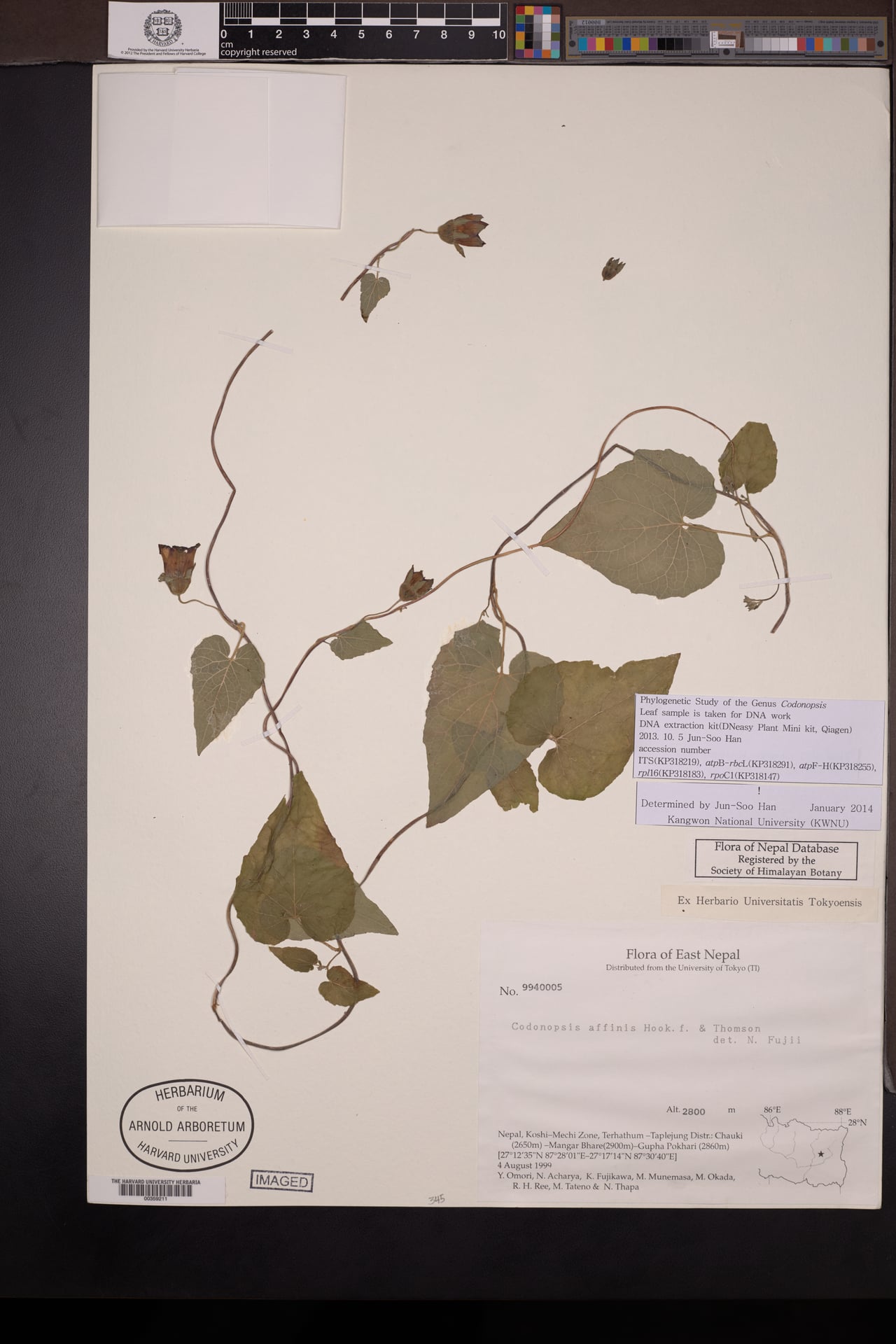
gbif · cc0
President and Fellows of Harvard College
President and Fellows of Harvard College

gbif · cc0
President and Fellows of Harvard College
President and Fellows of Harvard College

gbif · cc0
President and Fellows of Harvard College
President and Fellows of Harvard College
What to Eat
Edible parts: Fruit - spice
Codonopsis lanceolata (Korean: deodeok) is used as a food in Korean cuisine.
Where to Find It
It is a subtropical plant.
Asia, China, Tibet,
Countries: United Arab Emirates, Afghanistan, Armenia, Azerbaijan, Bangladesh, Bahrain, Brunei, Bhutan, China, Georgia, Indonesia, Israel, India, Iraq, Iran, Jordan, Japan, Kyrgyzstan, Cambodia, North Korea, South Korea, Kuwait, Kazakhstan, Laos, Lebanon, Sri Lanka, Myanmar, Mongolia, Maldives, Malaysia, Nepal, Oman, Philippines, Pakistan, Qatar, Saudi Arabia, Singapore, Syria, Thailand, Tajikistan, Timor-Leste, Turkmenistan, Turkey, Taiwan, Uzbekistan, Vietnam, Yemen
How to Identify
A herb. It has thickened roots. The stems are twining and 2 m long. They are green and branched. The leaves on the main stems are alternate and oval. They are 2.5-15 cm long by 1-9 cm wide. They have a white coating. The base is heart shape to rounded. The fruit is a flattened round capsule.
Medicinal Uses
Codonopsis pilosula (Chinese: 党参; pinyin: dǎngshēn) is an important medicinal herb in traditional Chinese medicine.
Names & Synonyms
Gyang-phu-sen
Codonopsis affinis var. birmanica C. B. Clarke
References (1)
- Li, S., et al, 2020, Monpa, memory, and change: an ethnobotanical study of plant use in Mêdog County, South-east Tibet, China. Journal of Ethnobiology and Ethnomedicine. (2020) 16:5 p 16


