Ampelocissus polystachya
(Wall. ex M. A. Lawson) Planch.
VitaceaeFruit
iNaturalist · cc-by-nc
(c) Yusran E. Ritonga, some rights reserved (CC BY-NC), uploaded by Yusran E. Ritonga
(c) Yusran E. Ritonga, some rights reserved (CC BY-NC), uploaded by Yusran E. Ritonga
iNaturalist · cc-by-nc
(c) Klowitz Tsai, some rights reserved (CC BY-NC)
(c) Klowitz Tsai, some rights reserved (CC BY-NC)
What to Eat
Edible parts: Fruit
The purple fruit are eaten.
Where to Find It
It is a tropical plant.
Andamans, Asia, Malaysia, Myanmar, SE Asia, Singapore,
Countries: United Arab Emirates, Afghanistan, Armenia, Azerbaijan, Bangladesh, Bahrain, Brunei, Bhutan, China, Georgia, Indonesia, Israel, India, Iraq, Iran, Jordan, Japan, Kyrgyzstan, Cambodia, North Korea, South Korea, Kuwait, Kazakhstan, Laos, Lebanon, Sri Lanka, Myanmar, Mongolia, Maldives, Malaysia, Nepal, Oman, Philippines, Pakistan, Qatar, Saudi Arabia, Singapore, Syria, Thailand, Tajikistan, Timor-Leste, Turkmenistan, Turkey, Taiwan, Uzbekistan, Vietnam, Yemen
How to Identify
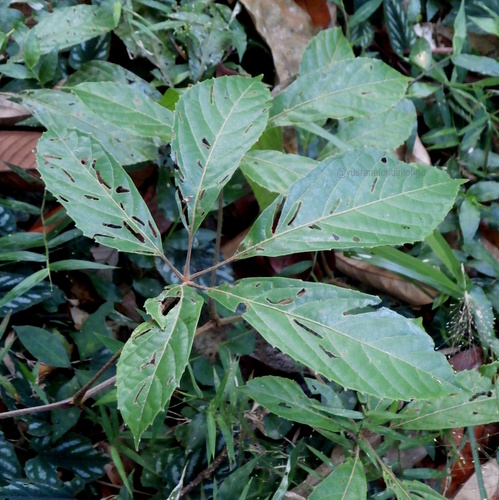
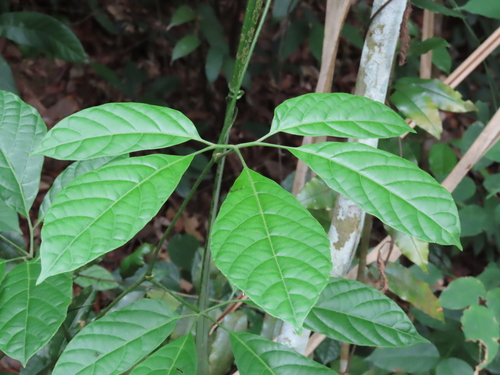
A vine. The leaves are arranged in spirals. The leaves have 3-5 leaflets. The leaflets have teeth along the edge. The end leaflet is oval and 17-24 cm long by 7-8.5 cm wide. The side leaflets are unequal on their sides and 13-15 cm long by 3.5-6.5 cm wide. The flowering clusters are 30 cm long. The spikes are 11 cm long. The fruit are purple.
How to Grow
It can be grown by cuttings.
Names & Synonyms
Vitis polystachya Wall. ex M. A. Lawson
References (1)
- World Checklist of Useful Plant Species 2020. Royal Botanic Gardens, Kew


