Renealmia thyrsoidea
(Ruiz) & Pav.) Poepp. & Endl.

(c) Riley Fortier, some rights reserved (CC BY-NC)
(c) Riley Fortier, some rights reserved (CC BY-NC)
(c) Riley Fortier, some rights reserved (CC BY-NC)
What to Eat
Edible parts: Fruit, Seeds - drink
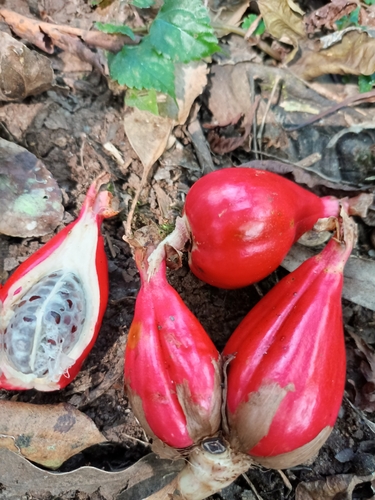
The stringy fibres inside the fruit are edible. They are boiled and eaten with manioc cakes. The flesh of the fruit is mixed with rice meal, or can be added to soups, where it imparts a pleasant flavour. It is considered to have nutritive properties. The globose to ellipsoid, black-purple fruit can be 15 - 45mm long and 7 - 25mm wide with a fleshy fruit wall around 3 - 7mm thick. The most interesting application of the fruit is that the seeds, when toasted and mashed, are made into a cafe' type of beverage.
Where to Find It
It is a tropical plant. It can grow in forests up to 3,000 m above sea level. It can grow in swampy areas.
Amazon, Bolivia, Brazil, Central America, Colombia, Costa Rica, Ecuador, Nicaragua, Panama, Peru, South America*, Trinidad, Venezuela,
How to Identify
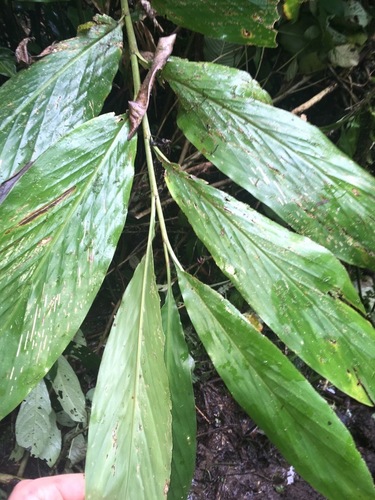
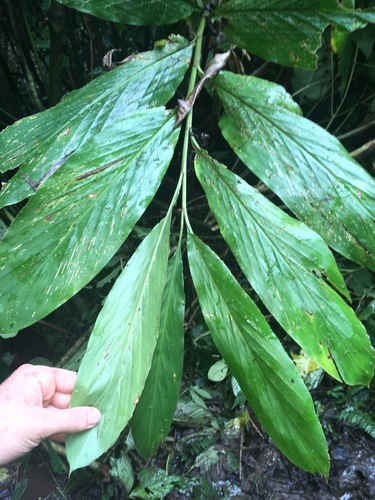
A ginger family herb. It can grow 1-5 m tall. It produces clumps of upright stems. The leaves are 20-75 cm long by 5-15 cm wide. The fruit are 2.5 cm long by 1.5 cm wide. There are 30-70 seeds.
Medicinal Uses
It is believed that pains may be alleviated by applying a heated leaf to the place where pain is felt. The dried leaves are often placed over cuts or scratches to act as a sort of bandage or cover. The seeds, when toasted and mashed, are made into a coffee type of beverage which, when taken with coffee, are said to aid in childbirth and serve as a remedy for chills and colds. The plant is valued in treating snakebite by crushing the stem and drinking an infusion once a day to prevent swelling.
Other Uses
The fruit, which has a thick, fleshy, purple-black flesh, is used to make an ink.
Other Information
It is cultivated in Ecuador.
Names & Synonyms
Machakuy shinwanku, Sacha shiwanku, Saratango, Shiwanku panka, Teentekagi, Tetemo
References (6)
- Caballero-Serrano, V., et al, 2019, Traditional ecological knowledge and medicinal plant diversity in Ecuadorian Amazon home gardens. Global Ecology and Conservation 17 (2019) e00524 p 14
- Ferns, Useful Tropical Plants
- Lopez-Diago, D. & Garcia, N., 2021, Wild edible fruits of Colombia. Biota ColomBiana 22 (2) p 54
- Roa, J. A. G. & Boada, D. S. G., 2018, Fundación para el Fortalecimiento de la Fruticultura y Plantas Alimenticias no Convencionales en Colombia.
- Torre, de la, L., et al, 2008, Enciclopedia de las Plantas Útiles del Ecuador. Herbario QCA. Pontificia Universidad Católica del Ecuador. p 625
- World Flora on Line