Cyperus bulbosus
J. Vahl
Bush onions, Onion grass, Nut grass
(c) catrionaandphil, some rights reserved (CC BY-NC)

(c) Nina Kerr, some rights reserved (CC BY)

(c) Nina Kerr, some rights reserved (CC BY)
What to Eat
Edible parts: Bulb, Tubers, Root
The tubers are eaten raw or roasted after removing the husk, or dried and ground into flour. They are a famine food.
Where to Find It
A tropical plant. It grows in tropical regions. In Australia it is inland near salt lakes. It grows in dry regions and seasonally wet grasslands. It grows in areas with an annual rainfall of about 300 mm. In East Africa it grows from 300-2,400 m altitude. It can grow in arid places. It can grow on coastal sand dunes.
Africa, Asia, Australia, Burkina Faso, East Africa, Egypt, Eritrea, Ethiopia, India, Indochina, Indonesia, Iran, Kenya, Mauritania, Middle East, Myanmar, Niger, Nigeria, North Africa, Pakistan, Sahel, SE Asia, Senegal, Somalia, Sri Lanka, Sudan, Tanzania, Uganda, Vietnam, West Africa,
How to Identify
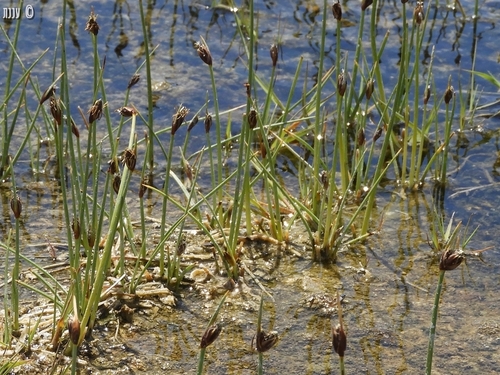
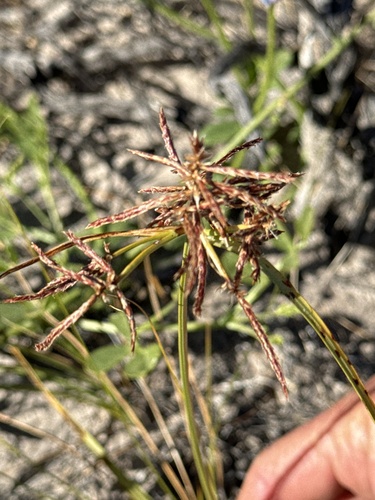
A sedge. These grow in clumps and have grass like leaves and solid stalks. It is a herb. It grows 10-40 cm high. The rhizomes are slender. They produce brown to black tubers are the tips. The leaves are 10-20 cm long by 0.2-0.3 cm wide. They are flat and erect. They are shiny green. The culms are 20-40 cm tall. The spikelets are 1-3 cm long.
Nutrition Score: 59/100
| Part | Moisture | kJ | kcal | Protein | Vit A | Vit C | Iron | Zinc |
|---|---|---|---|---|---|---|---|---|
| Bulb | 42.8 | 883 | 211 | 3.4 | — | 32 | 3.4 | 0.6 |
How to Grow
Plants can be grown by division or tubers. They can aso be grown from seed.
Wikipedia
Source ↗Cyperus bulbosus is a species of sedge found across Africa, the Middle East, Indian subcontinent, Southeast Asia, and Australia. In Australia, it is commonly called Nalgoo or (Australian) bush onion or "wild onion", but is not related to the onion or other Alliaceae. It is a component of Australian bushfood, but is considered an agricultural weed in other areas.
Other Information
It is usually a weed in cultivated fields. It is a famine food.
Notes
Chemical composition (after Paton & Dunlop) (grams per 100g): Protein = 2.27g. Fat = 0.58g. Carbohydrate (soluble) = 82.46g. Fibre = 1.51g. Ash = 1.58g. Water = 11.60g. Calories = 353. There are 550 Cyperus species.
Names & Synonyms
Akademoit, Bid, Gaddi, Gimaru, Gohosa, Gooso, Heqeyata, Hinkicha, Ilkuroti, Morkut, Motha, Mothabasa, Nalgoo, Ngaatu, Niyalbun, Puri, Puridumpa, Rabuon-apuoyo, Shilandi arisi, Theck root, Theg, Tjanmata, Yelka
References (47)
- Addis, G., et al, 2005, Ethnobotanical Study of Edible Wild Plants in Some Selected Districts of Ethiopia. Human Ecology, Vol. 33, No. 1, pp. 83-118
- Addis, G., Asfaw, Z & Woldu, Z., 2013, Ethnobotany of Wild and Semi-wild Edible Plants of Konso Ethnic Community, South Ethiopia. Ethnobotany Research and Applications. 11:121-141
- Addis, G., et al, 2013, The Role of Wild and Semi-wild Edible Plants in Household Food Sovereignty in Hamer and Konso Communities, South Ethiopia. Ethnobotany Research & Applications. 11:251-271
- Ambasta, S.P. (Ed.), 2000, The Useful Plants of India. CSIR India. p 157
- Asfaw, Z., Conservation and use of traditional vegetables in Ethiopia. FAO
- Asfaw, Z. and Tadesse, M., 2001, Prospects for Sustainable Use and Development of Wild Food Plants in Ethiopia. Economic Botany, Vol. 55, No. 1, pp. 47-62
- Bindon, P., 1996, Useful Bush Plants. Western Australian Museum. p 97
- Burkill, H. M., 1985, The useful plants of west tropical Africa, Vol. 1. Kew.
- Cancilla, D., 2018, Ethnobotanical and Ethnozoological Values Desktop Assessment - Eliwana Project. p 11
- Cherikoff V. & Isaacs, J., The Bush Food Handbook. How to gather, grow, process and cook Australian Wild Foods. Ti Tree Press, Australia p 189
- Crawford, I. M., 1982, Traditional Aboriginal Plant Resources in the Kalumburu Area: Aspects in Ethno-economics. Records of the Western Australian Museum Supplement No. 15
- Elliot, W.R., & Jones, D.L., 1984, Encyclopedia of Australian Plants suitable for cultivation. Vol 3. Lothian. p 156
- Ethiopia: Famine Food Field Guide. http://www.africa.upenn.edu/faminefood/category1.htm
- Flora of Pakistan. www.eFloras.org
- GAMMIE,
- GUPTA & KANODIA,
- Hedrick, U.P., 1919, (Ed.), Sturtevant's edible plants of the world. p 262
- IRVINE,
- Isaacs, J., 1987, Bush Food, Aboriginal Food and Herbal Medicine. Weldons. p 97
- Jardin, C., 1970, List of Foods Used In Africa, FAO Nutrition Information Document Series No 2.p 74
- Kenneally, K.E., Edinger, D. C., and Willing T., 1996, Broome and Beyond, Plants and People of the Dampier Peninsula, Kimberley, Western Australia. Department of Conservation and Land Management. p 205
- Lands, M., 1987, Mayi: Some Bush fruits of Dampierland. Magabala Books, Broome West Australia. p 29
- Lang, P. J., et al, 1986, Anangu Pitjantjatjara Lands Biological Survey. p 43
- Latz, P.K., 1996, Bushfires and Bushtucker: Aboriginal plant use in Central Australia. IAD Press Alice Springs p 158
- Latz, P & Wightman, G., 1995, Desert Bush Tucker Identikit. Common Native Food Plants of Central Australia. Parks & Wild Commission Northern territory. p 54
- Lazarides, M. & Hince, B., 1993, Handbook of Economic Plants of Australia, CSIRO. p 73
- Lim, T. K., 2015, Edible Medicinal and Non Medicinal Plants. Volume 9, Modified Stems, Roots, Bulbs. Springer p 32
- Low, T., 1991, Wild Food Plants of Australia. Australian Nature FieldGuide, Angus & Robertson. p 51
- Lulekal, E., et al, 2011, Wild edible plants in Ethiopia: a review on their potential to combat food insecurity. Afrika Focus - Vol. 24, No 2. pp 71-121
- Miers, G., 2004, Cultivation and sustainable wild harvest of Bushfoods by Aboriginal Communities in Central Australia. RIRDC report W03/124 p 19
- Morley, B.D., & Toelken, H.R., (Eds), 1983, Flowering Plants in Australia. Rigby. p 365
- Ocho, D. L., et al, 2012, Assessing the levels of food shortage using the traffic light metaphor by analyzing the gathering and consumption of wild food plants, crop parts and crop residues in Konso, Ethiopia. Journal of Ethnobiology and Ethnomedicine 8:30
- Paczkowska, G. & Chapman, A.R., 2000, The Western Australian Flora. A Descriptive Calatogue. Western Australian Herbarium. p 42
- Pascoe, B., 2018, Dark Emu. Aboriginal Australia and the birth of Agriculture. Magabala books, p 55
- PATON & DUNLOP,
- RIRDC, 2010, New Root Vegetables fo the Native Food Industry, Australian Government RIRDC Publication 9/161
- Romanowski, N., 2007, Edible Water Gardens. Hyland House. p 56
- Royal Botanic Gardens, Kew (1999). Survey of Economic Plants for Arid and Semi-Arid Lands (SEPASAL) database. Published on the Internet; http://www.rbgkew.org.uk/ceb/sepasal/internet [Accessed 16th April 2011]
- SAXENA,
- Simpson, D. A. & Inglis, C. A., 2001, Cyperaceae of Economic, Ethnobotanical and Horticultural Importance: A checklist. Kew Bulletin Vol. 56, No. 2 (2001), pp. 257-360
- Singh, H.B., Arora R.K.,1978, Wild edible Plants of India. Indian Council of Agricultural Research, New Delhi. p12
- Smith, M & Kalotas, A. C., 1985, Bardi Plants: An Annotated List of Plants and Their Use by the Bardi Aborigines of Dampierland, in North-western Australia. Rec. West Aust. Mus. 1985, 12(3): 317-359
- Smith, N and Wightman, G.M., 1990, Ethnobotanical Notes from Belyuen Northern Territory Australia. Northern Territory Botanical Bulletin No 10. Parks and Wildlife Commission of the Northern Territory. p 10
- Vigilante, T., et al, 2013, Island country: Aboriginal connections, values and knowledge of the Western Kimberley islands in the context of an island biological survey. Records of the Western Australian Museum Supplement 81: 145-182
- Wheeler, J.R.(ed.), 1992, Flora of the Kimberley Region. CALM, Western Australian Herbarium, p 1046
- Wightman, Glenn et al. 1992. Mudburra Ethnobotany: Aboriginal Plant Use from Kulumindini (Elliott) Northern Australia. Northern Territory Botanical Bulletin No 14. Parks and Wildlife Commission of the Northern Territory. p 14
- World Checklist of Useful Plant Species 2020. Royal Botanic Gardens, Kew
More from Cyperaceae