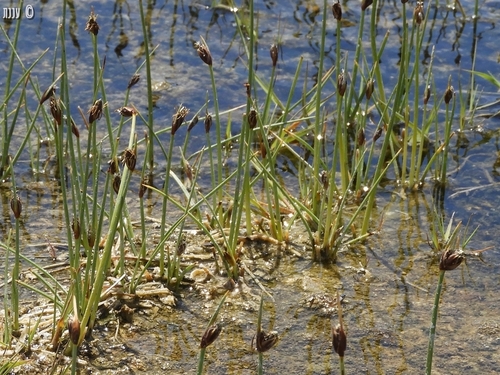
Cyperus distans
Linn. f.
Piedmont Flatsedge

(c) Ricky Taylor, some rights reserved (CC BY-NC), uploaded by Ricky Taylor

(c) Siegwalt U Küsel, some rights reserved (CC BY-NC), uploaded by Siegwalt U Küsel

(c) Jacy Chen, some rights reserved (CC BY), uploaded by Jacy Chen
What to Eat
Edible parts: Root, Tuber, Rhizome, Ash - salt
Tuber - raw or cooked. Used in sauces. The rhizome is used in food as a condiment and a spice. The plant ashes are extracted for salt. No further details are given, but the general process is to burn the dried plant then percolate water through the ashes to dissolve out the salts. The water is then evaporated to leave behind the salts. We have no specific information for this species, but it is said that the inner base of the young stems of all species in this genus can be eaten raw, and make an excellent survival food in times of need.
Where to Find It
A tropical plant. It grows in damp places. It grows throughout the tropics. In Yunnan.
Africa, Argentina, Asia, Australia, Bhutan, Botswana, Burkina Faso, Cambodia, Central America, Côte d'Ivoire, East Africa, Eswatini, Fiji, Ghana, Guianas, Guinea, Guinée, Guyana, Haiti, Himalayas, India, Indochina, Indonesia, Ivory Coast, Japan, Kenya, Laos, Madagascar, Malaysia, Mexico, Mozambique, Myanmar, Nepal, Nigeria, North America, Pacific, Papua New Guinea, PNG, Philippines, Sao Tome and Principe, SE Asia, Sierra Leone, South Africa, South America, Southern Africa, Sri Lanka, St Helena, St. Kitts and Nevis, Suriname, Swaziland, Thailand, Uganda, USA, Venezuela, Vietnam, West Africa, West Indies, Zambia, Zimbabwe,
How to Identify
A sedge. It keeps growing from year to year. It grows 30-100 cm high. It forms a loose tuft. The stalks have 3 angles and are thickened near the base. There are small corm-like underground stems or rhizomes. The blades are narrow and 4-6 mm wide. They are weakly folded The sheaths are light brown. The flowers are in groups at the one level and there are leafy bracts.
How to Grow
We have very little information on this species and do not know if it will be hardy in Britain, though judging by its native range it is unlikely to succeed outdoors in any but the very mildest areas of this country. The following notes are based on the general needs of the genus. Prefers a moist sandy loam.
Propagation: Surface sow seed in spring and keep the compost moist; germination usually takes 2–6 weeks at 18°C. Prick seedlings into individual pots as soon as large enough to handle, grow through their first winter in a greenhouse, and plant out in late spring after the last expected frosts. Division in spring or autumn essentially involves harvesting tubers and replanting them; tubers lifted in autumn are best stored in a cool, frost-free place over winter and planted out in spring.
Medicinal Uses
The juice of the root is used in the treatment of fevers.
Other Uses
The leaves are used for weaving hats, matting, and similar items.
Wikipedia
Source ↗Cyperus distans, also known as slender cyperus, is a species of sedge native to tropical and subtropical wetlands in sub-Saharan Africa, Asia (India, Indochina, China, Indonesia, Philippines, etc.), Madagascar, New Guinea, Australia, Latin America (from Mexico to Argentina), the West Indies, the southeastern United States (Florida, Georgia, North Carolina) and various oceanic islands.
Notes
There are 550 Cyperus species.
Names & Synonyms
Namacoca, Rumput wangi, Tsivendravendrana
References (12)
- Abbiw, D.K., 1990, Useful Plants of Ghana. West African uses of wild and cultivated plants. Intermediate Technology Publications and the Royal Botanic Gardens, Kew. p 31
- Alimenticias - FloraSBS
- Burkill, H. M., 1985, The useful plants of west tropical Africa, Vol. 1. Kew.
- Burkill, I.H., 1966, A Dictionary of the Economic Products of the Malay Peninsula. Ministry of Agriculture and Cooperatives, Kuala Lumpur, Malaysia. Vol 1 (A-H) p 743
- Ekman Herbarium records Haiti
- Plants for a Future database, The Field, Penpol, Lostwithiel, Cornwall, PL22 0NG, UK. http://www.scs.leeds.ac.uk/pfaf/
- Plants of Haiti Smithsonian Institute http://botany.si.edu/antilles/West Indies
- Simpson, D. A. & Inglis, C. A., 2001, Cyperaceae of Economic, Ethnobotanical and Horticultural Importance: A checklist. Kew Bulletin Vol. 56, No. 2 (2001), pp. 257-360
- Smith, A.C., 1979, Flora Vitiensis Nova, Lawaii, Kuai, Hawaii, Volume 1 p 247
- Suppl. pl. 103. 1782 ("1781")
- Swaziland's Flora Database http://www.sntc.org.sz/flora
- World Checklist of Useful Plant Species 2020. Royal Botanic Gardens, Kew
More from Cyperaceae