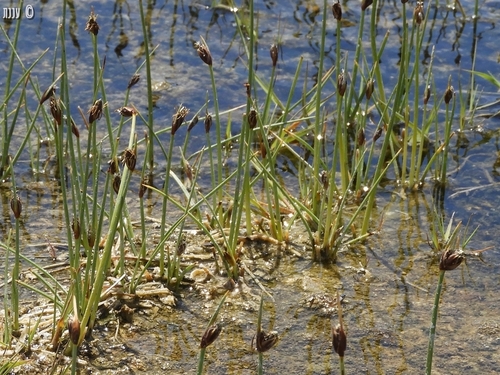
Cyperus papyrus
Linn.
Papyrus sedge
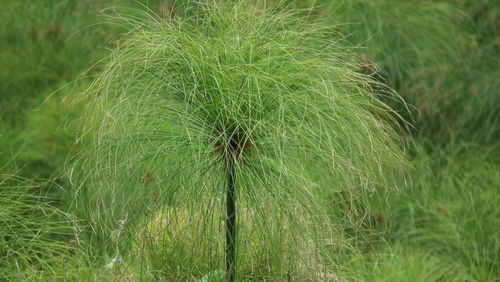
(c) Shaun Swanepoel, some rights reserved (CC BY), uploaded by Shaun Swanepoel
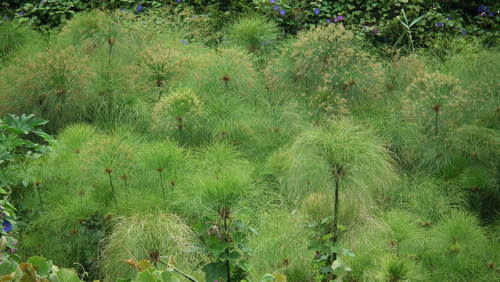
(c) Shaun Swanepoel, some rights reserved (CC BY)

(c) Douglas Goldman, some rights reserved (CC BY-SA), uploaded by Douglas Goldman
What to Eat
Edible parts: Rhizome, Root, Culms, Stems, Shoots, Vegetable, Spice
The pith of the stem was recommended as food in ancient Egypt. The rhizomes and the lowermost parts of the stems can be eaten raw or cooked, and may also be chewed and sucked like sugar cane, with the fibrous material spat out afterwards.
Where to Find It
It needs tropical conditions. It grows in marshy habitats and lakes. It will grow in slow flowing water. It will grow in water up to 1 m deep. It can grow in arid places. It suits hardiness zones 9-12.
Africa, Asia, Australia, Benin, Botswana, Central Africa, Central America, Chad, Congo R, Costa Rica, Côte d'Ivoire, East Africa, Egypt*, Europe, Fiji, Gabon, Greece, Guinea, Guinée, Hawaii, Indochina, Indonesia, Israel, Italy, Ivory Coast, Kenya, Laos, Liberia, Madagascar, Mediterranean, Middle East, Mozambique, Namibia, Nauru, Nigeria, North Africa, Oman, Pacific, Palestine, Rwanda, SE Asia, Senegal, Slovenia, South Africa, Southern Africa, Sudan, Syria, Tanzania, Uganda, USA, West Africa, Zambia, Zimbabwe,
How to Identify
A sedge. These grow in clumps and have grass like leaves and solid stalks. It is an erect herb which grows in tufts. It keeps growing from year to year. It grows 2.5 m tall. It has a short, thick, woody underground stem or rhizome. The stems are triangle shaped. The leaves are reduced to brown sheaths. There are 4-10 flowering bracts. These are 7-15 cm long. They are about 1 cm wide. The flower is compound with over 100 branches 10-25 cm long. Each has a sheath like bract 3-5 cm long near the base. There are also 3-5 bracts about 20 cm long at the tip. When the flowers are fertile there are 3-5 spikes with 20-30 spikelets. Each spikelet has 3-20 flowers. These are 1 cm long by 1 mm wide. The nut is 3 sided and brown.
How to Grow
Historic Crop Industrial Crop: Biomass Management: Hay Regional CropA plant of the subtropics to the tropics. It can tolerate a mean annual precipitation in the range 100 - 4,200mm, and a mean annual temperatures of 20 - 30?c. Succeeds in full sun and in partial shade. Prefers a fertile, wet soil, or shallow water up to 30cm deep. The plant can tolerate a pH in the range 6.0 - 8.5. Plants can spread rapidly by means of their rhizomes. Many African swamps are dominated by papyrus thickets, which totally block navigation. It is estimated that the swamp areas of the White Nile, and the 'Papyrus Swamps' around Lake Kioga and Victoria are responsible for the loss of 50% of that river's water through evaporation and plant transpiration. Plants can flower throughout the year.
Propagation: Seed or division.
Medicinal Uses
Papyrus had several medicinal uses in the past, though it is little or not at all used today. The pith was recommended for widening and drying fistulas. The most notable use involved burning papyrus sheets: the resulting ash was said to act like pulverised charcoal and was applied in treating certain eye diseases. The ash was also reported to check the spread of malignant ulcers in the mouth or elsewhere on the body. Additionally, ash produced by macerating the plant in vinegar before burning was said to heal wounds.
Other Uses
The fibrous pith of the stems is processed into paper by stripping away the outer covering, splitting the inner pith into thin, wafer-like strips, laying them side by side with a second layer placed crosswise on top, dampening the strips, and pressing them so their natural glue-like sap cements them together before drying. The plant was also traditionally used to make formal bouquets, funeral garlands, boats, cordage, fans, sandals, matting, corks, boxes, and paper. Papyrus stems can be used to caulk seams in wooden ships. Papyrus mats are used to make fences and huts. The rhizomes are cut into sections and used as beads.
Wikipedia
Source ↗Cyperus papyrus, better known by the common names papyrus sedge, papyrus, paper reed, Indian matting plant, or Nile grass, is a species of aquatic flowering plant belonging to the sedge family Cyperaceae. It is a tender herbaceous perennial, forming tall stands of reed-like swamp vegetation in shallow water. In nature, it grows in full sun, in flooded swamps, and on lake margins throughout Africa (where it is native), Madagascar, and the Mediterranean region. It has been introduced to tropical regions worldwide, such as the Indian subcontinent, South America, and the Caribbean. Along with its close relatives, papyrus sedge has a very long history of use by humans, notably by the Ancient Egyptians (as it is the source of papyrus paper, one of the first types of paper ever made). Parts of the plant can be eaten, and the highly buoyant stems can be made into boats. It is now often cultivated as an ornamental plant.
Other Information
It is cultivated.
Notes
There are 550 Cyperus species.
Names & Synonyms
Paper-rush, Paper-reed, Papirus, Uloko, Umufuunzo
References (33)
- Blamey, M and Grey-Wilson, C., 2005, Wild flowers of the Mediterranean. A & C Black London. p 528
- Bodkin, F., 1991, Encyclopedia Botanica. Cornstalk publishing, p 316
- Bremness, L., 1994, Herbs. Collins Eyewitness Handbooks. Harper Collins. p 165
- Brickell, C. (Ed.), 1999, The Royal Horticultural Society A-Z Encyclopedia of Garden Plants. Convent Garden Books. p 332
- Brouk, B., 1975, Plants Consumed by Man. Academic Press, London. p 143
- Cundall, P., (ed.), 2004, Gardening Australia: flora: the gardener's bible. ABC Books. p 458
- Fowler, D. G., 2007, Zambian Plants: Their Vernacular Names and Uses. Kew. p 66
- Grubben, G. J. H. and Denton, O. A. (eds), 2004, Plant Resources of Tropical Africa 2. Vegetables. PROTA, Wageningen, Netherlands. p 561
- Hedrick, U.P., 1919, (Ed.), Sturtevant's edible plants of the world. p 262
- Hibbert, M., 2002, The Aussie Plant Finder 2002, Florilegium. p 80
- Hussey, B.M.J., Keighery, G.J., Cousens, R.D., Dodd, J., Lloyd, S.G., 1997, Western Weeds. A guide to the weeds of Western Australia. Plant Protection Society of Western Australia. p 26
- Kiple, K.F. & Ornelas, K.C., (eds), 2000, The Cambridge World History of Food. CUP p 1828
- Lim, T. K., 2015, Edible Medicinal and Non Medicinal Plants. Volume 9, Modified Stems, Roots, Bulbs. Springer p 32
- Lord, E.E., & Willis, J.H., 1999, Shrubs and Trees for Australian gardens. Lothian. p 95
- Malaisse, F., 1997, Se nourrir en floret claire africaine. Approche ecologique et nutritionnelle. CTA., p 61
- Marinelli, J. (Ed), 2004, Plant. DK. p 268
- Nkeoua, G. & Boundzanga, G. C., 1999, Donnees sur les produits forestieres non ligneux en Republique du Congo. FAO. p 24
- Paczkowska, G. & Chapman, A.R., 2000, The Western Australian Flora. A Descriptive Calatogue. Western Australian Herbarium. p 45
- Pickering, H., & Roe, E., 2009, Wild Flowers of the Victoria Falls Area. Helen Pickering, London. p 58
- Romanowski, N., 2007, Edible Water Gardens. Hyland House. p 55
- Royal Botanic Gardens, Kew (1999). Survey of Economic Plants for Arid and Semi-Arid Lands (SEPASAL) database. Published on the Internet; http://www.rbgkew.org.uk/ceb/sepasal/internet [Accessed 16th April 2011]
- Ruiters-Welcome, A. K., 2019, Food plants of southern Africa. Ph.D. thesis. Univ. of Johannesburg p 51
- Sainty, G.R. & Jacobs, S.W.L., 1981, Waterplants of New South Wales. Water Resources Commission. NSW p 127
- Simpson, D. A. & Inglis, C. A., 2001, Cyperaceae of Economic, Ethnobotanical and Horticultural Importance: A checklist. Kew Bulletin Vol. 56, No. 2 (2001), pp. 257-360
- Slocum, P.D. & Robinson, P., 1999, Water Gardening. Water Lilies and Lotuses. Timber Press. p 93
- Smith, A.C., 1979, Flora Vitiensis Nova, Lawaii, Kuai, Hawaii, Volume 1 p 247
- Sp. pl. 1:47. 1753
- Stephens, K.M., & Dowling, R.M., 2002, Wetland Plants of Queensland. A field guide. CSIRO p 22
- Sukarya, D. G., (Ed.) 2013, 3,500 Plant Species of the Botanic Gardens of Indonesia. LIPI p 1148
- Welcome, A. K. & Van Wyk, B.-E., 2019, An inventory and analysis of the food plants of southern Africa. South African Journal of Botany 122 (2019) 136–179
- World Checklist of Useful Plant Species 2020. Royal Botanic Gardens, Kew
- Zeven, A. C. & de West, J. M. J., 1982, Dictionary of cultivated plants and their regions of diversity. Wageningen. p 108
- Zuchowski W., 2007, Tropical Plants of Costa Rica. A Zona Tropical Publication, Comstock Publishing. p 132
More from Cyperaceae