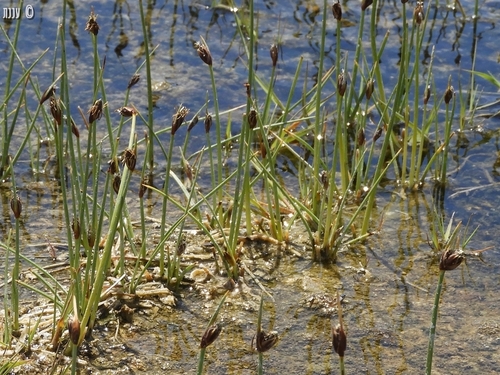
Cyperus rotundus
L.
Nut Grass, Purple Nutsedge
(c) chiuluan, some rights reserved (CC BY)
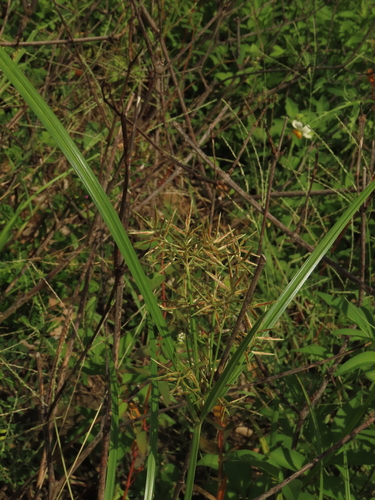
no rights reserved, uploaded by 葉子

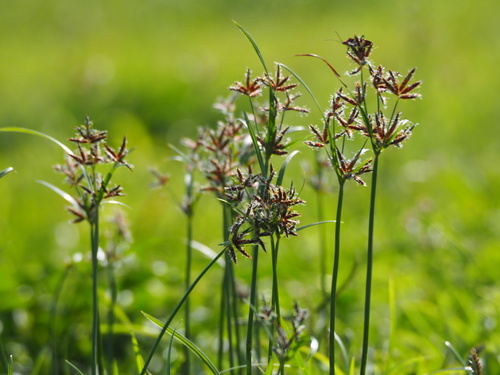
(c) Cin-Ty Lee, some rights reserved (CC BY-NC), uploaded by Cin-Ty Lee
What to Eat
Edible parts: Tubers, Seeds, Roots, Rhizomes, Culms
The tubers can be eaten raw or cooked. Freshly harvested tubers have a very strong flavour said to resemble Vick's VapoRub, but they become milder when allowed to dry. Other accounts describe a pleasant nutty flavour, while still others report the roots are very unpalatable raw and only slightly better when cooked. Dried roots can be ground into a powder and used as a cereal. The seeds are also edible but are very small and fiddly to use — considered a famine food, used only when other options are exhausted. Tubers are starchy with mild sweetness, and roasting improves flavour. They are available year-round in frost-free climates. Wash thoroughly and avoid harvesting from contaminated sites. Excavate carefully to retrieve the tuber chains. No improved cultivars exist; this plant is primarily regarded as a pest species. It is often confused with yellow nutsedge, though typically darker.
Known Hazards
Where to Find It
A tropical plant. It occurs world wide in warmer places. In Papua New Guinea it grows up to 1800 m altitude. In Nepal it grows between 300-2400 m altitude. It grows in moist places. It grows in wetlands. It can grow in most soil types and most pH levels. It cannot tolerate salt or shade. It can grow in arid places. It grows in the Sahara.
Afghanistan, Africa, American Samoa, Argentina, Asia, Australia, Balkans, Belize, Bhutan, Bolivia, Bosnia, Botswana, Brazil, British Indian Ocean Terr., BIOT, Burkina Faso, Cambodia, Cameroon, Cape Verde, Central Africa, Central America, Central Asia, Chad, Chile, China, East Africa, East Timor, Eswatini, Europe, Fiji, France, Ghana, Greece, Grenada, Guam, Guatemala, Guiana, Guianas, Guyana, Haiti, Himalayas, India, Indochina, Indonesia, Israel, Italy, Japan, Kazakhstan, Kenya, Kiribati, Korea, Kyrgyzstan, Laos, Lesotho, Madagascar, Malaysia, Mali, Marquesas, Mediterranean, Micronesia, Middle East, Morocco, Mozambique, Myanmar, Namibia, Nauru, Nepal, New Caledonia, New Zealand, Niger, Nigeria, Niue, Norfolk Island, North Africa, North America, Northeastern India, Pacific, Pakistan, Panama, Papua New Guinea, PNG, Paraguay, Philippines, Portugal, Rotuma, Sahel, Samoa, Sao Tome and Principe, Saudi Arabia, SE Asia, Sierra Leone, Solomon Islands, South Africa, South America, Southern Africa, Spain, Sri Lanka, St Helena, St. Kitts and Nevis, St Lucia, Sudan, Suriname, Swaziland, Taiwan, Tajikistan, Thailand, Timor-Leste, Tonga, Turkey, Türkiye, Tuvalu, Uruguay, USA, Uzbekistan, Venezuela, Vietnam, West Africa, West Indies, West Timor, Zambia, Zimbabwe,
How to Identify
A sedge. It is a herb that continues growing from year to year. It has both rhizomes and tubers under the ground. The leaves of this plant have a blunt tip and do not have a shoulder along the leaf. The leaves mostly grow from the base of the plant. They are narrow and flat and 5-20 cm long. The flower is a compound flower with 5 leafy bracts near the base of the flower. These are of different lengths. The flower stem is 3-angled and 20-50 cm high. The fruit are 3 angled and brown. They are about 1.5 mm long. The tubers of this species are dark brown, in a chain and have a bitter or unpleasant taste.
Nutrition Score: 46/100
| Part | Moisture | kJ | kcal | Protein | Vit A | Vit C | Iron | Zinc |
|---|---|---|---|---|---|---|---|---|
| Bulb | 53.3 | 750 | 179 | 1.9 | — | 2 | 5.8 | 1.4 |
How to Grow
An edible weed whose invasiveness overshadows its culinary value. Growing Conditions: Thrives in warm, moist soils but tolerates drought. Habitat & Range: Pantropical and widely naturalized. Size & Landscape Performance: Forms dense mats that outcompete crops. Cultivation (Horticulture): Not recommended. Pests & Problems: Persistence is its defining trait. Identification & Habit: Dark green leaves and purplish seed heads. Pollinators: Wind-pollinated. Propagation: Extensive rhizome networks and tubers. Plant Name: Purple Nutsedge. Family: Cyperaceae. Genus: Cyperus. Common Names: Purple nutgrass. USDA Hardiness Zones: Approximately 7–11. Height/Spread: 20–80 cm tall; spreads aggressively. Prefers a moist sandy loam and a sunny position. We do not know how hardy this plant will be in Britain, one report says that it is frost-tender, but it is found growing wild in areas of N. America that do experience frost. This plant is sometimes cultivated for its edible tubers in Tropical regions, however it is a serious weed of agricultural land in the tropics where it spreads rapidly at the roots and is considered to be one of the world's most damaging weeds. It is subject to statutory control in several countries.
Propagation: Not recommended for cultivation. Seed can be surface sown in spring in moist compost, with germination typically occurring in 2–6 weeks at 18°C. Prick seedlings into individual pots once large enough, overwinter in a greenhouse, and plant out in late spring after the last expected frosts. Division in spring or autumn is very easy; larger clumps can go directly into permanent positions, though smaller clumps are better potted up and grown on in a cold frame until well rooted before planting out in spring.
Medicinal Uses
Nut grass is a pungent, bitter-sweet herb that relieves spasms and pain, acting mainly on the digestive system and uterus. The roots and tubers are analgesic, antibacterial, antispasmodic, antitussive, aromatic, astringent, carminative, diaphoretic, diuretic, emmenagogue, litholytic, sedative, stimulant, stomachic, tonic, and vermifuge, and have applications for the skin. Internally they are used to treat digestive problems and menstrual complaints, and are commonly combined with black pepper (Piper nigrum) for stomachaches. Roots are harvested in summer or winter and dried for later use. An essential oil in the tubers has antibiotic activity and has been shown to arrest the growth of Micrococcus pyrogenes. The plant ranks 8th among 250 potential antifertility plants identified in China and is used in the treatment of cervical cancer.
Other Uses
The leaves are used in basketry and for weaving hats and matting. The aromatic root is used in perfumery in India, and when dried and ground to a fine powder it is used like talcum powder. Tubers provide food for small mammals but their spread reduces plant diversity.
Wikipedia
Source ↗Cyperus rotundus (coco-grass, Java grass, nut grass, purple nut sedge or purple nutsedge, red nut sedge, Khmer kravanh chruk) is a species of sedge (Cyperaceae) native to Africa, southern and central Europe (north to France and Austria), and southern Asia. The word cyperus derives from the Greek κύπερος, kyperos, and rotundus is from Latin, meaning "round". The earliest attested form of the word cyperus is the Mycenaean Greek 𐀓𐀞𐀫, ku-pa-ro, written in Linear B syllabic script.
Other Information
The roots are chewed especially by children.
Notes
It is mostly regarded as a serious weed in gardens in the tropical lowlands. There are 550 Cyperus species. It is used in medicine.
Names & Synonyms
Bhada, Chaguan humatag, Chufa roja, Coco grass, Contra cebra, Ei, Grama, Guel, Gunza, Injunca, Junquillo, Keya bon, Konnari gedde, Korai, Korrai kizhangu, Kuntayle, Motha, Mothe, Mothee, Mouku, Mumuta, Musta, Mustaka, Mutha, Mutha ghash, Muthanga, Myet-mon-nyin-ahnet, Pupu, Sembang kaothum, Suraj, Tamascal, Tamous-sayt, Te mumute, Teki, Tiririca, Topalak, Tungamuste, Tungegadde, Wet-mye-u, Xiang fu
References (80)
- Al-Sodany, Y. M., et al, 2013, Medicinal Plants in Saudi Arabia: I. Sarrwat Mountains at Taif, KSA. Academic Journal of Plant Sciences 6 (4): 134-145
- Ambasta, S.P. (Ed.), 2000, The Useful Plants of India. CSIR India. p 158
- Beckstrom-Sternberg, Stephen M., and James A. Duke. "The Foodplant Database." http://probe.nalusda.gov:8300/cgi-bin/browse/foodplantdb.(ACEDB version 4.0 - data version July 1994)
- Bodkin, F., 1991, Encyclopedia Botanica. Cornstalk publishing, p 316
- Borrell, O.W., 1989, An Annotated Checklist of the Flora of Kairiru Island, New Guinea. Marcellin College, Victoria Australia. p 20
- Brown, D., 2002, The Royal Horticultural Society encyclopedia of Herbs and their uses. DK Books. p 189
- Burkill, H. M., 1985, The useful plants of west tropical Africa, Vol. 1. Kew.
- Burkill, I.H., 1966, A Dictionary of the Economic Products of the Malay Peninsula. Ministry of Agriculture and Cooperatives, Kuala Lumpur, Malaysia. Vol 1 (A-H) p 746
- Cancilla, D., 2018, Ethnobotanical and Ethnozoological Values Desktop Assessment - Eliwana Project. p 11 (As Cyperus bifax)
- Chowdhury, A. & Das, A. P., 2014, Conservation through sustainable utilization of wetland leafy vegetables of Terai and Duars, West Bengal, India. International Journal of Advanced Life Sciences (IJALS), 7(4) p 654
- Cribb, A.B. & J.W., 1976, Wild Food in Australia, Fontana. p 157
- Dashorst, G.R.M., and Jessop, J.P., 1998, Plants of the Adelaide Plains & Hills. Botanic Gardens of Adelaide and State Herbarium. p 194
- Duarte, M. C., et al, 2022, Diversity of Useful Plants in Cabo Verde Islands: A Biogeographic and Conservation Perspective. Plants 2022, 11, 1313 p 4
- Duke, J.A., 1992, Handbook of Edible Weeds. CRC Press. p 82
- Ertug, F, Yenen Bitkiler. Resimli Türkiye Florası -I- Flora of Turkey - Ethnobotany supplement
- Facciola, S., 1998, Cornucopia 2: a Source Book of Edible Plants. Kampong Publications, p 90
- Flora of Australia Volume 49, Oceanic Islands 1, Australian Government Publishing Service, Canberra. (1994) p 428
- Flora of Pakistan. www.eFloras.org
- Flora of Solomon Islands
- Fowler, D. G., 2007, Zambian Plants: Their Vernacular Names and Uses. Kew. p 86
- Ghanimi, R., et al, 2022, Ethnobotanical study on wild edible plants traditionally used by Messiwa people, Morocco. Journal of Ethnobiology and Ethnomedicine. 18:16
- Hedrick, U.P., 1919, (Ed.), Sturtevant's edible plants of the world. p 263
- Henty, E.E., & Pritchard, G.S., 1973, Weeds of New Guinea and their control. Botany Bulletin No 7, Division of Botany, Lae, PNG. p 36
- Jardin, C., 1970, List of Foods Used In Africa, FAO Nutrition Information Document Series No 2.p 74
- KING,
- Kinupp, V. F., 2007, Plantas alimenticias nao-convencionais da regiao metropolitana de Porto Alegre, RS, Brazil p 75
- Kumar, G.M., & Shiddamallayya, N., 2014, Documentation of Wild Plant Tubers as Food Resources in Hassan District, Karnataka, International Journal of Applied Biology and Pharmaceutical Technology. 5(2) p 91
- Kumar, R. & Saikia, P., 2020, Wild edible plants of Jharkhand and their utilitarian perspectives. Indian Journal of Traditional Knowledge Vol 19 (2), April 2020, pp 237-250
- Kuo, W. H. J., (Ed.) Taiwan's Ethnobotanical Database (1900-2000), http://tk.agron.ntu.edu.tw/ethnobot/DB1.htm
- Lamp, C & Collet F., 1989, Field Guide to Weeds in Australia. Inkata Press. p 98
- Lazarides, M. & Hince, B., 1993, Handbook of Economic Plants of Australia, CSIRO. p 74
- Lim, T. K., 2015, Edible Medicinal and Non Medicinal Plants. Volume 9, Modified Stems, Roots, Bulbs. Springer p 32
- Lulekal, E., et al, 2011, Wild edible plants in Ethiopia: a review on their potential to combat food insecurity. Afrika Focus - Vol. 24, No 2. pp 71-121
- Malezas Comestibles del Cono Sur, INTA, 2009, Buernos Aires
- Manandhar, N.P., 2002, Plants and People of Nepal. Timber Press. Portland, Oregon. p 186
- McClatchey, W., Thaman, R., & Vodonaivalu, S., 2000, A Preliminary Checklist of the Flora of Rotuma with Rotuman Names. Pacific Science (2000) Vol. 54, No. 4: 345-363
- Meitei, L. R., et al, 2022, An ethnobotanical study on the wild edible plants used by forest dwellers in Yangoupokpi Lokchao Wildlife Sanctuary, Manipur, India. Ethnobotany Research and Application 23:15
- Misra, R. C., et al, 2013, Genetic resources of wild tuberous food plants traditionally used in Similipal Biosphere Reserve, Odisha, India. Genetic Resources and Crop Evolution. Vol. 60 No. 2. Springer
- Morley, B.D., & Toelken, H.R., (Eds), 1983, Flowering Plants in Australia. Rigby. p 367
- Murtem, G. & Chaudhrey, P., 2016, An ethnobotanical note on wild edible plants of Upper Eastern Himalaya, India. Brazilian Journal of Biological Sciences, 2016, v. 3, no. 5, p. 63-81
- Mutie, F. M., et al, 2023, Important Medicinal and Food Taxa (Orders and Families) in Kenya, Based on Three Quantitative Approaches. Plants 2023, 12, 1145
- Nassif, F., & Tanji, A., 2013, Gathered food plants in Morocco: The long forgotten species in Ethnobotanical Research. Life Science Leaflets 3:17-54
- Paczkowska, G. & Chapman, A.R., 2000, The Western Australian Flora. A Descriptive Calatogue. Western Australian Herbarium. p 46
- Pagag, K. & Borthakur, S.K., 2012, Wild edible wetland plants from Lakhimpur district of Assam, India. Pleione 6(2): 322 - 327
- PARMENTIER,
- Peekel, P.G., 1984, (Translation E.E.Henty), Flora of the Bismarck Archipelago for Naturalists, Division of Botany, Lae, PNG. p 56
- Peters, C. R., O'Brien, E. M., and Drummond, R.B., 1992, Edible Wild plants of Sub-saharan Africa. Kew. p 15
- Plants for a Future database, The Field, Penpol, Lostwithiel, Cornwall, PL22 0NG, UK. http://www.scs.leeds.ac.uk/pfaf/
- Plants of Haiti Smithsonian Institute http://botany.si.edu/antilles/West Indies
- Redzic, S. J., 2006, Wild Edible Plants and their Traditional Use in the Human Nutrition in Bosnia-Herzegovina. Ecology of Food and Nutrition, 45:189-232
- RIRDC, 2010, New Root Vegetables fo the Native Food Industry, Australian Government RIRDC Publication 9/161
- Roger, D. D., et al, 2012, Nutritional properties of “Bush Meals” from North Cameroon’s Biodiversity. Advances in Applied Science Research, 2012, 3 (3):1482-1493
- Romanowski, N., 2007, Edible Water Gardens. Hyland House. p 54 and p 56 (As Cyperus bifax)
- Royal Botanic Gardens, Kew (1999). Survey of Economic Plants for Arid and Semi-Arid Lands (SEPASAL) database. Published on the Internet; http://www.rbgkew.org.uk/ceb/sepasal/internet [Accessed 16th April 2011]
- Ruiters-Welcome, A. K., 2019, Food plants of southern Africa. Ph.D. thesis. Univ. of Johannesburg p 51
- Samydurai, P., et al, 2012, Wild habits of Kolli Hills being staple food of inhabitant tribes of eastern Ghats, Tamil Nadu, India. Indian Journal of Natural Products and Resources. 3(3) September 2012 pp 432-437
- Saunders, C.F., 1948, Edible and Useful Wild Plants. Dover. New York. p 25
- SAXENA,
- Simpson, D. A. & Inglis, C. A., 2001, Cyperaceae of Economic, Ethnobotanical and Horticultural Importance: A checklist. Kew Bulletin Vol. 56, No. 2 (2001), pp. 257-360 (Also as Cyperus bifax)
- Smith, A.C., 1979, Flora Vitiensis Nova, Lawaii, Kuai, Hawaii, Volume 1 p 249
- Sp. pl. 1:45. 1753
- Swapna, M. M. et al, 2011, A review on the medicinal and edible aspects of aquatic and wetland plants of India. J. Med. Plants Res. 5 (33) pp. 7163-7176
- Swaziland's Flora Database http://www.sntc.org.sz/flora
- Tbatou, M, et al, 2016, Wild Edible Plants traditionally used in the countryside of El Jadida, Coastal Area in the Center of Morocco. Life Sciences Leaflets 75:28-48
- Terra, G.J.A., 1973, Tropical Vegetables. Communication 54e Royal Tropical Institute, Amsterdam, p 43
- Thaman, R.R., 1976, The Tongan Agricultural System, University of the South Pacific, Suva, Fiji. p 394
- Thaman, R. R., 1987, Plants of Kiribati: A listing and analysis of vernacular names. Atoll Research Bulletin No. 296
- Thaman, R. R, 2016, The flora of Tuvalu. Atoll Research Bulletin No. 611. Smithsonian Institute p 45
- Topp, J. M. W., 1988, An Annotated Check List of the Flora of Diego Garcia, British Ocean Territory. Atoll Research Bulletin No. 313
- Tozer, F., 2007, The Uses of Wild Plants. Green Man Publishing. p 76
- USDA, ARS, National Genetic Resources Program. Germplasm Resources Information Network - (GRIN). [Online Database] National Germplasm Resources Laboratory, Beltsville, Maryland. Available: www.ars-grin.gov/cgi-bin/npgs/html/econ.pl (10 April 2000)
- Vernon, R., 1983, Field Guide to Important Arable Weeds of Zambia. Dept of Agriculture, Chilanga, Zambia. p 104
- Welcome, A. K. & Van Wyk, B.-E., 2019, An inventory and analysis of the food plants of southern Africa. South African Journal of Botany 122 (2019) 136–179
- Westerway, J., et al, 2018, Preliminary checklist of the naturalised and pest plants of Timor-Leste. Blumea 63:157-163
- Wickens, G.E., 1995, Edible Nuts. FAO Non-wood forest products. FAO, Rome. p160
- Wiersema, J. H. & Leon, B., 2013, World Economic Plants. A Standard Reference CRC Press. 2nd Ed. p 229
- Wijayakusuma, H.M.H., et al, 1996, Tanaman Berkhasiat Obat Di Indonesia. Pustaka Kartini. p 133
- Wild edible plants of Himachal Pradesh
- World Checklist of Useful Plant Species 2020. Royal Botanic Gardens, Kew
- Yuncker, T.G., 1959, Plants of Tonga, Bernice P. Bishop Museum, Hawaii, Bulletin 220. p 70
More from Cyperaceae