Cyphostemma currorii
(Hook. f.) Desc.
Kobas, Cobas

(c) Richard Droker, some rights reserved (CC BY-NC-ND)
no rights reserved
no rights reserved
What to Eat
Edible parts: Fruit, Caution, Stems - water
This tree is not used for human consumption, as the foliage and fruit are rich in oxalic acid. The fruits are consumed by animals in its natural habitat. Due to its trunk ability to preserve water and be able to survive in dry, arid areas these trees are often used for landscape cultivation.
Where to Find It
A tropical plant. It grows in dry stony areas and on rocky hillsides. It is in hot arid places. It suits hardiness zones 11-12.
Africa, Angola, Australia, Central Africa, Namibia, South Africa, Southern Africa,
How to Identify
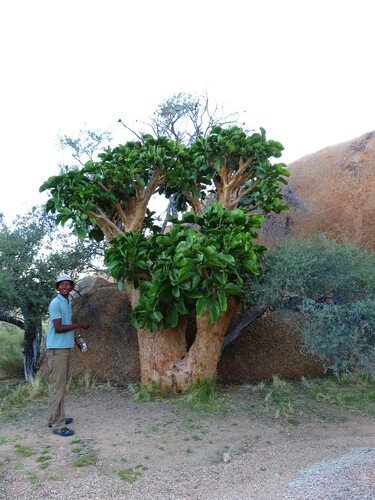
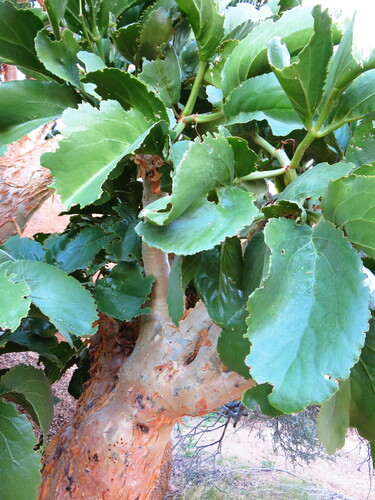
A succulent tree. It has a thick swollen trunk. It grows to 8 m high. It can be 2 m across at the base. It can be divided into a number of stems. The bark peels in papery strips. It loses its leaves in winter. The crown is round. The leaves are compound and fleshy. They are made up of 3 large leaflets. These can be 30 cm long by 18 cm across. The middle leaflets has a short stalk and the other two are stalkless. They are oval and bluntly pointed with a broad unequal base. The edges of the leaves have teeth. Leaflets are often folded together. The leaves are on long thick leaf stalks. The flowers are yellow-green and small. They have 4 petals. They occur in flat spreading heads. The flower group are on long stalks at the ends of branches. The fruit is grape-like. They are juicy and red. They contain oxalic acid which burns the throat.
Wikipedia
Source ↗Cyphostemma currorii is a succulent tree belonging to the family Vitaceae, also known as Koba or Butter-tree. They grow and reach a height of 6 meters or more. Cyphostemma currorii is found in hot, arid rocky places, and has been seen from southern Angola to Namibia and is common on the Brandberg.
Names & Synonyms
References (7)
- Cundall, P., (ed.), 2004, Gardening Australia: flora: the gardener's bible. ABC Books. p 458
- Fox, F. W. & Young, M. E. N., 1982, Food from the Veld. Delta Books. p 365
- Naturalia Monspel., Ser. Bot. 18:220. 1968
- Palgrave, K.C., 1996, Trees of Southern Africa. Struik Publishers. p 564
- Palmer, E and Pitman, N., 1972, Trees of Southern Africa. Vol. 2. A.A. Balkema, Cape Town p 1423
- Ruiters-Welcome, A. K., 2019, Food plants of southern Africa. Ph.D. thesis. Univ. of Johannesburg p 107
- Welcome, A. K. & Van Wyk, B.-E., 2019, An inventory and analysis of the food plants of southern Africa. South African Journal of Botany 122 (2019) 136–179


