Cyphostemma serpens
(Hochst. ex A. Rich.) Desc.
Alango, Obwombwe

iNaturalist · cc-by
(c) Jens-Christian Svenning, some rights reserved (CC BY), uploaded by Jens-Christian Svenning
(c) Jens-Christian Svenning, some rights reserved (CC BY), uploaded by Jens-Christian Svenning
iNaturalist · cc-by
(c) Jens-Christian Svenning, some rights reserved (CC BY)
(c) Jens-Christian Svenning, some rights reserved (CC BY)
What to Eat
Edible parts: Leaves, Vegetable, Fruit
The leaves and fruit are eaten as vegetables; the ripe fruit are especially popular with children.
Where to Find It
A tropical plant. It grows in grassland and seasonally flooded areas. It grows between 500 and 2,250 m above sea level.
Africa, Burundi, Chad, East Africa, Ethiopia, Gambia, Kenya, Nigeria, Rwanda, Senegal, Sierra Leone, Sudan, Tanzania, Uganda,
Countries: Angola, Burkina Faso, Burundi, Benin, Botswana, Congo (DRC), Central African Republic, Congo (Republic), Cote d'Ivoire, Cameroon, Cape Verde, Djibouti, Algeria, Egypt, Eritrea, Ethiopia, Gabon, Ghana, Gambia, Guinea, Equatorial Guinea, Guinea-Bissau, Kenya, Comoros, Liberia, Lesotho, Libya, Morocco, Madagascar, Mali, Mauritania, Mauritius, Malawi, Mozambique, Namibia, Niger, Nigeria, Rwanda, Seychelles, Sudan, Sierra Leone, Senegal, Somalia, South Sudan, Sao Tome & Principe, Eswatini, Chad, Togo, Tunisia, Tanzania, Uganda, South Africa, Zambia, Zimbabwe
How to Identify
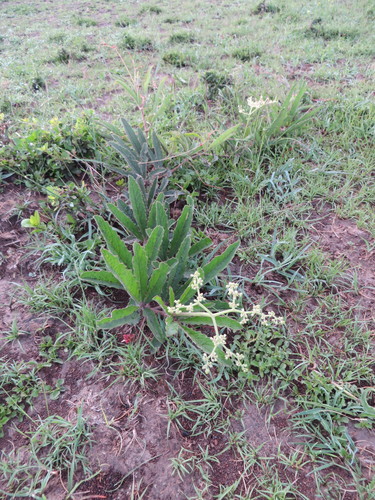
A trailing or climbing herb. It can grow 2 m long and form mats. It can have tendrils. The rootstock is swollen and woody. It is 30 cm long by 4-5 cm wide. The stems are green and flushed red at the nodes. The fruit are round and red and in clusters.
Other Information
The ripe fruit are eaten especially by children.
Names & Synonyms
Ebo, Lorrpo
Cissus lelyi Hutch.Cissus orondo Gilg & M. BrandtCissus schweinfurthii Planch.Cissus serpens Hochst. ex A. Rich.Cissus sesquipedalis GilgCyphostemma orondo (Gilg & M. Brandt) Desc.Cyphostemma schweinfurthii (Planch.) Desc.Vitis serpens (Hochst. ex A. Rich.) Baker
References (10)
- Bussman, R. W., et al., 2006, Plant Use of the Maasai of Sekenani Valley, Maasai Mara, Kenya. Journal of Ethnobiology and Ethnomedicine. 2:22
- Glover et al, 1966b, (As Cyphostemma orondo)
- Goode, P., 1989, Edible Plants of Uganda. FAO p 30 (As Cyphostemma orondo)
- Grivetti, L. E., 1980, Agricultural development: present and potential role of edible wild plants. Part 2: Sub-Saharan Africa, Report to the Department of State Agency for International Development. p 46 (As Cyphostemma orondo)
- Ichikawa, M., 1980, The Utilization of Wild Food Plants by the Suiei Dorobo in Northern Kenya. J. Anthrop. Soc. Nippon. 88(1): 25-48 (As Cyphostemma orondo)
- Jardin, C., 1970, List of Foods Used In Africa, FAO Nutrition Information Document Series No 2.p 128 (As Cissus orondo)
- Johns, T., and Kokwaro, J.O., 1991, Food Plants of the Luo of Siayo District, Kenya. Economic Botany 45(1), pp 103-113 (As Cyphostemma orondo)
- Mutie, F. M., et al, 2023, Important Medicinal and Food Taxa (Orders and Families) in Kenya, Based on Three Quantitative Approaches. Plants 2023, 12, 1145
- Peters, C. R., O'Brien, E. M., and Drummond, R.B., 1992, Edible Wild plants of Sub-saharan Africa. Kew. p 202 (As Cyphostemma orondo)
- World Checklist of Useful Plant Species 2020. Royal Botanic Gardens, Kew


