Daucus glochidiatus
(Labill.) Fischer, C. Meyer & Ave-Lall.
Australian carrot
(c) Bernadette Lingham, some rights reserved (CC BY-NC)
(c) Bernadette Lingham, some rights reserved (CC BY-NC)
(c) Bernadette Lingham, some rights reserved (CC BY-NC)
What to Eat
Edible parts: Root
The roots are eaten.
Where to Find It
It is a temperate plant. It grows on dry slopes and on dunes. It needs an open sunny position. It is resistant to frost and drought. Tasmania Herbarium.
Australia, New Zealand, Norfolk Island, Tasmania*,
How to Identify
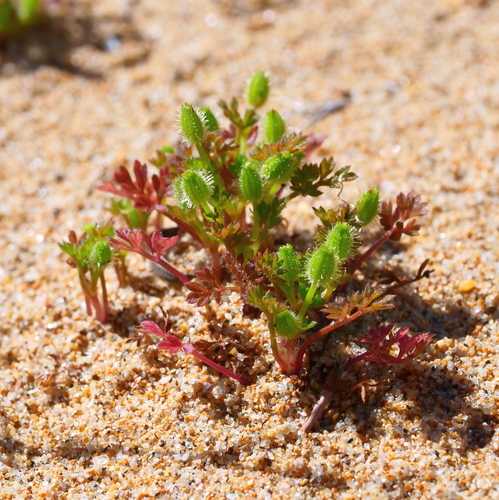
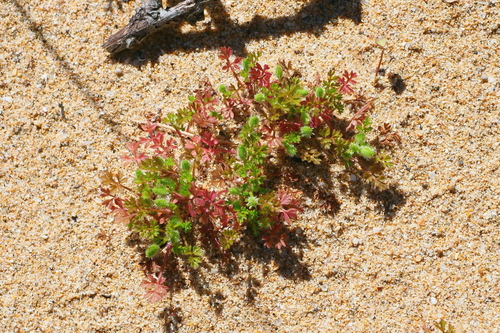
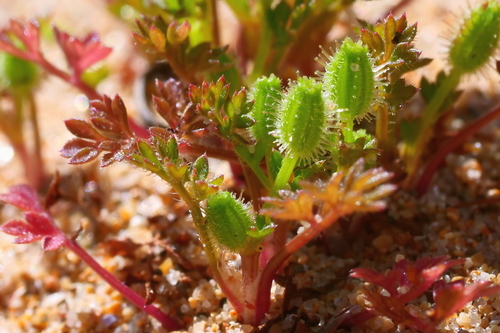
A slender herb. It is an annual with many branches. It grows 5-15 cm high. The roots are dark coloured. The leaves are 3-6 cm long and finely divided like a carrot leaf, but much smaller. The leaves are hairy and scattered up the stem. The flowers are crimson. They are very small and 1.5 mm across. They are clustered in groups of 1-6. The fruit are spiny. They are in clusters and are 3-5 mm long.
How to Grow
Plants can be grown by seeds.
Wikipedia
Source ↗Daucus glochidiatus, commonly known as Australian carrot, Austral carrot or native carrot, is a species of herb in the flowering plant family Apiaceae. It is native to Australia and New Zealand.
Notes
There are about 25 Daucus species.
Names & Synonyms
References (14)
- Bodkin, F., 1991, Encyclopedia Botanica. Cornstalk publishing, p 327
- Cherikoff V. & Isaacs, J., The Bush Food Handbook. How to gather, grow, process and cook Australian Wild Foods. Ti Tree Press, Australia p 189, 194
- Dashorst, G.R.M., and Jessop, J.P., 1998, Plants of the Adelaide Plains & Hills. Botanic Gardens of Adelaide and State Herbarium. p 114
- F. E. L. Fischer et al., Index sem. hort. petrop. 9(suppl.):11. 1844
- Flora of Australia Volume 49, Oceanic Islands 1, Australian Government Publishing Service, Canberra. (1994) p 271
- Harris, S., Buchanan, A., Connolly, A., 2001, One Hundred Islands: The Flora of the Outer Furneaux. Tas Govt. p 147
- Hunter, J. T. & Sheringham, P., 2006, Vegetation and Floristics of Melville Range Nature Reserve. A Report to the New South Wales Parks and Wildlife Service. p 165
- Hunter, J., 2012, Vegetation and Floristics of Gilwarny and Wingadee Nature Reserves. A Report to the New South Wales National Parks and Wildlife Service p 112
- Kiple, K.F. & Ornelas, K.C., (eds), 2000, The Cambridge World History of Food. CUP p 1724
- Lazarides, M. & Hince, B., 1993, Handbook of Economic Plants of Australia, CSIRO. p 77
- Paczkowska, G. & Chapman, A.R., 2000, The Western Australian Flora. A Descriptive Catalogue. Western Australian Herbarium. p 146
- Tasmanian Herbarium Vascular Plants list p 3
- Williams A. & Sides, T., 2008, Wiradjuri Plant Use in the Murrumbidgee Catchment. Murrumbidgee Catchment Management Authority. Wagga Wagga, p 74
- Woolmore, E et al, 2002, King Island Flora: A Field Guide. p 22