Daucus pusillus
Michx.
Rattlesnake weed, American carrot
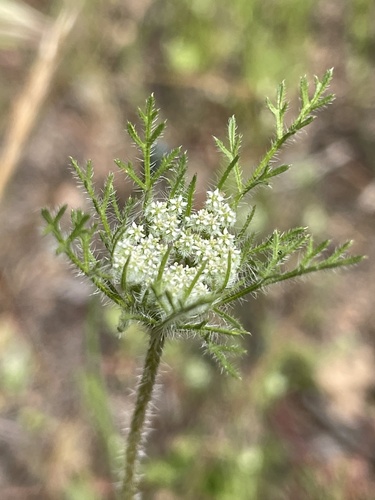
(c) Damon Tighe, some rights reserved (CC BY-NC), uploaded by Damon Tighe
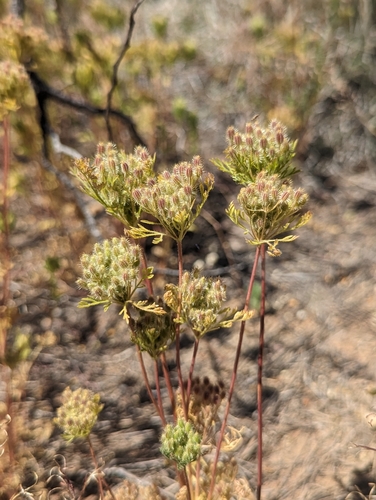
(c) Jaxon Lane, some rights reserved (CC BY-NC)

(c) dogtooth77, some rights reserved (CC BY-NC-SA)
What to Eat
Edible parts: Root, Vegetable
The primary edible part is the root. Leaves and fruits are edible, but only the root is clearly established as the main practical food. The leaves are not formally reported as edible, yet were found to be potentially usable in limited ways, while the mature, bristly fruits are cautioned against due to the choking hazard. Edible Uses & Rating: Western carrot ranks as a surprisingly good small-root food in the Southwest US. It will never compete with a cultivated carrot in size, but it compensates through abundance and efficiency. If hundreds of plants grow together in the shade of shrubs or cacti, the roots can be gathered quickly enough to matter. This efficiency is exactly what raises its value above what one would assume from its tiny size. As a regional wild food, it deserves a good rating despite its small stature. Taste, Processing & Kitchen Notes: The roots are strongly aromatic and distinctly carrot-like despite their tiny size. We note that the flavor and aroma are similar to commercially grown carrots, which is important because many miniature wild roots are more interesting botanically than culinary. Peeling is pointless and unnecessary. The simplest and best use is to wash them thoroughly and toss them into soups or stews whole. Young leaves, though not formally documented as edible, are hairy, bitter, resinous, and aromatic; tender young leaves may be usable in salads in very small amounts, while older ones are more suitable as potherbs. The fruits, however, should not be used as seasoning once the barbs have hardened, as they become a serious choking hazard. Seasonality (Phenology): Western carrot appears very early in the season across the southern United States, especially in late winter or early spring. Flowering in late winter or early spring, and seed production continues after that. That early-season timing is one of its great strengths because it provides edible roots when many other desert annuals are still just beginning. Calflora and Wildflower Center records likewise confirm it as a native annual of dry western habitats. Safety & Cautions (Food Use): The greatest caution is identification. Western carrot has several look-alikes in the same region, especially hedge parsley (Yabea microcarpa), field parsley (Torilis arvensis), desert sand-parsley (Ammoselinum giganteum), and bristly scaleseed (Spermolepis echinata). Of these, Yabea microcarpa is especially close, though confusing the two is of little consequence because both have edible roots. That is reassuring, but it should not lead to carelessness with other Apiaceae. A second caution is the mature fruit: the barbed schizocarps become physically dangerous to swallow once the barbs stiffen. Harvest & Processing Workflow: The roots should be gathered while the plants are still young, before dry weather or fruiting makes them too coarse. Because they are tiny, efficient gathering is important: pull plants from moist or loosened soil in colonies, trim tops, wash thoroughly, and cook whole. There is no reason to peel them. If leaves are being used experimentally, younger leaves should be sampled first and older leaves reserved for potherbs. Mature fruits should be left alone. Cultivar/Selection Notes: There are no food cultivars of the western carrot. The practical “selection” is ecological rather than genetic: choose colonies in loose, workable soil where roots can be pulled quickly and where the soil is least gritty. In desert conditions, shade-grown plants under shrubs may also be more tender. Look-Alikes & Confusion Risks: Western carrot can be difficult because several annual desert Apiaceae share the same general, delicate, divided, white-umbel appearance. The common look-alikes all inhabit the same region, and none of the distinguishing features are absolutely reliable alone. The deeply divided bracts, barbed bristly fruits, and back-to-back flattened schizocarps are important, but mature fruit is often needed for certainty. Hedge parsley is especially similar but differs in fruit compression and hooked rather than barbed bristles. The safest approach is careful, repeated familiarity rather than single-trait identification. Traditional/Indigenous Use Summary: We place the western carrot clearly within the southwestern US edible flora and link it closely with hedge parsley. Even if it never became a major staple, its abundance, early season, and good carrot-like flavor make it exactly the kind of small root that would have mattered in everyday traditional foraging. Root - raw or cooked[46, 61, 105, 161, 257].
Known Hazards
Where to Find It
It is a temperate plant. In Argentina it grows from sea level to 2,300 m above sea level.
Argentina, Brazil, Chile, Hawaii, North America, Pacific, Paraguay, South America, Uruguay, USA,
How to Identify
A biennial herb reaching 0.6m tall and 0.3m wide. Hardy to UK zone 5, not frost tender. Seeds ripen August to September. Hermaphroditic and self-fertile, pollinated by flies and beetles. Noted for attracting wildlife. Adapts to light sandy, medium loamy, or heavy clay soils with good drainage. Tolerates mildly acid to mildly alkaline pH. Requires full sun, prefers moist soil, and tolerates coastal exposure.
How to Grow
Western carrot, now best referred to as Daucus pusillus, belongs to the parsley family (Apiaceae) and the genus Daucus. Common names include American wild carrot, western carrot, southwestern carrot, and rattlesnake carrot. It is a native annual herb found across the southern half of the United States and especially relevant in southern California, Arizona, and adjacent dry regions. Calflora describes it as a native annual herb in California, while the Lady Bird Johnson Wildflower Center treats it as native across the southern half of the U.S. ? In practical terms it behaves like a cool-season to warm-season annual in roughly USDA Zones 7–10, sometimes beyond in mild climates. Plants usually grow about 10–60 cm tall and 10–35 cm across, though many are much smaller in truly dry habitats. Western carrot is one of those plants that teaches a central lesson of desert foraging: size alone does not determine usefulness. Its roots are tiny but flavorful, early, and easy to gather in numbers. That combination gives it a real place in the southwestern edible landscape, especially in comparison with the much less regionally relevant wild carrot. Growing Conditions: Western carrot grows best in deserts, washes, mesas, and open dry ground, especially where there is some seasonal moisture and partial shelter from shrubs or prickly pears. Calflora treats it as a native annual herb in California, and the Wildflower Center describes it as native across much of the southern U.S., reinforcing its adaptation to warm-season dryland habitats. Habitat & Range: It occurs primarily in southern Arizona and California, but broader records show it extending well beyond that across the southern half of the United States. It is especially associated with desert and dry open habitats. Size & Landscape Performance: As a landscape plant, western carrot is more of a delicate native annual filler than a formal ornamental. It can look airy and fine-textured beneath shrubs or in seasonal desert displays, but it is chiefly interesting ecologically and ethnobotanically rather than horticulturally. Cultivation (Horticulture): It could be cultivated by direct seeding in lean, well-drained soil with winter or early spring moisture. However, because the plant is annual and small, it is unlikely to be grown deliberately except in native plant collections or ecological gardens. Pests & Problems: The principal problem is not pest pressure but rather tiny root size and difficulty identifying roots. Drying winds and hard soils can also shorten the useful harvest window. Mature barbed fruits are another practical issue because they become troublesome to handle and dangerous to ingest. Identification & Habit: Western carrot is a native annual, hirsute plant with alternate, compound or deeply pinnately dissected leaves, open compound umbels, deeply divided bracts and bractlets, white flowers, and strongly flattened barbed fruits. Calflora and the Wildflower Center both recognize it as an annual native herb. Pollinators: Like wild carrot, western carrot likely attracts a wide guild of small umbel-visiting insects, including flies, tiny bees, beetles, and wasps. The open white umbels are classic generalist pollinator structures.
Propagation: Sow seed in situ in August/September or April. Germination is improved by cold stratification, so the autumn sowing tends to be more successful.
Medicinal Uses
The plant is antipruritic, a blood purifier, and febrifuge. A decoction has been used to treat colds, itching, fevers, and snakebites. A poultice of the chewed plant has also been applied directly to snakebites.
Other Uses
None known.
Wikipedia
Source ↗Daucus pusillus is a species of wild carrot known by the common names American wild carrot and rattle-snake-weed. Its Latin name means "little carrot", or "tiny carrot". It is similar in appearance to other species and subspecies of wild carrot, with umbels of white or pinkish flowers. The taproots are small, edible carrots. It should not be confused with Conium maculatum, which is highly poisonous.
Notes
There are about 25 Daucus species.
Names & Synonyms
Cenoura-selvagem, Zanahoria silvestre
References (10)
- Beckstrom-Sternberg, Stephen M., and James A. Duke. "The Foodplant Database." http://probe.nalusda.gov:8300/cgi-bin/browse/foodplantdb.(ACEDB version 4.0 - data version July 1994)
- Facciola, S., 1998, Cornucopia 2: a Source Book of Edible Plants. Kampong Publications, 18
- Fl. bor.-amer. 1:164. 1803
- INFOODSUpdatedFGU-list.xls
- Kermath, B. M., et al, 2014, Food Plants in the Americas: A survey of the domesticated, cultivated and wild plants used for Human food in North, Central and South America and the Caribbean. On line draft. p 299
- Kinupp, V. F., 2007, Plantas alimenticias nao-convencionais da regiao metropolitana de Porto Alegre, RS, Brazil p 61
- Kinupp, V. F. & Bergman, I., 2008, Protein and minerals of native species, potential vegetables and fruits. Cienc.Tecnol. Aliment. Vol. 28 No. 4 Campinas Oct/Dec.
- Malezas Comestibles del Cono Sur, INTA, 2009, Buernos Aires
- Plants for a Future database, The Field, Penpol, Lostwithiel, Cornwall, PL22 0NG, UK. http://www.scs.leeds.ac.uk/pfaf/
- Tozer, F., 2007, The Uses of Wild Plants. Green Man Publishing. p 77