Dendrocalamus asper
(Roemer & Schultes) Backer ex K. Heyne
Giant bamboo, Sweet bamboo
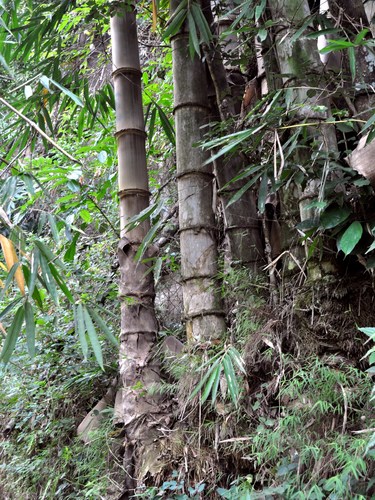
(c) Wie146, some rights reserved (CC BY-SA)
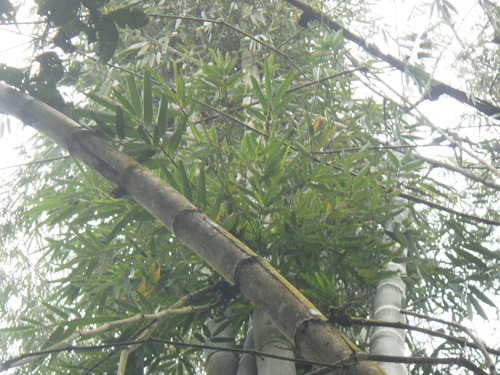
(c) Naufal Urfi Dhiya'ulhaq, some rights reserved (CC BY-NC)
What to Eat
Edible parts: Shoots
Young stems are cooked and are free of bitterness. Harvested before they emerge from the soil, they are tender and sweet, and are used as a vegetable, pickled, or preserved. They can be cut into strips and used as a substitute for macaroni in soups. The edible portion of young shoots is about 34%; shoots weigh on average 5.4 kg before peeling and 1.8 kg after peeling.
Where to Find It
A tropical bamboo. In tropical Asia it grows from sea level to 1500 m altitude. It does best between 400-500 m altitude. It grows best on heavy soils with good drainage. It is found in Makiling Forest in Laguna in the Philippines at lower elevations and also in Mindanao. In the Cairns Botanical Gardens. In XTBG Yunnan. It suits hardiness zones 9-12.
Africa, Asia, Australia, Benin, Central Africa, China, Congo, East Africa, East Timor, Ghana, India, Indochina, Indonesia, Kenya, Laos, Madagascar, Malaysia, Myanmar, Pacific, Papua New Guinea, PNG, Philippines, SE Asia, Singapore, Taiwan, Thailand, Timor-Leste, USA, Vietnam, West Africa,
How to Identify
A very large densely tufted bamboo. It is a woody grass. It forms large groves. The culms or stems can be 20-30 m high. The clumps can spread 12-24 m wide. The stalks are 15-20 cm across. They are covered with fine velvety brown hairs when young. The internodes can be 10-20 cm long lower down and 30-50 cm long higher up. The nodes are swollen. The lowest nodes have many aerial roots. The nodes in the middle and higher have branches. The culm sheath is 20-40 cm long by 20-25 cm wide. The leaf blade is 30 cm long by 2.5 cm wide.
Nutrition Score: 1/100
| Part | Moisture | kJ | kcal | Protein | Vit A | Vit C | Iron | Zinc |
|---|---|---|---|---|---|---|---|---|
| Shoots | 72 | 17 | 2.5 | — | — | — | — | — |
How to Grow
It can be grown from rhizomes, culm or branch cuttings. The spacing is 5-10 m apart. Mulching is essential to produce young shoots.
Propagation: Sow seed in containers, barely covering it; germination usually takes place readily. Prick out into individual pots as soon as plants are large enough to handle. Plant out into permanent positions when 20cm tall. Plants may remain in a low-growing juvenile state for several years — cutting culms to ground level can stimulate taller adult growth. Can also be propagated by rhizome, culm, and branch cuttings; propagules are raised in the nursery until rooted, then planted out in the field before or during the first half of the rainy season.
Medicinal Uses
No medicinal uses are known for this plant.
Other Uses
The upper internodes of the culm — which are longer than the lowermost ones — are used as containers for water or for collecting juice tapped from palm inflorescences. Internodes are also used as ready-made field cooking pots: one end or the node is opened, the internode filled with vegetables, meat, rice, and water, then covered and placed on a fire. The culms have thick walls and are very strong and durable, used as building material for houses and bridges, and for making furniture, boards, musical instruments, household utensils, crafts, fishing boat outriggers, and paper.
Wikipedia
Source ↗Dendrocalamus asper, also known as giant bamboo or dragon bamboo (in China), is a giant, tropical, clumping species of bamboo native to Southeast Asia. In addition to its prolific nature across Asia, the plant's overall attractive appearance (and ease of care) has seen this species introduced widely across South America and Africa (namely Kenya, Malawi and Ghana), as well as Mexico and Florida. One advantage of this bamboo, especially for gardens, is its natural growth habit as a sympodial, colony-forming plant. Overall this bamboo maintains its own "personal" growing space, and does not grow laterally (runners), thus posing less risk of being environmentally-invasive. Although D. asper is widely considered to be non-invasive, that is only a generalized experience of most gardeners. Any species of plant can grow one way in its early stages of life, only to then grow very differently in another, especially if relocated. This could be seen as significant growth spurts, or gradually decreasing vigor of the plant. Changes in growth habit can potentially be due to warmer or colder climates, irrigation methods, higher or lower precipitation, chemical exposures, varying soil and substrate types, or just general transplant shock. The majority of individuals planting D. asper praise its neat, mound-forming growth habit, and overall hardiness. This bamboo species of the genus Dendrocalamus grows 15–20 m tall, and 8–12 cm in diameter. It is found commonly in India, Sri Lanka, Southwest China and Southeast Asia. and more recently in Latin America and warmer regions in the United States. This timber bamboo has traditionally used as a building material for heavy construction because its culms are large diameter and very straight, and its young shoots are consumed as a vegetable. Along with Moso bamboo in China, Dendrocalamus asper is the most popular bamboo species in Asia whose shoots are used as a source of food. Culms of Dendrocalamus asper bamboo are greyish green, becoming dull brown on drying. Lower nodes of young culms are covered with golden brown hairs which are the most easily distinguishing factor of the species. Young shoots are brownish black. Internode length is 25–60 cm, diameter 3.5–15 cm. The culm walls are generally very thick but also show great variation in this thickness. The nodes are prominent. The culm sheath is straw-colored and appear large, and broad; the top of the sheath is rounded, and auricles are small. The upper surface is covered with golden brown hairs. The under surface is not hairy. Sheaths fall off early. Mature culms grow very straight with tapering occurring only at the upper level, and the culms show very little branching, making them easier to harvest upon maturity. This species flowers intermittently, with flowering events occurring at time intervals greater than 60 years. The seed is very fragile and seedlings have a high mortality rate requiring considerable care and controlled environments in their first few weeks of growth. Although with a wide natural occurrence and having been introduced at small scale to many countries it has only recently been grown under a commercial setting. EcoPlanet Bamboo became the first entity to grow Dendrocalamus asper from seed with the development of a million plant nursery, the largest of its kind, focused on this species. In 2015 EcoPlanet Bamboo became the first entity globally to grow the species commercially in a Public Private Partnership with the Ghana Forestry Commission.
Production
The shoots emerge in the rainy season. They develop to their full height in one year. A good healthy clump can produce several shoots each year. A good clump with 10 culms can produce 60 shoots in one year. The edible portion of young shoots is 5.4 kg before peeling and 1.8 kg after peeling. A well established plantation can produce 10 tonnes/ha/yr or edible shoots.
Other Information
It is a cultivated food plant.
Notes
There are about 29 Dendrocalamus species. Most bamboo shoots contain hydrogen cyanide which is destroyed on cooking.
Names & Synonyms
Au betun, Awi bitung, Bambu betung, Bambu cetong, Betung, Bitoong Bamboo, Bukawe, Buloh Betong, Buloh panching, Buluh batung, Deling petung, Hok, Jajang betung, Kuur, Kyalu-wa, Manh tong, Petunu, Phai-tong, Pring betung, Soon, Sun, Tre manh tong, Zhu Sun
References (29)
- Arora, R. K., 2014, Diversity in Underutilized Plant Species - An Asia-Pacific Perspective. Bioversity International. p 40
- Borrell, O.W., 1989, An Annotated Checklist of the Flora of Kairiru Island, New Guinea. Marcellin College, Victoria Australia. p 23
- Brink, M., 2008. Dendrocalamus asper (Schult. & Schult.f.) Backer ex K.Heyne. [Internet] Record from Protabase. Louppe, D., Oteng-Amoako, A.A. & Brink, M. (Editors). PROTA (Plant Resources of Tropical Africa), Wageningen, Netherlands. < http://database.prota.org/search.htm>. Accessed 15 October 2009.
- Burkill, I.H., 1966, A Dictionary of the Economic Products of the Malay Peninsula. Ministry of Agriculture and Cooperatives, Kuala Lumpur, Malaysia. Vol 1 (A-H) p 792
- Cundall, P., (ed.), 2004, Gardening Australia: flora: the gardener's bible. ABC Books. p 487
- Dransfield, S. & Widjaja, EA., 1995, Plant Resources of South East Asia. PROSEA No. 7 Bamboos. Leiden. p 21, 80
- Facciola, S., 1998, Cornucopia 2: a Source Book of Edible Plants. Kampong Publications, p 46
- Foo, J.T.S.(ed), 1996, A Guide to Common Vegetables. Singapore Science Foundation. p 18
- Friday, J. B., 2005, Forestry and Agroforestry Trees of East Timor. http://www.ctahr.hawaii.edu/forestry/data/Timor/Timor trees.html
- Hibbert, M., 2002, The Aussie Plant Finder 2002, Florilegium. p 84
- http://www.plantnames.unimelb.edu.au/sorting/Bamboos_Edible.html
- http://www.plantnames.unimelb.edu.au/sorting/Bamboos_Edible.html (As Sinocalamus flagellifer)
- Hu, Shiu-ying, 2005, Food Plants of China. The Chinese University Press. p 287
- Indian Forester 1:340. 1875 (As Gigantochloa aspera)
- Martin, F.W. & Ruberte, R.M., 1979, Edible Leaves of the Tropics. Antillian College Press, Mayaguez, Puerto Rico. p 194
- Monsalud, M.R., Tongacan, A.L., Lopez, F.R., & Lagrimas, M.Q., 1966, Edible Wild Plants in Philippine Forests. Philippine Journal of Science. p 475 (As Gigantochloa aspera)
- Nutt. pl. Ned.-Ind. ed. 2, 1:301. 1927
- Ochse, J.J. et al, 1931, Vegetables of the Dutch East Indies. Asher reprint. p 307
- Ong, H., et al, 2012, Traditional knowledge and usage of edible plants among the Semai community of Kampung Batu 16, Tapah, Perak, Malaysia. Scientific Research and Essays Vol. 7(4), pp. 441-445, 30 January, 2012
- Peekel, P.G., 1984, (Translation E.E.Henty), Flora of the Bismarck Archipelago for Naturalists, Division of Botany, Lae, PNG. p 56
- Solomon, C., 2001, Encyclopedia of Asian Food. New Holland. p 17
- Sukarya, D. G., (Ed.) 2013, 3,500 Plant Species of the Botanic Gardens of Indonesia. LIPI p 839
- Tanaka, Y & Van Ke, N., 2007, Edible Wild Plants of Vietnam. Orchid Press. p 119
- USDA, ARS, National Genetic Resources Program. Germplasm Resources Information Network - (GRIN). [Online Database] National Germplasm Resources Laboratory, Beltsville, Maryland. Available: www.ars-grin.gov/cgi-bin/npgs/html/econ.pl (10 April 2000)
- van Wyk, B., 2005, Food Plants of the World. An illustrated guide. Timber press. p 174
- Wiersema, J. H. & Leon, B., 2013, World Economic Plants. A Standard Reference CRC Press. 2nd Ed. p 238
- World Checklist of Useful Plant Species 2020. Royal Botanic Gardens, Kew
- Yang, Y., et al, A review of bamboo resources in Yunnan, China www.bioversityinternational.org
- Zeven, A. C. & de West, J. M. J., 1982, Dictionary of cultivated plants and their regions of diversity. Wageningen. p 53


