Dendrocnide moroides
(Wedd.) Chew
Gympie stinger, Mulberry-leaved Stinger, Stinging bush

(c) ebony_potts, some rights reserved (CC BY-NC)

(c) Rolf Lawrenz, some rights reserved (CC BY), uploaded by Rolf Lawrenz
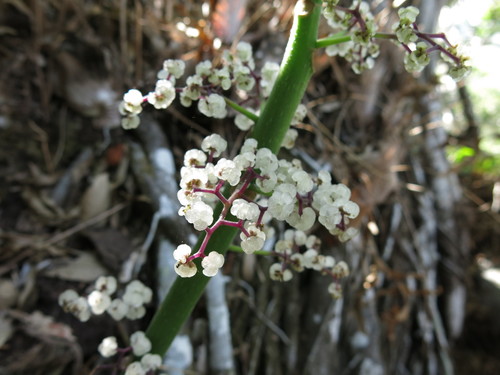
(c) sworboys, some rights reserved (CC BY-NC), uploaded by sworboys
What to Eat
Edible parts: Fruit
Fruit - raw. Juicy. The infructescence is up to 15 cm long, consisting of a number of more or less globular heads arranged in panicles. The nuts or achenes resemble small seeds and are surrounded by the fleshy, watery, swollen receptacles or pedicels. Extreme care should be exercised if you decide to eat this fruit, due to the severity of the sting this plant can give. The following notes, from Dendrocnide photiniphylla, might also apply here - The fruits usually have at least some stinging hairs on them - these need to be removed before eating the fruit. This can be done quite easily by tossing a number of fruits together in a bag, thus abrading the hairs.
Known Hazards
Where to Find It
A subtropical plant. It grows naturally in rainforest in Queensland and New South Wales in Australia. It grows from sea level to 900 m above sea level. It is best in a rich, well-composted soils. It grows in an open, sunny position. It is damaged by frost and drought.
Australia, East Timor, Malesia, SE Asia, Timor-Leste,
How to Identify
A shrub up to 4 m high. The leaves are simple and 11-28 cm long. Both sides of the leaves have stinging hairs. Plants are separately male and female. The fruit are 1.6 cm long by 1.8 cm wide. They occur in bunches in the axils of leaves. The colour can be white or pink. There are several seeds inside. The seeds are 1-2 mm across. The fruit is edible once the stinging hairs have been removed.
How to Grow
Plants can be grown by seed or cuttings.
Propagation: Seed - easy. Cuttings root easily - just thrusting a branch into moist ground will usually produce a new plant.
Medicinal Uses
The cause of the intense pain has been the subject of scientific research since European explorers first encountered the plant in the mid-19th century. While it is known that a cocktail of toxins is contained within the trichomes, its exact nature was not fully understood as of 2018. It is known that the active constituents are very stable, since dead leaves found on the forest floor and even decades-old laboratory specimens can still inflict the sting. Early studies suggested that a variety of compounds, such as histamine, acetylcholine, 5-hydroxytryptamine and formic acid, could be responsible; however, none of these has been proven to produce a similar intensity or duration of pain to those exhibited by the sting from the plant. Around 1970 a new compound was identified and given the name moroidin. It was for a time thought possibly to be the causative agent; however, later research showed that it did not cause the same effects as a sting from the plant. In 2020 a previously unknown family of disulfide-rich peptides was identified by a group of researchers and given the name gympietides. These compounds were shown to be similar to some toxins found in cone snails, and produce significant pain responses in laboratory tests. Moreover, their complex structure – resembling the inhibitor cystine knot – made them highly stable, explaining how the sting lasts for such a long time. There has been anecdotal evidence of some plants having no sting but still possessing the hairs, suggesting a chemical change to the toxin.
Other Uses
The wood is very soft.
Wikipedia
Source ↗| image_caption = Young plant | status = LC | status_system = QLDNCA | status_ref = | taxon = Dendrocnide moroides | authority = (Wedd.) Chew | range_map = Dendrocnide-moroides-distribution-map.png | range_map_caption = Dendrocnide moroides distribution in Australia | synonyms_ref = | synonyms = Laportea moroides Wedd. Urtica moroides A.Cunn. ex Wedd. Urticastrum moroides (Wedd.) Kuntze }} Dendrocnide moroides, commonly known in Australia as the stinging tree, stinging bush, or gympie-gympie, is a plant in the nettle family Urticaceae found in rainforest areas of Malaysia and Australia. It is notorious for its extremely painful and long-lasting sting. The common name gympie-gympie comes from the language of the indigenous Gubbi Gubbi people of south-eastern Queensland.
Notes
There are 36 Dendrocnide species.
Names & Synonyms
References (15)
- Bodkin, F., 1991, Encyclopedia Botanica. Cornstalk publishing, p 334
- Cooper W & Cooper W T, 1994, Fruits of the Rain Forest. RD Press p 88
- Cowie, I, 2006, A Survey of Flora and vegetation of the proposed Jaco-Tutuala-Lore National Park. Timor-Lests (East Timor) www.territorystories.nt/gov.au p 55
- Cronin, L., 1989, The Concise Australian Flora. Reed. p 157
- Elliot, W.R., & Jones, D.L., 1984, Encyclopedia of Australian Plants suitable for cultivation. Vol 3. Lothian. p 251
- Flora of Australia, Volume 3, Hamamelidales to Casuarinales, Australian Government Publishing Service, Canberra (1989) p 76, 74
- Hinton, B & B., 1982, A Wilderness in Bloom. Wildflowers of tropical Australia. p 48
- Jackes, B.R., 2001, Plants of the Tropics. Rainforest to Heath. An Identification Guide. James Cook University. p 85
- Lavelle, M., 2008, Wild Flowers of Australia and Oceania. Southwater. p 84
- Lazarides, M. & Hince, B., 1993, Handbook of Economic Plants of Australia, CSIRO. p 78
- Low, T., 1991, Wild Food Plants of Australia. Australian Nature FieldGuide, Angus & Robertson. p 79
- Nicholson, N & H., 1996, Australian Rainforest Plants 3, Terania Rainforest Publishing. NSW. p 20
- Townsend, K., 1994, Across the Top. Gardening with Australian Plants in the tropics. Society for Growing Australian Plants, Townsville Branch Inc. p 156
- Williams, J.B., Harden, G.J., and McDonald, W.J.F., 1984, Trees and shrubs in rainforests of New South Wales and Southern Queensland. Univ. of New England, Armidale. p 64
- Williams, K.A.W., 1999, Native Plants of Queensland Volume 4. Keith A.W. Williams North Ipswich, Australia. p 150


