Dendrophthoe acacioides
(Cunn. ex Benth.) Tieghem
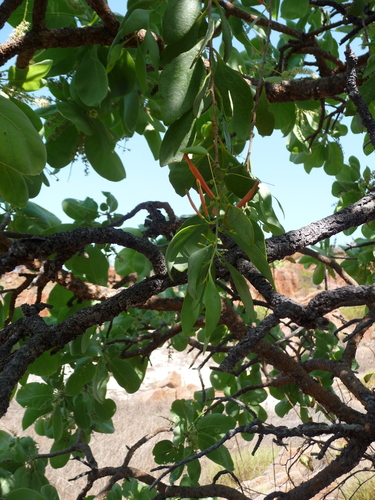
iNaturalist · cc-by-nc
(c) Russell Palmer, some rights reserved (CC BY-NC), uploaded by Russell Palmer
(c) Russell Palmer, some rights reserved (CC BY-NC), uploaded by Russell Palmer

iNaturalist · cc-by-nc
(c) geoffbyrne, some rights reserved (CC BY-NC)
(c) geoffbyrne, some rights reserved (CC BY-NC)

iNaturalist · cc-by-nc
(c) geoffbyrne, some rights reserved (CC BY-NC)
(c) geoffbyrne, some rights reserved (CC BY-NC)
What to Eat
Edible parts: Flower nectar, Fruit
Children suck the nectar from the flowers. The flower nectar and fruit are edible portions.
Where to Find It
A tropical plant. It grows at least from sea level to 300 m above sea level.
Australia*,
Countries: Australia
How to Identify
A shrub that grows attached to trees. It partly grows using the sap from the tree. It grows on the stems of the trees. The leaves are 4-8 cm long by 0.5-1 cm wide. The leaf stalks can be 1 cm long. The flowers are yellow, orange or red. There are 2 or 3 flowers in a group. It grows on Acacia and Grevillea and other plants.
Other Information
Children suck the nectar from the flowers.
Notes
There are about 30 Dendrophthoe species. They are in the tropics.
Names & Synonyms
Nyilanyil
Amyema acacioides (Cunn. ex Benth.) DanserLoranthus acacioides Cunn. ex Benth.Loranthus kimberleyensis C. A. Gardner
References (4)
- Paczkowska, G. & Chapman, A.R., 2000, The Western Australian Flora. A Descriptive Catalogue. Western Australian Herbarium. p 285
- Smith, M & Kalotas, A. C., 1985, Bardi Plants: An Annotated List of Plants and Their Use by the Bardi Aborigines of Dampierland, in North-western Australia. Rec. West Aust. Mus. 1985, 12(3): 317-359
- Vigilante, T., et al, 2013, Island country: Aboriginal connections, values and knowledge of the Western Kimberley islands in the context of an island biological survey. Records of the Western Australian Museum Supplement 81: 145-182
- Wheeler, J.R.(ed.), 1992, Flora of the Kimberley Region. CALM, Western Australian Herbarium, p 578


