Dentella repens
(L.) J. R. Forst. & G. Forst.
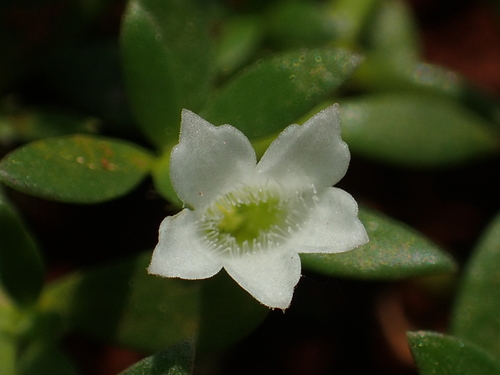
no rights reserved, uploaded by 葉子

(c) scallions, some rights reserved (CC BY)

(c) scallions, some rights reserved (CC BY)
What to Eat
Edible parts: Leaves
The leaves are edible.
Where to Find It
A tropical plant. It suits tropical and subtropical locations. It grows along stream banks and flood plains near coasts in northern Australia. It needs an open sunny position.
Asia, Australia, British Indian Ocean Terr., BIOT, Cambodia, China, East Timor, Himalayas, India, Indochina, Indonesia, Laos, Malaysia, Mexico, Myanmar, Nepal, North America, Pacific, Philippines, Polynesia, SE Asia, Sri Lanka, Taiwan, Thailand, Timor-Leste, Tuvalu, USA, Vietnam,
How to Identify
A spreading annual herb. It lies along the ground and spreads 0.5 m wide. The stems root at the nodes. The leaves are 0.6-1 cm long by 0.2-0.3 cm wide. They are bright green. The flowers are about 1 cm across and like tubes. They are white and grow in the axils of leaves. They occur singly and are without stalks. They have 5 lobes. The fruit is a round capsule which is green.
How to Grow
Plants are grown from seed or cuttings.
Wikipedia
Source ↗Dentella repens, the creeping dentella, is a slender, prostrate herb that grows in low-lying areas, riverbanks, and clayey soils up to 350 m elevation. It has dichotomous branches that root at the nodes, opposite subsessile leaves, and interpetiolar stipules. The small white funnel-shaped flowers are solitary, axillary, and often borne in V-shaped forks of branches, with a hairy calyx and a two-celled ovary. Flowering and fruiting occur throughout the year, and the species is assessed as Least Concern (LC).
Notes
There are about 10 Dentella species. It is used in medicine.
Names & Synonyms
Bunga karang, Kadubhaji
References (11)
- Ambasta, S.P. (Ed.), 2000, The Useful Plants of India. CSIR India. p 167
- Arora, R. K., 2014, Diversity in Underutilized Plant Species - An Asia-Pacific Perspective. Bioversity International. p 40
- Burkill, I.H., 1966, A Dictionary of the Economic Products of the Malay Peninsula. Ministry of Agriculture and Cooperatives, Kuala Lumpur, Malaysia. Vol 1 (A-H) p 794
- Char. gen. pl. 26, t. 13. 1776
- Cowie, I, 2006, A Survey of Flora and vegetation of the proposed Jaco-Tutuala-Lore National Park. Timor-Lests (East Timor) www.territorystories.nt/gov.au p 52
- Elliot, W.R., & Jones, D.L., 1984, Encyclopedia of Australian Plants suitable for cultivation. Vol 3. Lothian. p 254
- Martin, F.W. & Ruberte, R.M., 1979, Edible Leaves of the Tropics. Antillian College Press, Mayaguez, Puerto Rico. p 216
- Paczkowska, G . & Chapman, A.R., 2000, The Western Australian Flora. A Descriptive Calatogue. Western Australian Herbarium. p 513
- Swapna, M. M. et al, 2011, A review on the medicinal and edible aspects of aquatic and wetland plants of India. J. Med. Plants Res. 5 (33) pp. 7163-7176
- Thaman, R. R, 2016, The flora of Tuvalu. Atoll Research Bulletin No. 611. Smithsonian Institute p 109
- Topp, J. M. W., 1988, An Annotated Check List of the Flora of Diego Garcia, British Ocean Territory. Atoll Research Bulletin No. 313


