Aesculus flava
Solander
Sweet buckeye, Horse Chestnut, Yellow Buckeye
(c) Sandy Wolkenberg, some rights reserved (CC BY), uploaded by Sandy Wolkenberg

(c) Stephen Bucklin, some rights reserved (CC BY-NC), uploaded by Stephen Bucklin

(c) Sandy Wolkenberg, some rights reserved (CC BY), uploaded by Sandy Wolkenberg
What to Eat
Edible parts: Seeds, Nectar
The seed must be cooked before eating and is said to be as sweet as a chestnut. Immature seeds harvested in late August have been found to be very tasty with no noticeable bitterness. Seeds can reach 45mm in diameter and are easy to harvest. They can be dried, ground into a flour, and used as a gruel. Because the seed contains saponins, it must be leached before it is safe to eat. North American Indians slow-roasted the nuts to neutralise the saponins, then sliced them thinly, placed them in a cloth bag, and rinsed them in a running stream for 2–5 days. The result is reported to be tasty and nutritious, though most minerals are lost in the process. The flowers also contain a sweet nectar that is delicious when sucked directly from the bloom.
Known Hazards
Where to Find It
It is a temperate plant. They grow naturally in Eastern North America - Pennsylvania to Tennessee and west to Ohio in woodland on moist rich soils. It prefers a well drained soil. Trees are very hardy to cold when dormant. Plants can grow in shady places. Temperate. It suits hardiness zones 4-9.
Australia, Britain, Europe, North America, USA*,
How to Identify
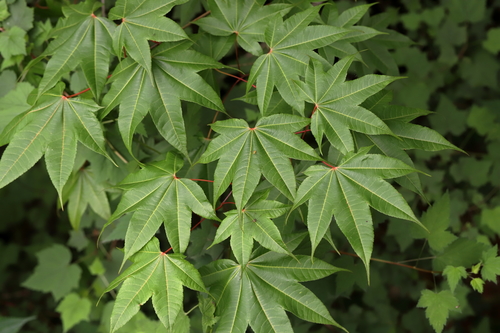
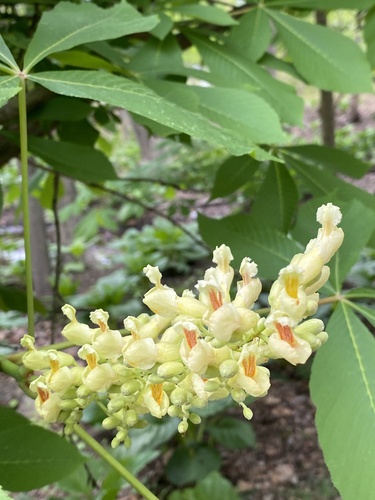
A tree which grows to 20-30 m high and spreads to 8 m across. The bark is dark brown and becomes furrowed with age. The leaves are divided into leaflets like fingers on a hand. There are usually 5 leaflets which have sharp teeth. They can be 15 cm long. The leaves are dark green but turn yellow before falling. The flowers are small and yellow or pink. They are in upright panicles or clusters. The flower clusters are 15 cm long. The fruit are smooth and rounded and are 6 cm across. The fruit are covered in brown scales. The fruit have 2-4 seeds. The seed can be 4.5 cm across.
How to Grow
Prefers a deep loamy well-drained soil but is not too fussy. Grows best in eastern and south-eastern areas of England probably needing a continental climate in order to thrive. Although the trees are very hardy when dormant, the new growth can be damaged by late spring frosts. Plants grow well in a woodland situation, tolerating shading by larger trees. Seedlings grow away quickly, the plants reaching maturity when about 60 - 80 years old. The form Asculus flava vestita (Sarg.)Fern. is growing well at Kew Gardens. It has been seen with large crops of fruit on a number of occasions, even in cooler summers. These fruits have only been tried when immature (harvested at the end of August) but were then very tasty with no bitterness. Fruits are produced more abundantly in warm summers. Most members of this genus transplant easily, even when fairly large.
Propagation: Seed is best sown outdoors or in a cold frame as soon as it is ripe, as it germinates almost immediately and has very limited viability — it must not be allowed to dry out. Young seedlings need protection from severe weather. Stored seed should be soaked for 24 hours before sowing, though even then germination is not guaranteed. Sow with the scar facing downwards. When sowing in a cold frame, pot seedlings up in early spring and transplant to their permanent positions during summer.
Medicinal Uses
None known.
Other Uses
Saponins from the seed serve as a soap substitute. Chop the seed into small pieces and infuse in hot water to extract them; the liquid can then be used to wash the body or clothes, though it leaves a lingering smell of horse chestnuts. The wood is very soft, light, and close-grained, and is difficult to split. It weighs 27lb per cubic foot and is used for making artificial limbs, wooden ware, and pulp, and is occasionally sawn into lumber.
Wikipedia
Source ↗Aesculus flava, also known commonly as the common buckeye, the sweet buckeye, and the yellow buckeye, is a species of deciduous tree in the subfamily Hippocastanoideae of the family Sapindaceae. The species is native to the Ohio Valley and Appalachian Mountains of the Eastern United States. It grows in mesophytic forests or floodplains, generally in acidic to circumneutral soil, reaching a height of 20m to 48m (65 ft to 154 ft).
Production
Trees reach maturity in about 60-80 years.
Notes
There are 15 Aesculus species. Also put in the family Hippocastanaceae.
Names & Synonyms
References (8)
- Anonymous, Cat. Arb. Frut. Horto Edin. Cresc. 1778:3. 1778
- Bodkin, F., 1991, Encyclopedia Botanica. Cornstalk publishing, p 54
- Coombes, A.J., 2000, Trees. Dorling Kindersley Handbooks. p 179
- Cundall, P., (ed.), 2004, Gardening Australia: flora: the gardener's bible. ABC Books. p 107
- Etherington, K., & Imwold, D., (Eds), 2001, Botanica's Trees & Shrubs. The illustrated A-Z of over 8500 trees and shrubs. Random House, Australia. p 78
- Joyce, D., 1998, The Garden Plant Selector. Ryland, Peters and Small. p 106
- Plants for a Future database, The Field, Penpol, Lostwithiel, Cornwall, PL22 0NG, UK. http://www.scs.leeds.ac.uk/pfaf/
- Young, J., (Ed.), 2001, Botanica's Pocket Trees and Shrubs. Random House. p 72