Aesculus glabra
Willd.
Ohio buckeye, Fetid buckeye
(c) Christian Grenier, some rights reserved (CC BY-NC), uploaded by Christian Grenier

(c) Douglas Goldman, some rights reserved (CC BY-SA), uploaded by Douglas Goldman
(c) Brian Finzel, some rights reserved (CC BY-SA), uploaded by Brian Finzel
What to Eat
Edible parts: Seeds, Nut
The seed must be cooked before eating. It can be dried, ground into a flour, and used as a gruel. Seeds are fairly large — up to 35mm in diameter — and easy to harvest. They are quite rich in saponins and must be leached of these toxins before they are safe to eat. The traditional method used by Indigenous peoples was to slow-roast the nuts (neutralising the saponins), slice them thinly, place them in a cloth bag, and rinse in a running stream for 2–5 days. By the end of this process, most of the minerals and other nutrients will also have been leached out.
Known Hazards
Where to Find It
It is a temperate plant. It grows naturally in moist places in South-eastern and Central North America. It does best in a deep loamy well drained soil. It does best in cool, moist places like river valley bottoms. It is frost resistant but sensitive to drought. It suits hardiness zones 4-9. Arboretum Tasmania.
Australia, Canada, Europe, France, Germany, North America*, Tasmania, USA,
How to Identify
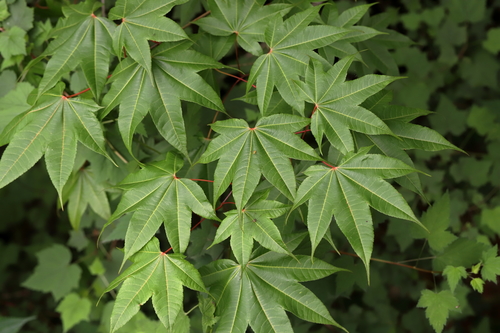
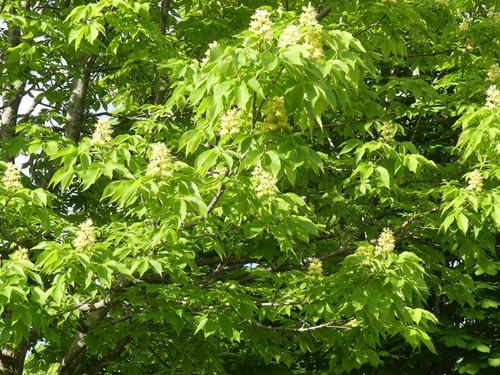
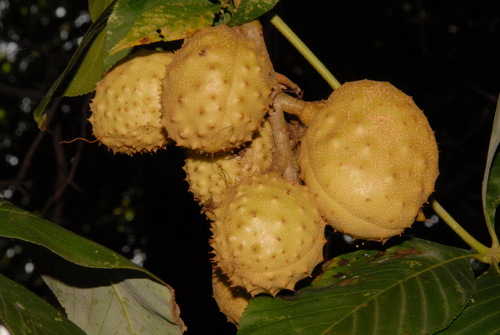
A tree which grows to 20 m high. The trunk can be 50 cm across. The bark is grey but becomes brown with age. It becomes rough and scaly with plates. The twigs, bark, flowers and leaves all produce a bad smell if crushed. The leaves have 5-7 leaflets on a central stalk. The leaflets are 6-15 cm long. They taper to a point. They have uneven teeth. They are yellowish-green on the upper surface and are paler and hairy underneath. They turn orange-yellow in autumn. The leaf scars are horse shoe shaped. There are 3 vein scars. The flowers are 15-35 mm long and bell shaped. They have 4 yellowish-green petals. The fruit are 25-50 mm long and light brownish-green. They are covered with blunt spines. There are 1-3 seeds. These are 20-35 mm wide.
How to Grow
Prefers a deep loamy well-drained soil but is not too fussy. This species is the state tree of Ohio. Its growth-rate is moderate in the wild, with trees living up to 100 years. In Britain, it grows best in eastern and south-eastern areas of England probably needing a continental climate in order to thrive. Although the trees are hardy when dormant, the new growth can be damaged by late spring frosts. The twigs, bark, flowers and leaves all produce a foetid odour if crushed. Most members of this genus transplant easily, even when fairly large.
Propagation: Seed is best sown outdoors or in a cold frame as soon as it is ripe, as it germinates almost immediately and has very limited viability — it must not be allowed to dry out. Young seedlings need protection from severe weather. Stored seed should be soaked for 24 hours before sowing, though even then germination is not guaranteed. Sow with the scar facing downwards. When sowing in a cold frame, pot seedlings up in early spring and transplant to their permanent positions during summer.
Medicinal Uses
Minute doses of the seed are used internally to treat spasmodic coughs, asthma, and internal irritations. Externally, the seed is applied as a tea or ointment for rheumatism and piles. An extract of the bark has been used as an irritant of the cerebro-spinal system.
Other Uses
Saponins from the seed function as a soap substitute. Chop the seed into small pieces and infuse in hot water to extract them; the liquid can be used to wash the body or clothes, though a lingering smell of horse chestnuts is a drawback. The wood is close-grained, light, soft, and white, though often marked by dark lines of decay. It weighs 28lb per cubic foot, is easy to carve, and resists splitting. It is well suited for making artificial limbs and is also used for woodenware, pulp, and occasional lumber.
Wikipedia
Source ↗Aesculus glabra, commonly known as Ohio buckeye, Texas buckeye, fetid buckeye is a species of tree in the soapberry family (Sapindaceae) native to North America. Its natural range is primarily in the Midwestern and lower Great Plains regions of the United States, extending southeast into the geological Black Belt of Alabama and Mississippi. It is also found locally in the extreme southwest of Ontario, on Walpole Island in Lake St. Clair. It is found in a variety of natural habitats, including streambanks, upland mesic forests, and along the margins of old fields. It is typically found in calcareous areas.
Production
Trees live for 80 years.
Notes
There are 15 Aesculus species. Also put in the family Hippocastanaceae.
Names & Synonyms
References (7)
- Bodkin, F., 1991, Encyclopedia Botanica. Cornstalk publishing, p 54
- Enum. pl. 1:405. 1809
- Etherington, K., & Imwold, D., (Eds), 2001, Botanica's Trees & Shrubs. The illustrated A-Z of over 8500 trees and shrubs. Random House, Australia. p 79
- Farrar, J.L., 1995, Trees of the Northern United States and Canada. Iowa State University press/Ames p 157
- Krochmal, A. & Krochmal, C., 1982, Uncultivated Nuts of The United States. United States Department of Agriculture Forest Service. p 30
- Little, E.L., 1980, National Audubon Society Field Guide to North American Trees. Alfred A. Knopf. p 582
- Plants for a Future database, The Field, Penpol, Lostwithiel, Cornwall, PL22 0NG, UK. http://www.scs.leeds.ac.uk/pfaf/