Aesculus indica
(Wall. ex Cambess.) Hook.
Indian chestnut, Indian horse chestnut

(c) Steve Law, some rights reserved (CC BY-SA)
(c) Chief RedEarth, some rights reserved (CC BY-NC-ND), uploaded by Chief RedEarth
(c) jsw565350, some rights reserved (CC BY-NC)
What to Eat
Edible parts: Seeds, Fruit
The seed must be cooked before eating. It can be dried and ground into a powder for use as a gruel. In Nepal, seeds are roasted and eaten directly, or dried, ground into flour, and mixed with wheat flour to develop flavour when making bread. Seeds are around 35mm in diameter and easy to harvest. However, they contain toxic saponins that must be removed before the seed is safe to eat. As an emergency food in times of famine, the seed is dried, ground to a powder, and soaked in water for about 12 hours to draw out the bitter saponins before being used to make a halva. Mature trees in the wild are estimated to yield around 60kg of seed per year.
Where to Find It
It is a temperate plant. It grows naturally in North-western Himalayas in wet temperate forests and shady ravines to 3,000 metres altitude. It does best on moist well drained soils. It is resistant to frosts but sensitive to drought. It does best if temperatures do not go below -5°C. It suits hardiness zones 6-9. Arboretum Tasmania.
Afghanistan, Asia, Australia, Britain, Europe, Himalayas, India, Myanmar, Nepal, NW India, Pakistan, SE Asia, Tasmania,
How to Identify
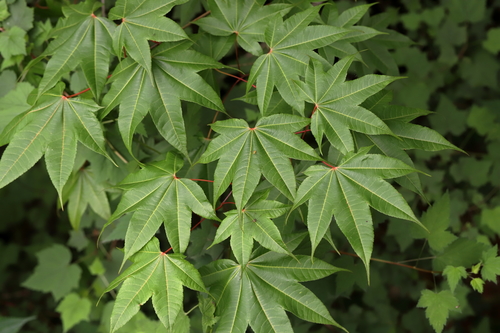
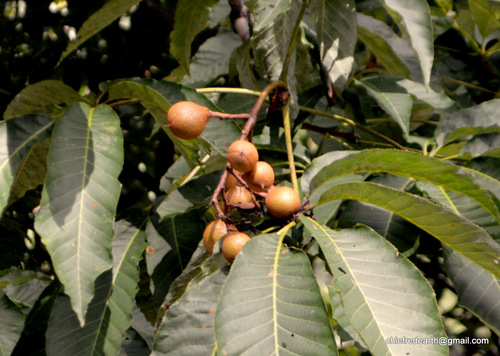
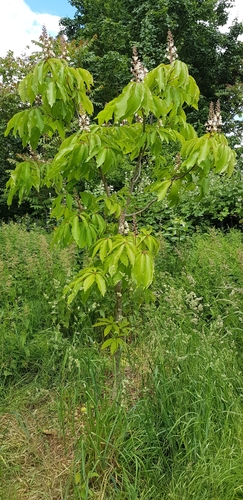
A tree which grows to 30 m high and spreads to 12 m wide. It forms branches low down and they extend upwards at steep angles. The bark is smooth and grey-green. The leaves open bronze, then turn dark green and finally yellow. They are divided into leaflets which spread out like fingers on a hand. The leaflets are narrow and have stalks. The flowers are white or pinkish. They occur in 12-15 cm long spikes. The fruit are pear shaped and smooth. Seeds are about 3.5 cm across. They are almost black and shiny.
Nutrition
| Part | Moisture | kJ | kcal | Protein | Vit A | Vit C | Iron | Zinc |
|---|---|---|---|---|---|---|---|---|
| Seeds | — | — | — | — | — | 8.5 | 705.9 | — |
How to Grow
It is grown from seed. The seed need to be planted immediately after opening the nuts. Seed germinates quickly. Trees transplant fairly easily.
Propagation: Seed is best sown outdoors or in a cold frame as soon as it is ripe, as it germinates almost immediately and has very limited viability — it must not be allowed to dry out. Young seedlings need protection from severe weather. Stored seed should be soaked for 24 hours before sowing, though even then germination is not guaranteed. Sow with the scar facing downwards. When sowing in a cold frame, pot seedlings up in early spring and transplant to their permanent positions during summer.
Medicinal Uses
The seed is astringent, acrid, and narcotic. An oil extracted from the seed is applied externally to treat skin disease and rheumatism. Juice from the bark is used to treat rheumatism. A paste made from the oil cake is applied to the forehead to relieve headaches. The seed is also given to horses suffering from colic and used as an anthelmintic to rid horses of intestinal parasites.
Other Uses
Saponins in the seed make a useful soap substitute. Chop the seed into small pieces and infuse in hot water to extract them; the liquid can be used to wash the body or clothes, though a lingering smell of horse chestnuts is a drawback. The wood is soft and close-grained, and is used for construction, cases, spoons, and cups.
Wikipedia
Source ↗Aesculus indica, commonly known as the Indian horse-chestnut or Himalayan horse chestnut, is a species of deciduous broad-leaved tree in the family Sapindaceae.
Production
Mature trees yield about 60 kg of seeds per year. In NW India plants flower and fruit April to August.
Other Information
The fruit are a famine food.
Notes
There are 15 Aesculus species. Also put in the family Hippocastanaceae.
Names & Synonyms
Bankhor, Bunkhori, Goon, Gun, Hane, Hanudun, Jungli khanor, Kandar, Kanur, Kashmere Kakra, Khanor, Khnor, Kunour, Naru, Pangar, Pangla, Satal, Torjaga, West Himalayan Horse chestnut
References (35)
- Agarwal, R. & Chandra, V., 2019, Diversity of wild edible plants in the Mandal-Chopta forest, Uttarakhand. Journal of Medicinal Plants Studies 2019; 7(1): 89-92
- Ambasta S.P. (Ed.), 2000, The Useful Plants of India. CSIR India. p 18
- Aryal, K. P., et al, 2018, Diversity and use of wild and non-cultivated edible plants in the Western Himalaya. Journal of Ethnobiology and Ethnomedicine (2018) 14:10
- Biocyclopedia Edible Plant Species. biocyclopedia.org
- Bodkin, F., 1991, Encyclopedia Botanica. Cornstalk publishing, p 54
- Bot. Mag. 85: t. 5117. 1859
- Brickell, C. (Ed.), 1999, The Royal Horticultural Society A-Z Encyclopedia of Garden Plants. Convent Garden Books. p 84
- Coombes, A.J., 2000, Trees. Dorling Kindersley Handbooks. p 180
- Cundall, P., (ed.), 2004, Gardening Australia: flora: the gardener's bible. ABC Books. p 107
- Dobriyal, M. J. R. & Dobriyal, R., 2014, Non Wood Forest Produce an Option for Ethnic Food and Nutritional Security in India. Int. J. of Usuf. Mngt. 15(1):17-37
- Dutt, B., et al, 2011, Ethnobotanical Survey of Plants used by Gaddi Tribe of Bharmour Area in Himachal Pradesh. ENVIS Bulletin: Himalayan Ecology 19, 2011
- Dyani, S.K., & Sharma, R.V., 1987, Exploration of Socio-economic plant resources of Vyasi Valley in Tehri Garwhal. J. Econ. Tax. Bot. Vol. 9 No. 2 pp 299-310
- Etherington, K., & Imwold, D., (Eds), 2001, Botanica's Trees & Shrubs. The illustrated A-Z of over 8500 trees and shrubs. Random House, Australia. p 79
- Flora of Pakistan. www.eFloras.org
- GUPTA,
- Harris, E & J., 1983, Field Guide to the Trees and Shrubs of Britain. Reader's Digest. p 159
- Hedrick, U.P., 1919, (Ed.), Sturtevant's edible plants of the world. p 28
- Joyce, D., 1998, The Garden Plant Selector. Ryland, Peters and Small. p 107
- Khan, M. & Hussain, S., 2014, Diversity of wild edible plants and flowering phenology of district Poonch (J & K) in the northwest Himalaya. Indian Journal of Sci, Res. 9(1): 032-038
- Khan, A. H., et al, 2023, Traditional foraging for ecological transition? Wild food ethnobotany among three ethnic groups in the highlands of the eastern Hindukush, North Pakistan. Journal of Ethnobiology and Ethnomedicine 19:9
- Kishor, A., et al, 2018, Wild Food Plants of Himachal Pradesh: A Review. Plant Archives Vol. 18 No.2 pp. 2737-2751
- Llamas, K.A., 2003, Tropical Flowering Plants. Timber Press. p 341
- Lord, E.E., & Willis, J.H., 1999, Shrubs and Trees for Australian gardens. Lothian. p 46
- Manandhar, N.P., 2002, Plants and People of Nepal. Timber Press. Portland, Oregon. p 76
- Menninger, E.A., 1977, Edible Nuts of the World. Horticultural Books. Florida p 113
- Negi, P. S. & Subramani, S. P., 2015, Wild Edible Plant Genetic Resources for Sustainable Food Security and Livelihood of Kinnaur District, Himachal Pradesh, India, International Journal of Conservation Science. 6 (4): 657-668
- Parmar, C., & Kaushel, M. K., 1982, In Wild Fruits. Kalyani Publishers, New Delhi, India. p 6
- Plants for a Future database, The Field, Penpol, Lostwithiel, Cornwall, PL22 0NG, UK. http://www.scs.leeds.ac.uk/pfaf/
- Ryan, S., 2008, Dicksonia. Rare Plants Manual. Hyland House. p 6
- Sahni, K.C., 2000, The Book of Indian Trees. Bombay Natural History Society. Oxford. p 63
- Thakur, D., et al, 2017, Why they eat, what they eat: patterns of wild edible plants consumption in a tribal area of Western Himalaya. Journal of Ethnobiology and Ethnomedicine (2017) 13:70
- Upreti, K., et al, 2010, Diversity and Distribution of Wild Edible Fruit Plants of Uttarakhand. in Biodiversity Potentials of the Himalaya. p 160
- WATT
- Wickens, G.E., 1995, Edible Nuts. FAO Non-wood forest products. FAO, Rome. p 132
- Young, J., (Ed.), 2001, Botanica's Pocket Trees and Shrubs. Random House. p 73