Aesculus parviflora
Walter
Dwarf buckeye, Bottlebrush Buckeye

(c) John Trent, some rights reserved (CC BY-NC-ND), uploaded by John Trent

(c) sandycspencer, some rights reserved (CC BY-NC)
What to Eat
Edible parts: Seeds
The seed can be cooked, or dried and ground into a powder for use as a gruel. It is quite large and easy to harvest, though it is rarely produced in Britain. The seed contains bitter saponins that must be leached out before eating. Based on practice documented for A. californica, one method involves slow-roasting the nuts (which renders the saponins harmless), then slicing them thinly, placing them in a cloth bag, and rinsing in a stream for 2–5 days. Note that most minerals and other nutrients will also be lost during this process.
Known Hazards
Where to Find It
It is a temperate plant. It grows naturally in woodlands and on the coastal plains in Southern North America. Plants are very shade tolerant. It does best in a well drained soil. It can tolerate cold to about -20°C. They need a long hot dry summer to fruit. Arboretum Tasmania. It suits hardiness zone 6-10.
Australia, North America, Slovenia, Tasmania, USA*,
How to Identify
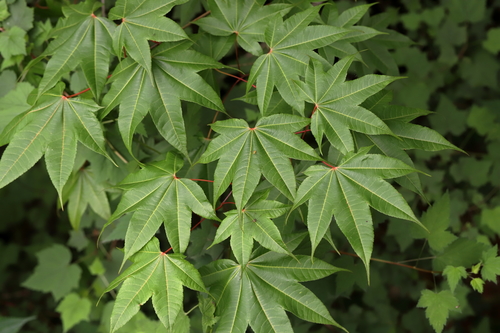
A small tree growing up to 4 m high and spreading to 4 m across. It has many stems. It forms new growth from the roots producing a clump. The leaves have 5 large leaflets. The veins are distinct. The leaves are downy on the underside. The flowers occur in spidery spikes. The petals are small and white and the stamens are long and pinkish.
How to Grow
It can be grown by seed, cuttings or suckers. Fresh seed which has not been allowed to dry out should be used. Seed germinates quickly. Trees transplant fairly easily. Root cuttings should be used if grown from cuttings. Plants spread easily by suckers.
Propagation: Sow seed outdoors or in a cold frame as soon as it is ripe, as it germinates almost immediately and has very limited viability — it must not be allowed to dry out. Stored seed should be soaked for 24 hours before sowing, though even then germination cannot be guaranteed. Sow with the scar facing downward. Seedlings started in a cold frame should be potted up in early spring and planted out in summer. Root cuttings 5–7 cm long can be taken in December; store them upside down in sand, pot up in March or April, grow on to at least 20 cm tall, then plant out in late spring or early summer after the last frosts. Suckers can be divided during the dormant season and planted directly into permanent positions if desired.
Medicinal Uses
The plant has antiperiodic and antirheumatic properties, and has been used in the treatment of colic, piles, constipation, and whooping cough.
Other Uses
The saponins in the seed serve as a soap substitute. To extract them, chop the seed into small pieces and infuse in hot water; the resulting liquid can be used to wash the body or clothes, though it leaves a lingering odour of horse chestnuts. The plants can also be used as tall ground cover for large areas — they are slow to establish but eventually form wide, spreading clumps. The wood is easily worked and has been used to make water troughs, packing cases, tea boxes, and ornamental articles.
Wikipedia
Source ↗Aesculus parviflora, the bottlebrush buckeye or small-flowered buckeye, is a species of suckering deciduous shrub in the family Sapindaceae. It is native to the southeastern United States, where it is found primarily in Alabama, locally in western Georgia, and with a disjunct population in South Carolina along the Savannah River. Its natural habitat is in mesic forests, on bluffs and in ravines. This plant is moderately poisonous to humans if eaten. Symptoms include depression, muscle weakness, paralysis, vomiting, and diarrhea; the nuts, being of attractive appearance, are the most likely part to cause poisoning. It has also been reported to be toxic to pets.
Production
Plants are slow to establish.
Notes
There are 15 Aesculus species. Also put in the family Hippocastanaceae.
Names & Synonyms
Grmasti divji kostanj
References (11)
- Biocyclopedia Edible Plant Species. biocyclopedia.org
- Bodkin, F., 1991, Encyclopedia Botanica. Cornstalk publishing, p 55
- Brickell, C. (Ed.), 1999, The Royal Horticultural Society A-Z Encyclopedia of Garden Plants. Convent Garden Books. p 84
- Cundall, P., (ed.), 2004, Gardening Australia: flora: the gardener's bible. ABC Books. p 108
- Etherington, K., & Imwold, D., (Eds), 2001, Botanica's Trees & Shrubs. The illustrated A-Z of over 8500 trees and shrubs. Random House, Australia. p 80
- Fl. carol. 128. 1788
- Hedrick, U.P., 1919, (Ed.), Sturtevant's edible plants of the world. p 28
- Plants for a Future database, The Field, Penpol, Lostwithiel, Cornwall, PL22 0NG, UK. http://www.scs.leeds.ac.uk/pfaf/
- Ryan, S., 2008, Dicksonia. Rare Plants Manual. Hyland House. p 6
- Wickens, G.E., 1995, Edible Nuts. FAO Non-wood forest products. FAO, Rome. p 132
- Young, J., (Ed.), 2001, Botanica's Pocket Trees and Shrubs. Random House. p 73