Digitaria debilis
(Desf.) Willd.
Finger grass
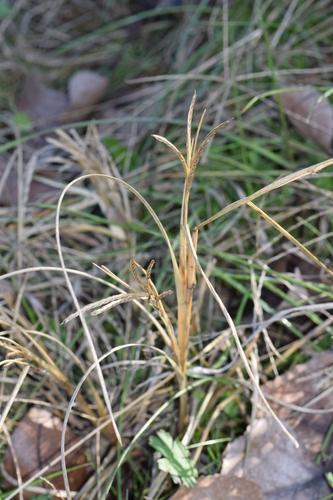
(c) José Ignacio Márquez Corro, some rights reserved (CC BY-NC)

Wikimedia Commons

Wikimedia Commons - Kiruthikapalani
What to Eat
Edible parts: Seeds, Cereal
The seeds are harvested and used as a cereal grain.
Where to Find It
A tropical plant. It grows in sandy and clay soils. It grows between sea level to 1,600 m above sea level. It is often along river banks. It can grow in arid places.
Africa, Algeria, Angola, Botswana, Burkina Faso, Cameroon, Central Africa, Chad, Congo, East Africa, Egypt, Eswatini, Ethiopia, Europe, France, Ghana, Italy, Kenya, Liberia, Madagascar, Malawi, Mali, Mediterranean, Mozambique, Namibia, Nigeria, North Africa, Portugal, Senegal, Sierra Leone, South Africa, Southern Africa, Spain, Sudan, Swaziland, Tanzania, West Africa, Zambia, Zimbabwe,
How to Identify
A grass. It can form tufts or lie along the ground. It can grow each year from seeds or keep growing from year to year. It grows 60 cm high. The leaf blades are 20-25 mm long by 2-4 mm wide. The spikelets can occur singly or in pairs. They are 2-3 mm long by 1 mm wide.
Notes
There are about 250 Digitaria species.
Names & Synonyms
Kindresifotsy
References (8)
- Abbiw, D.K., 1990, Useful Plants of Ghana. West African uses of wild and cultivated plants. Intermediate Technology Publications and the Royal Botanic Gardens, Kew. p 25
- Busson, 1965,
- Enum. pl. 1:91. 1809
- Grivetti, L. E., 1980, Agricultural development: present and potential role of edible wild plants. Part 2: Sub-Saharan Africa, Report to the Department of State Agency for International Development. p 32
- Jardin, C., 1970, List of Foods Used In Africa, FAO Nutrition Information Document Series No 2.p 2
- Peters, C. R., O'Brien, E. M., and Drummond, R.B., 1992, Edible Wild plants of Sub-saharan Africa. Kew. p 21
- Royal Botanic Gardens, Kew (1999). Survey of Economic Plants for Arid and Semi-Arid Lands (SEPASAL) database. Published on the Internet; http://www.rbgkew.org.uk/ceb/sepasal/internet [Accessed 8th May 2011]
- World Checklist of Useful Plant Species 2020. Royal Botanic Gardens, Kew


