Aesculus pavia
L.
Red buckeye, Scarlet buckeye, Firecracker-plant

(c) Alex Abair, some rights reserved (CC BY), uploaded by Alex Abair

(c) Alex Abair, some rights reserved (CC BY), uploaded by Alex Abair

(c) Alex Abair, some rights reserved (CC BY), uploaded by Alex Abair
What to Eat
Edible parts: Seeds, Nut, Caution
The seed can be cooked, or dried and ground into a powder for use as a gruel. It is quite large — about 25 mm in diameter — and easy to harvest. However, it is rich in saponins that must be removed before eating. Based on practice documented for A. californica, one method involves slow-roasting the nuts (which renders the saponins harmless), slicing them thinly, placing them in a cloth bag, and rinsing in a stream for 2–5 days. Most minerals and other nutrients will also be lost during this process.
Known Hazards
Where to Find It
It is a temperate plant. They grow naturally in South-eastern North America from Virginia to Florida and west to Louisiana in rich moist soils in deciduous woods. It can grow well in sandy soils. Trees are very shade tolerant but can also grow in sunny positions. It suits hardiness zones 6-10. Arboretum Tasmania.
Australia, North America, USA, Tasmania,
How to Identify
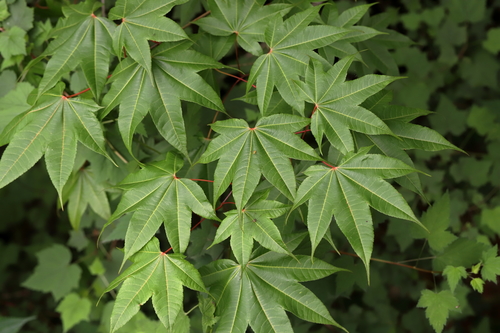
A deciduous shrub. It grows to 5 m high and spreads to 3 m across. It has dense cane like branches. The bark is dark grey and smooth. The leaves have leaflets divided like fingers on a hand. The leaves have 5 leaflets. These have sharp teeth. They can be 15 cm long. They are dark glossy green above and turn red in autumn. The flowers are 4 cm long and deep crimson. They are produced in upright spikes. The fruit is rounded and smooth and brown. It encloses 1 or 2 glossy brown seeds.
How to Grow
Plants can be grown from seed. Fresh seed which has not been allowed to dry out should be used. Seed germinates quickly. Trees transplant fairly easily. Plants can be grown by separating the suckers during the dormant time.
Propagation: Sow seed outdoors or in a cold frame as soon as it is ripe, as it germinates almost immediately and has very limited viability — it must not be allowed to dry out. Stored seed should be soaked for 24 hours before sowing, though even then germination cannot be guaranteed. Sow with the scar facing downward. Seedlings started in a cold frame should be potted up in early spring and planted out in summer. Suckers can be divided during the dormant season and planted directly into permanent positions if desired.
Medicinal Uses
The powdered bark is hypnotic and odontalgic. It is used in the treatment of ulcers. A poultice of powdered seeds has been applied to cancer tumours and infections, and used as a salve for sores. An infusion of the roots has been used as a bath treatment for dyspepsia.
Other Uses
Saponins from the seed and roots act as a soap substitute. To extract them, chop the seed into small pieces and infuse in hot water; the liquid can then be used to wash the body or clothes, though it leaves a lingering odour of horse chestnuts.
Wikipedia
Source ↗Aesculus pavia, known as red buckeye or firecracker plant (formerly Pavia rubra), is a species of deciduous flowering plant. The small tree or shrub is native to the southern and eastern parts of the United States, found from Illinois to Virginia in the north and from Texas to Florida in the south. It is hardy far to the north of its native range, with successful cultivation poleward to Arboretum Mustila in Finland. It has a number of local names, such as scarlet buckeye, woolly buckeye and firecracker plant.
Production
Trees are fast-growing but also short-lived. They can commence flowering when only 1 metre tall.
Notes
There are 15 Aesculus species. Also put in the family Hippocastanaceae.
Names & Synonyms
References (11)
- Coombes, A.J., 2000, Trees. Dorling Kindersley Handbooks. p 181
- Cundall, P., (ed.), 2004, Gardening Australia: flora: the gardener's bible. ABC Books. p 108
- Etherington, K., & Imwold, D., (Eds), 2001, Botanica's Trees & Shrubs. The illustrated A-Z of over 8500 trees and shrubs. Random House, Australia. p 80
- Krochmal, A. & Krochmal, C., 1982, Uncultivated Nuts of The United States. United States Department of Agriculture Forest Service. p 32
- Little, E.L., 1980, National Audubon Society Field Guide to North American Trees. Alfred A. Knopf. p 587
- Lord, E.E., & Willis, J.H., 1999, Shrubs and Trees for Australian gardens. Lothian. p 46
- Loughmiller, C & L., 1985, Texas Wildflowers. A Field Guide. University of Texas, Austin. p 105
- Plants for a Future database, The Field, Penpol, Lostwithiel, Cornwall, PL22 0NG, UK. http://www.scs.leeds.ac.uk/pfaf/
- Sp. pl. 1:344. 1753
- Wickens, G.E., 1995, Edible Nuts. FAO Non-wood forest products. FAO, Rome. p 132
- Young, J., (Ed.), 2001, Botanica's Pocket Trees and Shrubs. Random House. p 74