Aframomum mala
(K. Schum.) K. Schum.
East African cardamon
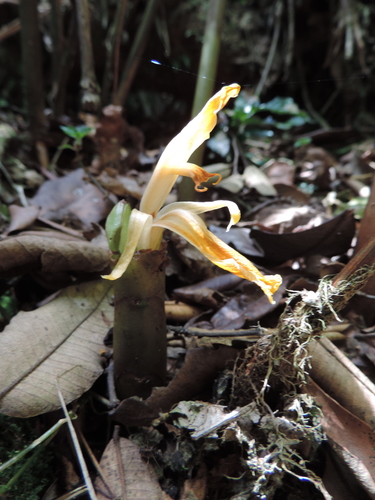
(c) Marco Schmidt, some rights reserved (CC BY-NC-SA), uploaded by Marco Schmidt
What to Eat
Edible parts: Fruit, Pith, Seed
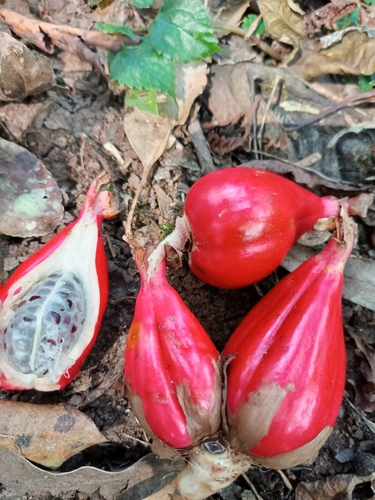
The fruits are eaten raw. The seeds are surrounded by masses of white sweet-acid pulp inside 3 membranes. The sweet, sugary pulp is frequently eaten as a snack - it is particularly liked by children. The fruit is a round to oval, tough, orange-red-black berry 7 - 9cm long including the calyx beak. The seeds are crushed and used as a spice like pepper.
Where to Find It
It is a tropical plant. It grows in the undergrowth and on the edges of mountain forests. It grows between 1,000-1,700 m above sea level.
Africa, East Africa, Kenya, Sudan, Tanzania,
How to Identify
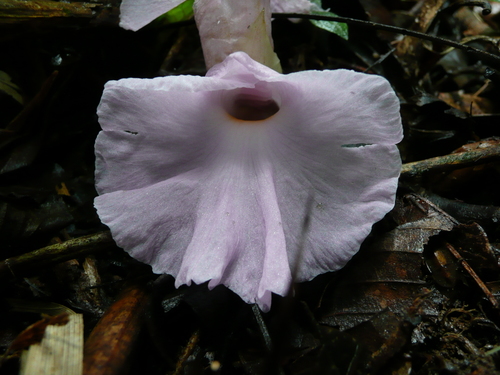
A ginger family herb. The leafy shoots grow 2-4 m tall. It has extensive rhizomes 4-6 mm thick. The leaves are narrowly oval and 20-50 cm long by 5-11 cm wide. They are wedge shaped and taper to the tip. There are 5-6 flowers in a group. The come from the base of the leafy shoots. The fruit are oval and 4.5 cm long and 2 cm across. The seeds are 4 mm long by 2 mm wide.
Medicinal Uses
The crushed seeds are boiled with the roots of Piper capensis and drunk as an aphrodisiac.
Other Uses
The dense stands formed by the plant are a favoured habitat for snakes, especially green mamba.
Wikipedia
Source ↗Aframomum mala is a species of flowering plant in the ginger family, Zingiberaceae. It was first described by Karl Moritz Schumann and Adolf Engler, and was given its current name by Karl Moritz Schumann. It is a rhizomatous geophyte native to Tanzania.
Notes
There are about 50 Aframomum species.
Names & Synonyms
Osaye
References (9)
- Bircher, A. G. & Bircher, W. H., 2000, Encyclopedia of Fruit Trees and Edible Flowering Plants in Egypt and the Subtropics. AUC Press. p 11
- e-monocot.org/taxon/urn:kew.org:wcs:taxon:218396
- Johns, T., and Kokwaro, J.O., 1991, Food Plants of the Luo of Siayo District, Kenya. Economic Botany 45(1), pp 103-113.
- Mutie, F. M., et al, 2023, Important Medicinal and Food Taxa (Orders and Families) in Kenya, Based on Three Quantitative Approaches. Plants 2023, 12, 1145
- Nishida & Uehara, 1983,
- Peters, C. R., O'Brien, E. M., and Drummond, R.B., 1992, Edible Wild plants of Sub-saharan Africa. Kew. p 42
- Ruffo, C. K., Birnie, A. & Tengnas, B., 2002, Edible Wild Plants of Tanzania. RELMA p 114
- Seidemann J., 2005, World Spice Plants. Economic Usage, Botany, Taxonomy. Springer. p 10 (As Aframomum malum)
- von Katja Rembold, 2011, Conservation status of the vascular plants in East African rain forests. Dissertation Universitat Koblenz-Landau