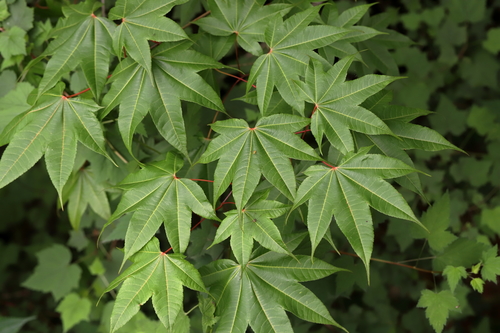
Dodonaea viscosa
(L.) Jacq.
Sticky hop-bush, Common sand olive
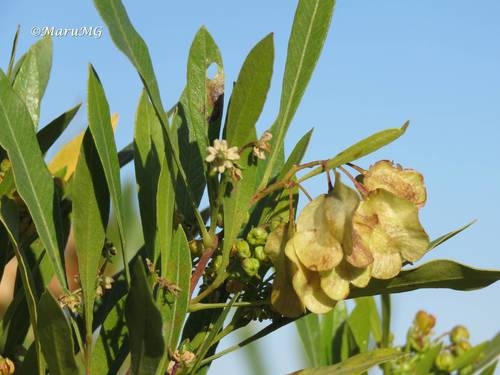
(c) María Eugenia Mendiola González, some rights reserved (CC BY-NC-SA), uploaded by María Eugenia Mendiola González
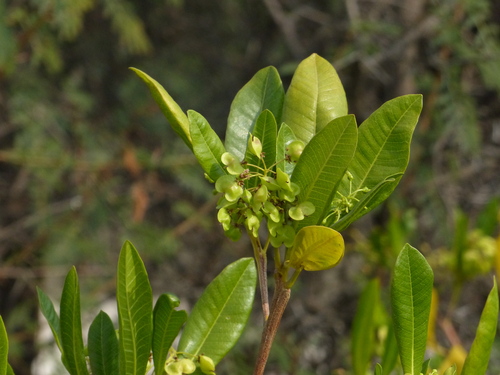
(c) Radha Veach, some rights reserved (CC BY-NC)
What to Eat
Edible parts: Seeds, Fruit, Leaves
The seeds are used as a condiment, though no further details are given. The bitter fruits serve as a substitute for hops and yeast in brewing beer. The chewed leaves are said to be stimulating, but they contain saponins and are also reported to be mildly cyanogenic, making their use inadvisable.
Known Hazards
Where to Find It
They suit tropical and warm places. They often grow on rocky, stony or sandy soil. Plants are damaged by frost. In Tasmania it grows near the East Coast. It can grow in semi arid places as well as on the edges of evergreen forest in high rainfall areas. In East Africa it grows from sea level to 2,700 m altitude. It needs a temperature above 3-5°C. It can grow in arid places. It is highly salt tolerant. In Argentina it grows from sea level to 2,800 m above sea level. It suits hardiness zones 9-11. Melbourne Botanical gardens. Tasmania Herbarium. In Sichuan and Yunnan.
Afghanistan, Africa, Andaman Is., Angola, Antigua-Barbuda, Argentina, Asia, Australia*, Bahamas, Bangladesh, Belize, Benin, Bermuda, Bolivia, Botswana, Brazil, Burkina Faso, Burundi, Cameroon, Caribbean, Central Africa, Central African Republic, CAR, Central America, Chile, China, Colombia, Comoros, Congo DR, Congo R, Cook Is., Costa Rica, Côte d'Ivoire, Cuba, Djibouti, Dominican Republic, East Africa, East Timor, Easter Island, Ecuador, El Salvador, Eritrea, Eswatini, Ethiopia, Fiji, Gabon, Gambia, Ghana, Grenada, Guadeloupe, Guam, Guatemala, French Guiana, Guianas, Guinea, Guinée, Guinea-Bissau, Guyana, Haiti, Hawaii, Himalayas, Honduras, India, Indochina, Indonesia, Iran, Iraq, Israel, Ivory Coast, Jamaica, Japan, Kenya, Kiribati, Liberia, Madagascar, Malawi, Malaysia, Maldives, Mariana Islands, Marquesas, Martinique, Mauritius, Mediterranean, Mexico, Micronesia, Middle East, Mozambique, Myanmar, Namibia, Nauru, Nepal, Netherlands Antilles, New Caledonia, New Zealand, Nicaragua, Nigeria, Niue, Norfolk Is., North America, Northeastern India, NW India, Oman, Pacific, Pakistan, Palau, Palestine, Panama, Papua New Guinea, PNG, Peru, Philippines, Puerto Rico, Reunion, Rwanda, Samoa, Saudi Arabia, SE Asia, Senegal, Seychelles, Sierra Leone, Slovenia, Socotra, Solomon Islands, Somalia, South Africa, Southern Africa, South America, Spain, Sri Lanka, Sudan, Suriname, St Helena, Swaziland, Taiwan, Tanzania, Tasmania*, Thailand, Timor-Leste, Togo, Tonga, Trinidad-Tobago, Uganda, United Arab Emirates, UAE, Uruguay, USA, Vanuatu, Venezuela, Vietnam, Wallis and Futuna, West Africa, West Indies, Yemen, Zambia, Zimbabwe,
How to Identify
A shrub or small tree. It can be 10 m high. It can have many stems. The leaves are sticky and are 3-10 cm long. They are narrow with wavy edges. A variety with purple leaves also occurs. The flowers are greenish. Male and female flowers occur on separate plants. The fruit are hops 18 mm long and with wings. They occur in clusters at the ends of branches. They can be red or white. Many different kinds or subspecies of this plant occur. The seed is edible.
How to Grow
Plants are grown from seed. Seed germinate in 3 weeks but they can be slow to germinate. They need a temperature above 18°C. Seeds can be soaked in water at 65°C for 4 minutes and then in cool water for 24 hours. Plants can be pruned often and make a good hedge in windy places. Male and female plants must be grown if seed is required. Plants can be grown from cuttings of half ripe wood. Plants need to be transplanted when small or sown directly where they are to grow.
Propagation: Sow seed in spring in a greenhouse — it can be slow to germinate according to some sources, though it has germinated in as little as 3 weeks in a cold greenhouse. Prick seedlings into individual pots once large enough to handle and grow on in a sunny part of the greenhouse for at least their first winter. For outdoor planting, set out in early summer of their second or third year after the last expected frosts, and provide frost protection for the following winter or two. Alternatively, take cuttings of half-ripe wood in July or August and root in a frame.
Medicinal Uses
The leaves are anodyne, astringent, diaphoretic, febrifuge, odontalgic, and vulnerary — the variety angustissima is normally used for febrifuge purposes. Internally, they are used to treat fevers. Externally, they are applied for toothache, sore throats, wounds, skin rashes, and stings. For toothache, the leaves are chewed without swallowing the juice. The bark is used in astringent baths and poultices.
Other Uses
The leaves contain up to 18% tannin. Plants tolerate hard pruning well and make an effective hedge for exposed, windy sites. The wood is heavy, tough, and resistant, and is used for wedges, hammers, turnery, inlay work, and cabinetry.
Wikipedia
Source ↗Dodonaea viscosa, also known as the broadleaf hopbush, is a species of flowering plant in the Dodonaea (hopbush) genus that has a cosmopolitan distribution in tropical, subtropical and warm temperate regions of Africa, the Americas, southern Asia and Australasia. Dodonaea is part of Sapindaceae, the soapberry family. This species is notable for its extremely wide distribution, which it achieved only over the last 2 million years (from its region of origin in Australia) via oceanic dispersal. Harrington and Gadek (2009) referred to D. viscosa as having "a distribution equal to some of the world's greatest transoceanic dispersers".
Production
It is fast growing.
Other Information
It is a cultivated food plant.
Notes
There are about 70 Dodonea species. They are mostly in Australia.
Names & Synonyms
Akeake, Aliar, Bandara, Bandedu, Benmenu, Broadleaf hopbush, Bururr, Chapulixtle, Chotia, Dingadinganalahy, Hmaing, Hopbush, Iheji, Jakhmi, Kmba, Kudhi-ruuvaali, Lala vao, Lamouaye, Liheji, Mehndi, Meshrass, Mkengata, Mohra, Muia, Musambya, Muwena-muthua, Native hops, Nedeg-deg-ca, Nedege-degeca, Paniaphul, Sanatha, Sand olive, Sentha, Sinatha, Switch-sorrel, Te kaiboia, Unnataruvi, Varnish-leaf, Vassoura-vermelha, Velari, Xayramad
References (69)
- Ambasta, S.P. (Ed.), 2000, The Useful Plants of India. CSIR India. p 181
- Barwick, M., 2004, Tropical and Subtropical Trees. A Worldwide Encyclopedic Guide. Thames and Hudson p 152
- Blamey, M and Grey-Wilson, C., 2005, Wild flowers of the Mediterranean. A & C Black London. p 128
- Bodkin, F., 1991, Encyclopedia Botanica. Cornstalk publishing, p 354
- Brown, D., 2002, The Royal Horticultural Society encyclopedia of Herbs and their uses. DK Books. p 195
- Burkill, H. M., 1985, The useful plants of west tropical Africa, Vol. 2. Kew.
- Burkill, I.H., 1966, A Dictionary of the Economic Products of the Malay Peninsula. Ministry of Agriculture and Cooperatives, Kuala Lumpur, Malaysia. Vol 1 (A-H) p 862
- Collier, P., 1993, Woodland Wild flowers of Tasmania. Plant Identikit. Society for growing Australian Plants Tasmania Region. Hobart. p 62
- Cooper, W. and Cooper, W., 2004, Fruits of the Australian Tropical Rainforest. Nokomis Editions, Victoria, Australia. p 489
- Cowie, I, 2006, A Survey of Flora and vegetation of the proposed Jaco-Tutuala-Lore National Park. Timor-Lests (East Timor) www.territorystories.nt/gov.au p 52
- Crowe, A., 1997, A Field Guide to the Native Edible Plants of New Zealand. Penguin. p 153
- Cundall, P., (ed.), 2004, Gardening Australia: flora: the gardener's bible. ABC Books. p 508
- Dharani, N., 2002, Field Guide to common Trees & Shrubs of East Africa. Struik. p 222 (As Dodonaea angustifolia)
- Doran, J.C., & Turnbull, J.W. (Eds), 1997, Australian Trees and Shrubs: species for land rehabilitation and farm plantings in the tropics. ACIAR Monograph No 24. p 353
- Enum. syst. pl. 19. 1760 (Select. stirp. amer. hist. 109. 1763)
- Etherington, K., & Imwold, D., (Eds), 2001, Botanica's Trees & Shrubs. The illustrated A-Z of over 8500 trees and shrubs. Random House, Australia. p 265
- Facciola, S., 1998, Cornucopia 2: a Source Book of Edible Plants. Kampong Publications, p 224
- Flora of Australia Volume 49, Oceanic Islands 1, Australian Government Publishing Service, Canberra. (1994) p 243
- Flora of Pakistan. www.eFloras.org
- Fowler, D. G., 2007, Zambian Plants: Their Vernacular Names and Uses. Kew. p 59
- Fox, F. W. & Young, M. E. N., 1982, Food from the Veld. Delta Books. p 334
- Franklin, J., Keppel, G., & Whistler, W., 2008, The vegetation and flora of Lakeba, Nayau and Aiwa Islands, Central Lau Group, Fiji. Micronesica 40(1/2): 169–225, 2008
- Gilfedder, L et al, 2003, The Nature of the Midlands. Midlands Bushweb. PO Box 156 Longford, Tasmania. p 104
- Greig, D., 1996, Flowering Natives for Home Gardens. Angus & Robertson. p 144
- Harris, S., Buchanan, A., Connolly, A., 2001, One Hundred Islands: The Flora of the Outer Furneaux. Tas Govt. p 150 (subsp. spatula)
- Haslam, S., 2004, Noosa's Native Plants. Noosa Integrated Catchment Assn. Inc. p 23
- Hastings Advance Community College, 2017, Uses for Native Plants of the Mornington Peninsula. 86pp. p 40
- Hibbert, M., 2002, The Aussie Plant Finder 2002, Florilegium. p 88
- Hunter, J. T. et al, Budjiti traditional use of plants on Naree Station. p 10
- Karim, F. M. & Dakheel, A, J., 2006, Salt-tolerant plants of the United Arab Emirates. 2006. International Center for Biosaline Agriculture, Dubai, UAE. p 149
- Kew Plants of the World Online
- Khan, M. & Hussain, S., 2014, Diversity of wild edible plants and flowering phenology of district Poonch (J & K) in the northwest Himalaya. Indian Journal of Sci, Res. 9(1): 032-038
- Kinupp, V. F., 2007, Plantas alimenticias nao-convencionais da regiao metropolitana de Porto Alegre, RS, Brazil p 98
- Kinupp, V. F. & Bergman, I., 2008, Protein and minerals of native species, potential vegetables and fruits. Cienc.Tecnol. Aliment. Vol. 28 No. 4 Campinas Oct/Dec.
- Kirkpatrick, J.B. & Backhouse, S., 1985, Native Trees of Tasmania. p 66
- Lazarides, M. & Hince, B., 1993, Handbook of Economic Plants of Australia, CSIRO. p 84
- Llamas, K.A., 2003, Tropical Flowering Plants. Timber Press. p 342
- Long, C., 2005, Swaziland's Flora - siSwati names and Uses http://www.sntc.org.sz/flora/
- Lord, E.E., & Willis, J.H., 1999, Shrubs and Trees for Australian gardens. Lothian. p 161
- Matthews, J., 1987, New Zealand Native Plants for your Garden. Pacific Publishers, p 44
- Mbuya, L.P., Msanga, H.P., Ruffo, C.K., Birnie, A & Tengnas, B., 1994, Useful Trees and Shrubs for Tanzania. Regional Soil Conservation Unit. Technical Handbook No 6. p 236
- Melzer, R. & Plumb, J., 2011, Plants of Capricornia. Belgamba, Rockhampton. p 329
- Paczkowska, G . & Chapman, A.R., 2000, The Western Australian Flora. A Descriptive Calatogue. Western Australian Herbarium. p 530
- Palgrave, K.C., 1996, Trees of Southern Africa. Struik Publishers. p 538
- Parham, B. E. V., 1972, Plants of Samoa. New Zealand Department of Scientific and Industrial Research. Information Series. No. 85 p 54
- Pasha, M. K. & Uddin, S. B., 2019, Minor Edible Fruits of Bangladesh. Bangladesh J. Plant Taxon. 26(2): 299–313
- Plants for a Future database, The Field, Penpol, Lostwithiel, Cornwall, PL22 0NG, UK. http://www.scs.leeds.ac.uk/pfaf/
- Plants of Haiti Smithsonian Institute http://botany.si.edu/antilles/West Indies
- Royal Botanic Gardens, Kew (1999). Survey of Economic Plants for Arid and Semi-Arid Lands (SEPASAL) database. Published on the Internet; http://www.rbgkew.org.uk/ceb/sepasal/internet [Accessed 10th June 2011]
- Ruiters-Welcome, A. K., 2019, Food plants of southern Africa. Ph.D. thesis. Univ. of Johannesburg p 100
- Salmon, J.T., 1989, The Native Trees of New Zealand. Heinmann Reid p 227
- Schatz, G.E., 2001, Generic Tree Flora of Madagascar. Royal Botanical Gardens, Kew and Missouri Botanical Garden. p 365
- Selvam, V., 2007, Trees and shrubs of the Maldives. RAP Publication No. 2007/12 p 82
- Staples, G.W. and Herbst, D.R., 2005, A tropical Garden Flora. Bishop Museum Press, Honolulu, Hawaii. p 511
- Stewart, K., 1984, Collins handguide to the Native Trees of New Zealand. Collins. p 38
- Sujanapal, P., & Sankaran, K. V., 2016, Common Plants of Maldives. FAO & Kerala FRI, p 115
- Tasmanian Herbarium Vascular Plants list p 53
- Thaman, R. R., 1987, Plants of Kiribati: A listing and analysis of vernacular names. Atoll Research Bulletin No. 296
- Townsend, K., 1994, Across the Top. Gardening with Australian Plants in the tropics. Society for Growing Australian Plants, Townsville Branch Inc. p 169
- van Roosmalen, M.G.M., 1985, Fruits of the Guianan Flora. Utrecht Univ. & Wageningen Univ. p 393
- Welcome, A. K. & Van Wyk, B.-E., 2019, An inventory and analysis of the food plants of southern Africa. South African Journal of Botany 122 (2019) 136–179
- Wheeler, J.R.(ed.), 1992, Flora of the Kimberley Region. CALM, Western Australian Herbarium, p 653
- White, F., Dowsett-Lemaire, F. and Chapman, J. D., 2001, Evergreen Forest Flora of Malawi. Kew. p 529
- Whiting, J. et al, 2004, Tasmania's Natural Flora. Tasmania's Natural Flora Editorial Committee PO Box 194, Ulverstone, Tasmania, Australia 7315 p 312
- Wild edible plants of Himachal Pradesh
- Williams, K.A.W., 1999, Native Plants of Queensland Volume 4. Keith A.W. Williams North Ipswich, Australia. p 164
- World Checklist of Useful Plant Species 2020. Royal Botanic Gardens, Kew
- www.ceres.org.au/bushfoodcatalogue
- Zizka, G., 1991, Flowering Plants of Easter Island. Palmarum Hortus Francofurtensis