Dovyalis rhamnoides
(Burch. ex DC.) Burch. & Harv.
Crownberry, Common dovyalis, Common sourberry
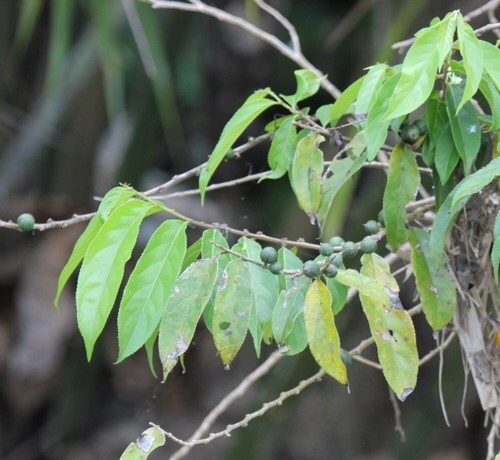
(c) Corne Brink, some rights reserved (CC BY-SA), uploaded by Corne Brink

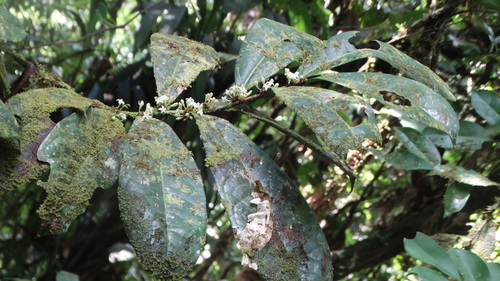
(c) Robert Taylor, some rights reserved (CC BY)

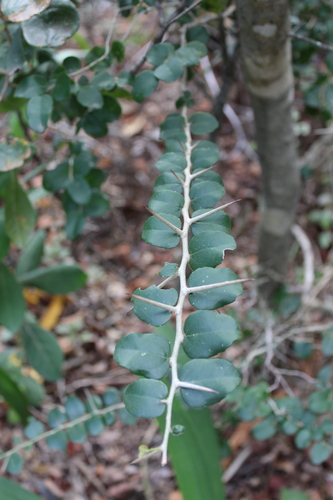
(c) Robert Taylor, some rights reserved (CC BY)
What to Eat
Edible parts: Fruit
The fleshy red fruit make good jelly and preserves, and are also used for wine production.
Known Hazards
Where to Find It
It is a subtropical plant. It grows from sea level to 1370 m in South Africa. It occurs in forested areas near the coast as well as inland in mountain evergreen forest. In Brisbane Botanical Gardens.
Africa, Australia, Eswatini, South Africa, Southern Africa, Swaziland,
How to Identify
A rigid spiny shrub. It can be a tree to 5 m tall. It is slender and spreading. The trunk can be 22 cm across. The branches can often have straight spines 2.5-8 cm long. The twigs and spines are usually slender. The leaves are simple and alternate. They are soft and thin. The leaves are 1.3-2.5 cm long by 1.3-1.9 cm wide. They can be heart-shaped or oval. The male and female flowers occur on separate trees. The flowers are small and cream or green. The male flowers occur in small clusters in the axils of leaves and the female flowers are single and on short stalks. The fruit is an oval berry. It is fleshy and 1.3 cm across. It becomes bright red. The fruit are edible.
Nutrition
| Part | Moisture | kJ | kcal | Protein | Vit A | Vit C | Iron | Zinc |
|---|---|---|---|---|---|---|---|---|
| Fruit | 90.4 | — | — | — | — | 71 | — | — |
How to Grow
Plants are easily grown from seed. Seedlings transplant easily.
Medicinal Uses
No medicinal uses mentioned in the data.
Other Information
The fruit are popular.
Notes
There are about 22 Dovyalis species. Also put in the Flacourtiaceae family.
Names & Synonyms
Appelkoos, Cape cranberry, Gewonesuurvessie, Mabambana, Umabambambane, Umnyazuma, Umkokolo, Umnyezane, Umqokolo
References (18)
- Fox, F. W. & Young, M. E. N., 1982, Food from the Veld. Delta Books. p 229
- W. H. Harvey & O. W. Sonder, Fl. cap. 1:69. 1860
- Hedrick, U.P., 1919, (Ed.), Sturtevant's edible plants of the world. p 282 (As Dovyalis ziziphoides)
- INFOODS:FAO/INFOODS Databases
- J. Bot. (Hooker) 3:251. 1841 (As Dovyalis ziziphoides)
- Jardin, C., 1970, List of Foods Used In Africa, FAO Nutrition Information Document Series No 2.p 133 (As Dovyalis ziziphoides)
- Long, C., 2005, Swaziland's Flora - siSwati names and Uses http://www.sntc.org.sz/flora/
- Palgrave, K.C., 1996, Trees of Southern Africa. Struik Publishers. p 640
- Palmer, E and Pitman, N., 1972, Trees of Southern Africa. Vol. 3. A.A. Balkema, Cape Town p 1567
- Plowes, N. J. & Taylor, F. W., 1997, The Processing of Indigenous Fruits and other Wildfoods of Southern Africa. in Smartt, L. & Haq. (Eds) Domestication, Production and Utilization of New Crops. ICUC p 190
- Ruiters-Welcome, A. K., 2019, Food plants of southern Africa. Ph.D. thesis. Univ. of Johannesburg p 99
- Schmidt, E., Lotter, M., & McCleland, W., 2007, Trees and shrubs of Mpumalanga and Kruger National Park. Jacana Media p 430
- Swaziland's Flora Database http://www.sntc.org.sz/flora
- van Wyk, Be., & Gericke, N., 2007, People's plants. A Guide to Useful Plants of Southern Africa. Briza. p 42
- van Wyk, B-E., 2011, The potential of South African plants in the development of new food and beverage products. South African Journal of Botany 77 (2011) 857–868
- Wehmeyer, A. S, 1986, Edible Wild Plants of Southern Africa. Data on the Nutrient Contents of over 300 species
- Welcome, A. K. & Van Wyk, B.-E., 2019, An inventory and analysis of the food plants of southern Africa. South African Journal of Botany 122 (2019) 136–179
- World Checklist of Useful Plant Species 2020. Royal Botanic Gardens, Kew