Dovyalis rotundifolia
(Thunb.) Thunb. & Harv.
Wild apricot, Dune dovyalis

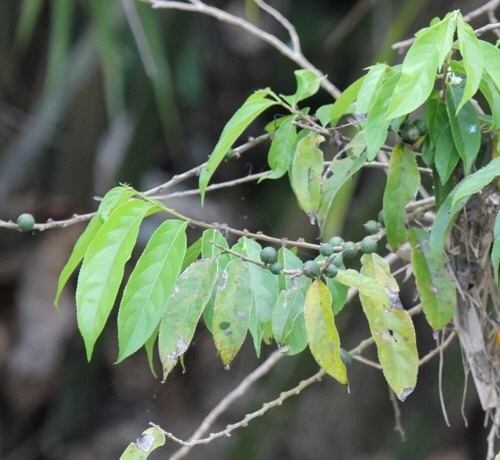
(c) Andrew Gillespie, some rights reserved (CC BY), uploaded by Andrew Gillespie

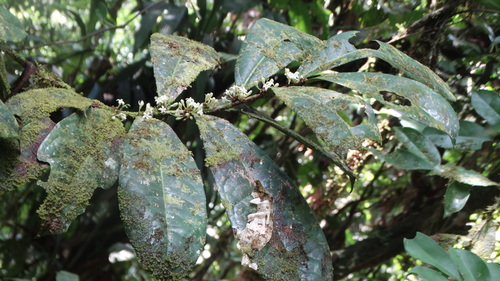
(c) Henry de Lange, some rights reserved (CC BY)
What to Eat
Edible parts: Fruit
The bright red fruit are eaten fresh or used to make preserves.
Where to Find It
It is a subtropical plant. It grows near the coast often nears dunes.
Africa, South Africa*, Southern Africa,
How to Identify
A shrub or small tree 3-6 m high. The stem can be 30 cm across. The leaves are dark glossy green. The leaves are simple and alternate. They have short stalks. Leaves are 1.3-4 cm long and 0.8-2.5 cm wide. There are spines up to 5 cm long in the axils of leaves. The flowers are male and female on separate plants. They are small and pale yellow. A few flowers occur in a cluster. Flowers often grow on old wood. The fruit is oval and has a small point at the tip. They are 1.3 cm long and fleshy. They are bright red. There are usually 2 seeds. The fruit are edible.
Other Information
The fruit have a good flavour.
Notes
There are about 22 Dovyalis species. Also put in the Flacourtiaceae family.
Names & Synonyms
References (9)
- Fox, F. W. & Young, M. E. N., 1982, Food from the Veld. Delta Books. p 230
- Jardin, C., 1970, List of Foods Used In Africa, FAO Nutrition Information Document Series No 2.p 133 (As Dovyalis celastroides)
- Palgrave, K.C., 1996, Trees of Southern Africa. Struik Publishers. p 640
- Palmer, E and Pitman, N., 1972, Trees of Southern Africa. Vol. 3. A.A. Balkema, Cape Town p 1566
- Peters, C. R., O'Brien, E. M., and Drummond, R.B., 1992, Edible Wild plants of Sub-saharan Africa. Kew. p 114
- Plowes, N. J. & Taylor, F. W., 1997, The Processing of Indigenous Fruits and other Wildfoods of Southern Africa. in Smartt, L. & Haq. (Eds) Domestication, Production and Utilization of New Crops. ICUC p 190
- Ruiters-Welcome, A. K., 2019, Food plants of southern Africa. Ph.D. thesis. Univ. of Johannesburg p 99
- Welcome, A. K. & Van Wyk, B.-E., 2019, An inventory and analysis of the food plants of southern Africa. South African Journal of Botany 122 (2019) 136–179
- World Checklist of Useful Plant Species 2020. Royal Botanic Gardens, Kew