Dracontium polyphyllum
L.
Motley-stalked dragon-plant
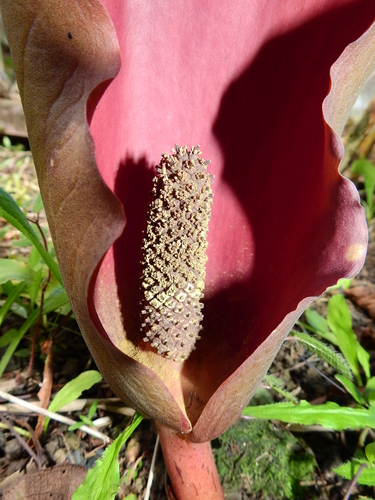
(c) Sébastien SANT, some rights reserved (CC BY-NC), uploaded by Sébastien SANT

(c) Guillaume Léotard, some rights reserved (CC BY-NC)

(c) Guillaume Léotard, some rights reserved (CC BY-NC)
What to Eat
Edible parts: Tuber, Root, Corm
The tubers are cooked and eaten.
Where to Find It
A tropical plant. It grows in moist forests. It grows up to 220 m above sea level.
Amazon, Asia, Brazil, Central America, Colombia, Costa Rica, Guianas, Haiti, India, Indonesia, Myanmar, Pacific, Peru*, SE Asia, South America, Suriname, Trinidad, Venezuela, West Indies,
How to Identify
A taro family herb. It is like Amorphophallus. The tubers are round and 6-10 cm wide by 5-8 cm thick. They are flat on top and rounded underneath. There are a few small tubers. The tuber produces a single leaf. The leaf stalks are 1-2 m long and 2-4 cm across. They are dark green or mottled. The leaf blades spreads horizontally and can be 1 m across. The leaves are divided. There is usually one flowering shoot. There are 150-300 flowers arranged in a spiral on one stalk. There is a spathe 6-12 cm long by 3-5 cm wide. The collection of fruits are 5-16 cm long and 3-4 cm wide. The berries have 3 seeds.
How to Grow
Plants can be grown from seeds or by division of the tuber.
Notes
There are 23 Dracontium species.
Names & Synonyms
Adive kanda, Changuango, Drakontium latina, Guapa, Jararaca-mirim, Jiracaca, Kaat curna, Sevala
References (9)
- Ambasta, S.P. (Ed.), 2000, The Useful Plants of India. CSIR India. p 183
- Ekman Herbarium records Haiti
- Hedrick, U.P., 1919, (Ed.), Sturtevant's edible plants of the world. p 282
- Kermath, B. M., et al, 2014, Food Plants in the Americas: A survey of the domesticated, cultivated and wild plants used for Human food in North, Central and South America and the Caribbean. On line draft. p 320
- Lim, T. K., 2015, Edible Medicinal and Non Medicinal Plants. Volume 9, Modified Stems, Roots, Bulbs. Springer p 40
- SHORTT,
- Sp. pl. 2:967. 1753
- Sukarya, D. G., (Ed.) 2013, 3,500 Plant Species of the Botanic Gardens of Indonesia. LIPI p 1104
- WATT,


