Drosera indica
L.
Sundew, Insect eating plant, Indian Sundew

(c) Siddarth Machado, some rights reserved (CC BY), uploaded by Siddarth Machado
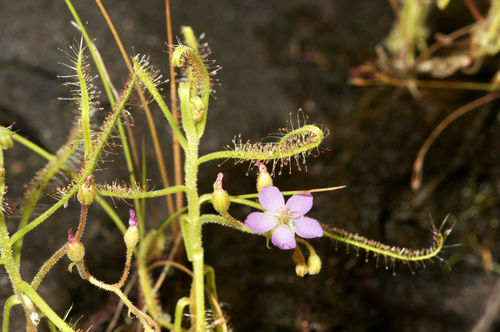
(c) Beat Akeret, some rights reserved (CC BY-NC)
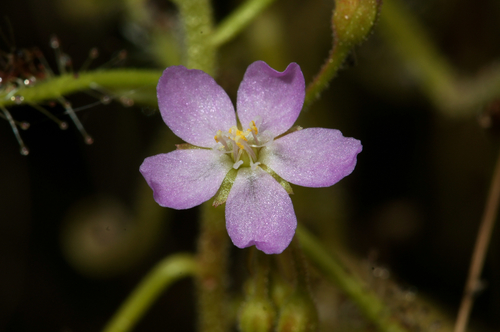
(c) Beat Akeret, some rights reserved (CC BY-NC)
What to Eat
Edible parts: Sap, Plant - tea
The plant sap can be consumed, and the plant can be brewed as a tea.
Where to Find It
It grows in tropical and warm temperate areas. It grows in wet soggy soils. In West Africa it is in wet grassland savannah. In China it grows from sea level to 600 m altitude in southern China. It can grow in arid places. It suits hardiness zones 9-12.
Africa, Asia, Australia, Burkina Faso, Cambodia, Central Africa, China, East Africa, Gabon, Guinea, Guinée, Guinea-Bissau, India, Indochina, Japan, Laos, Malaysia, Mozambique, Myanmar, Pacific, Papua New Guinea, PNG, SE Asia, Sierra Leone, Sri Lanka, Taiwan, Vietnam, West Africa, Zimbabwe,
How to Identify
A small herb. It can be 30-50 cm tall. It can be erect or trailing. It grows as an annual. The leaves are long and thin. They are yellowish green and the edges are sometimes rolled inwards. They have sticky hairs. Leaves are 5-12 cm long. The flowers are white or pink. They are 2 cm across. The fruit is a capsule.
How to Grow
Plants can be grown from seed or stem cuttings.
Wikipedia
Source ↗Drosera indica, sometimes known as the Indian sundew, is a species of sundew native to tropical and southern Africa, Madagascar and tropical and subtropical Asia. It was first described by Carl Linnaeus in his Species Plantarum in 1753. Until the early 21st century it was mostly considered a highly variable species with a wide distribution including Australia, but since 2000 several distinct species have been separated from D. indica within Drosera section Arachnopus, which is often referred to as the ‘Drosera indica complex’. Many of these species are endemic to Australia, but D. indica itself is now widely considered to be absent from that country.
Other Information
It is sold in local markets in China.
Notes
There are about 90-120 Drosera species.
Names & Synonyms
Hou mi cao, Nay-hnin-pauk-pin
References (16)
- Ambasta, S.P. (Ed.), 2000, The Useful Plants of India. CSIR India. p 184
- Conn, B.J., (Ed.) 1995, Handbooks of the Flora of Papua New Guinea. Vol 3. Melbourne University Press. p 52
- Cundall, P., (ed.), 2004, Gardening Australia: flora: the gardener's bible. ABC Books. p 514
- Elliot, W.R., & Jones, D.L., 1984, Encyclopedia of Australian Plants suitable for cultivation. Vol 3. Lothian. p 341
- Flora of China @ efloras.org Volume 8
- Flora of Australia, Volume 8, Lecythidales to Batales, Australian Government Publishing Service, Canberra (1982) p 15
- Hibbert, M., 2002, The Aussie Plant Finder 2002, Florilegium. p 89
- Kenneally, K.E., Edinger, D. C., and Willing T., 1996, Broome and Beyond, Plants and People of the Dampier Peninsula, Kimberley, Western Australia. Department of Conservation and Land Management. p 97
- Latz, P.K., 1996, Bushfires and Bushtucker: Aboriginal plant use in Central Australia. IAD Press Alice Springs p 162
- Levitt, D., 1981, Plants and people. Aboriginal uses of plants on Groote Eylandt. Australian Institute of Aboriginal Studies, Canberra. p 92
- Li, D. et al, 2017, Ethnobotanical survey of herbal tea plants from the traditional markets in Chaoshan, China. Journal of Ethnopharmacology. 205 (2017) 195-206
- Paczkowska, G. & Chapman, A.R., 2000, The Western Australian Flora. A Descriptive Catalogue. Western Australian Herbarium. p 227
- Pham-Hoang Ho, 1999, An Illustrated Flora of Vietnam. Nha Xuat Ban Tre. p 534
- Townsend, K., 1994, Across the Top. Gardening with Australian Plants in the tropics. Society for Growing Australian Plants, Townsville Branch Inc. p 169
- Townsend, K., 1999, Field Guide to Plants of the Dry Tropics. Society for Growing Australian Plants, Townsville Branch Inc. p 156
- Wheeler, J.R.(ed.), 1992, Flora of the Kimberley Region. CALM, Western Australian Herbarium, p 238
