Drypetes arguta
(Muell. Arg.) Hutch.
Water ironplum

(c) Mark Hyde, Bart Wursten and Petra Ballings, some rights reserved (CC BY-NC)

(c) Mark Hyde, Bart Wursten and Petra Ballings, some rights reserved (CC BY-NC)

(c) Mark Hyde, Bart Wursten and Petra Ballings, some rights reserved (CC BY-NC)
What to Eat
Edible parts: Fruit
Sections of branches of this tree have traditionally been used in hut construction, and the wood has also been used to make sticks. The fruits are edible and have been used to make a fermented alcoholic drink.
Where to Find It
A tropical plant. It grows in coastal forest and near streams. It can grow in arid places. In Zimbabwe it grows up to 6
Africa, East Africa, Eswatini, Mozambique, South Africa, Southern Africa, Swaziland, Tanzania, Zimbabwe,
How to Identify
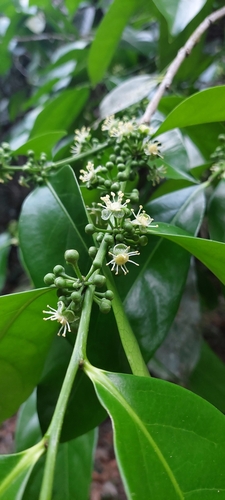
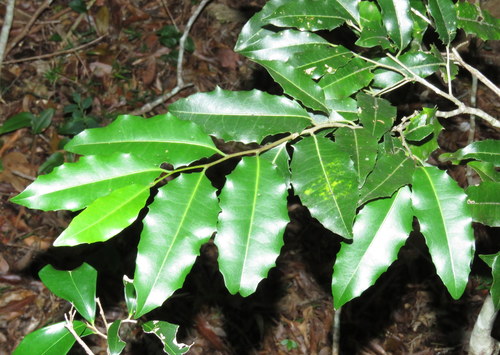
An evergreen shrub or tree. It grows to 6 m high. The bark is slightly rough and cracked. The leaves are simple and carried alternately. The leaves are sword shaped or oval. The base of the leaves is round and uneven and notched. The leaf tapers towards a pointed tip. The leaves are 4-8 cm long and with sharp teeth along the edge. They have very short leaf stalks. The male and female flowers are on separate trees. The grow in the axils of the leaves in young growth. The fruit are round and apricot red. They are 2 cm across and have 2 cells. The fruit is edible.
Wikipedia
Source ↗Drypetes arguta, commonly known as the water ironplum, is a species of small tree or large bush in the family Putranjivaceae. It is native to tropical East Africa. It was first described in 1920 by the English botanist John Hutchinson, who named it Cyclostemon argutus. It was later transferred to the genus Drypetes.
Notes
There are about 200 Drypetes species. These were previously in the Euphorbiaceae.
Names & Synonyms
Bastard white ironwood, Kushwane tree, Umkaswane, Umkhashwane, Water drypetes, Water ironplum
References (12)
- Fox, F. W. & Young, M. E. N., 1982, Food from the Veld. Delta Books. p 195
- Jardin, C., 1970, List of Foods Used In Africa, FAO Nutrition Information Document Series No 2.p 134
- Long, C., 2005, Swaziland's Flora - siSwati names and Uses http://www.sntc.org.sz/flora/
- Palgrave, K.C., 1996, Trees of Southern Africa. Struik Publishers. p 402
- Palmer, E and Pitman, N., 1972, Trees of Southern Africa. Vol. 2. A.A. Balkema, Cape Town p 1111
- Plowes, N. J. & Taylor, F. W., 1997, The Processing of Indigenous Fruits and other Wildfoods of Southern Africa. in Smartt, L. & Haq. (Eds) Domestication, Production and Utilization of New Crops. ICUC p 190
- Royal Botanic Gardens, Kew (1999). Survey of Economic Plants for Arid and Semi-Arid Lands (SEPASAL) database. Published on the Internet; http://www.rbgkew.org.uk/ceb/sepasal/internet [Accessed 16th April 2011]
- Ruiters-Welcome, A. K., 2019, Food plants of southern Africa. Ph.D. thesis. Univ. of Johannesburg p 93
- Schmidt, E., Lotter, M., & McCleland, W., 2007, Trees and shrubs of Mpumalanga and Kruger National Park. Jacana Media p 276
- Swaziland's Flora Database http://www.sntc.org.sz/flora
- Welcome, A. K. & Van Wyk, B.-E., 2019, An inventory and analysis of the food plants of southern Africa. South African Journal of Botany 122 (2019) 136–179
- World Checklist of Useful Plant Species 2020. Royal Botanic Gardens, Kew