Dysoxylum arborescens
(Blume) Miq.
Mossman Mahogany

(c) ryanthughes, some rights reserved (CC BY-NC)

(c) Russell Cumming, some rights reserved (CC BY-NC)

(c) apteryxrowi, some rights reserved (CC BY-NC)
What to Eat
Edible parts: Seeds
The seeds are peeled and roasted before eating.
Where to Find It
A tropical and subtropical plant. They grow in mixed mountain forest in the tropics. They are found in the Philippines in lower and middle altitude forests throughout the islands. They need acid and well drained soil.
Andamans, Asia, Australia, India, Indonesia, Malaysia, Pacific, Papua New Guinea, PNG, Philippines, SE Asia, Solomon Islands, Taiwan, Thailand, Vanuatu,
How to Identify
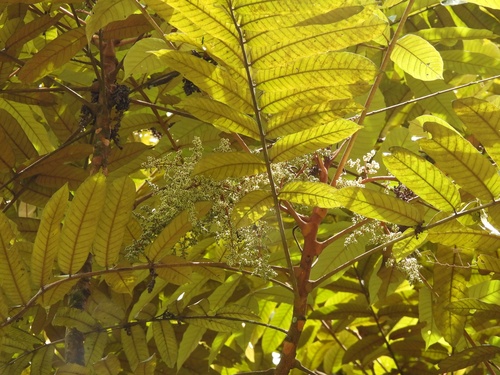
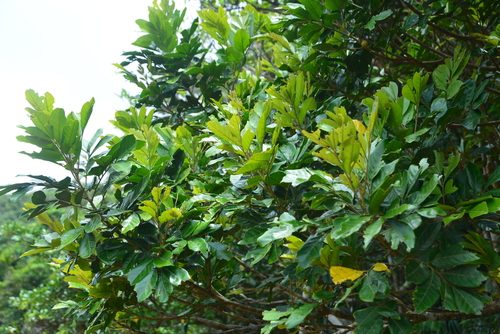
A medium to large tree with rigid branches. It can be 6-10 m high and spread to 3-8 m wide. It has smooth branches with lenticels. The bark of the young branches is dark red. The leaves are alternate and scattered with 7 pairs of leaflets. The leaves are 12-20 cm long. The leaf stalks have grooves along their length. The leaflets are thinly leathery and shiny on the upper surface. The leaflets are 7-15 cm long by 2.5-5 cm wide. They are oblong and unequal at the base. Flowers are borne in the axils of leaves and are yellowish white. They are small, about 1 cm across. The stamens are slightly shorter than the petals. The fruit are round but flattened and can be wrinkled. They are red and with 5 cells. The flesh is white and they have 1 to 4 seeds.
How to Grow
Plants can be grown from seed which must be planted while fresh.
Medicinal Uses
Medicine for coughs is made from the bark.
Other Uses
The sapwood is fawnish. The wood is suitable for medium to heavy construction work, planking, flooring, panelling, and for manufacturing high grade furniture, wood pallets, veneer and plywood. We have no more specific information on the wood of this species, but it is one of a group of species that are the source of a commercial timber known in the trade as 'jarum-jarum'. The general description of jarum-jarum is as follows:- The heartwood is orange-red to brick red when fresh,darkening on exposure; it is clearly demarcated from the yellow sapwood. The texture is moderately coarse but uneven due to the abundant of parenchyma; the grain is straight, interlocked, wavy or irregular; there is a watersilk marking on flat-sawn surfaces due to the parenchyma bands. The wood is moderately hard to hard. It is used for purposes such as flooring, furniture, wall panelling, solid door construction, veneer and plywood.
Production
In Australia, flowering occurs in November to December.
Notes
Medicine for coughs is made from the bark. There are about 80-200 Dysoxylum species. They occur in Asia and the Pacific in the tropics.
Names & Synonyms
Birimi, Kalimutain, Paang, Ta suea khon
References (11)
- Argent, G et al, nd, Manual of the Larger and More important non Dipterocarp Trees of Central Kalimantan Indonesia. Volume 2 Forest Research Institute, Samarinda, Indonesia. p 418
- Borrell, O.W., 1989, An Annotated Checklist of the Flora of Kairiru Island, New Guinea. Marcellin College, Victoria Australia. p 101, 199
- Cooper, W. and Cooper, W., 2004, Fruits of the Australian Tropical Rainforest. Nokomis Editions, Victoria, Australia. p 288
- Elliot, W.R., & Jones, D.L., 1984, Encyclopedia of Australian Plants suitable for cultivation. Vol 3. Lothian. p 375
- Foreman, D. B., 1971, A checklist of the Vascular Plants of Bougainville with Descriptions of some Common Forest Trees. Botany Bulletin No. 5. Department of Botany. p 108
- Jackes, B.R., 2001, Plants of the Tropics. Rainforest to Heath. An Identification Guide. James Cook University. p 63
- Jones, D. L, 1986, Ornamental Rainforest Plants in Australia, Reed Books, p 171
- Johns, R.J., 1976, Common Forest Trees of Papua New Guinea. Part 5 Angiospermae, Forestry College Bulolo, PNG p 208
- Monsalud, M.R., Tongacan, A.L., Lopez, F.R., & Lagrimas, M.Q., 1966, Edible Wild Plants in Philippine Forests. Philippine Journal of Science. p 493
- Townsend, K., 1994, Across the Top. Gardening with Australian Plants in the tropics. Society for Growing Australian Plants, Townsville Branch Inc. p 170
- Wongprasert, T. et al, 2011, A Synoptic Account of the Meliaceae of Thailand. Thai For. Bull. 39:210-266