Echinochloa pyramidalis
(Lam.) Hitchc. et Chase
Antelope grass
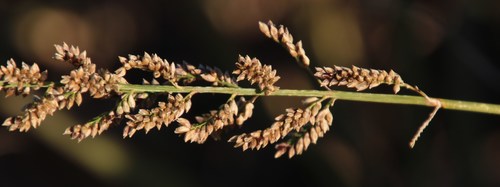
(c) Tony Rebelo, some rights reserved (CC BY-SA), uploaded by Tony Rebelo

(c) Tony Rebelo, some rights reserved (CC BY-SA)

(c) Tony Rebelo, some rights reserved (CC BY-SA)
What to Eat
Edible parts: Seeds, Grains, Cereal, Culm - salt
Echinochloa pyramidalis is palatable to livestock and is cultivated for fodder, being able to withstand heavy grazing; it grows during the wet season, dying back to the base during the dry season, but will resprout vigorously after wildfires, even in the middle of the dry season. It can be made into hay, but for this purpose the glabrous varieties are chosen. The grain is sometimes used for human consumption. This grass can be used to prevent erosion on river banks prone to flooding and on earth dams. It can be used in a similar way to reeds for sewage control. Where it has become invasive, as for example in Mexico and Guyana, it reduces biodiversity and grows so vigorously that it displaces native plants.
Where to Find It
A tropical plant. It is a major part of the floating plants along the Nile and Niger Rivers. It is common in swamps throughout tropical Africa. It can grow in temperate places. It grows from sea level to 2,400 m above sea level. It can grow in arid places. It grows in savannah.
Africa, Angola, Australia, Botswana, Burkina Faso, Cameroon, Central Africa, Central African Republic, CAR, Central America, Chad, Congo, Côte d'Ivoire, East Africa, Eswatini, Ethiopia, French Guiana, Gabon, Gambia, Ghana, Guadeloupe, Guinea, Guinée, Guinea-Bissau, Ivory Coast, Kenya, Madagascar, Malawi, Mali, Middle East, Mozambique, Namibia, Nicaragua, Niger, Nigeria, Papua New Guinea, PNG, Rwanda, Sahel, Saudi Arabia, Senegal, Sierra Leone, Somalia, South Africa, South America, Southern Africa, St Helena, Sudan, Swaziland, Tanzania, Uganda, Venezuela, West Africa, West Indies, Zambia, Zimbabwe,
How to Identify
A tall swamp grass. It grows up to 5 m high. It is like a reed and keeps growing from year to year. It has rhizomes or underground stems. The stems are solid.
How to Grow
It can be grown by cuttings or tillers.
Wikipedia
Source ↗Echinochloa pyramidalis is a species of large grass, occurring naturally in flooded regions and beside lakes in tropical Africa and America, and introduced to various other countries. It is commonly known as antelope grass.
Other Information
It is a famine food.
Notes
The plant is useful for animal grazing especially in the dry season. There are about 35 Echinochloa species. They grow in tropical to warm temperate regions.
Names & Synonyms
Ahilava, Al foula, Al fula, Limpopo grass, Nhamiquinte
References (22)
- Abbiw, D.K., 1990, Useful Plants of Ghana. West African uses of wild and cultivated plants. Intermediate Technology Publications and the Royal Botanic Gardens, Kew. p 25
- Burkill, H. M., 1985, The useful plants of west tropical Africa, Vol. 2. Kew.
- Cobley, L.S. (rev. Steele, W.M.) 2nd Ed., 1976, An Introduction to the Botany of Tropical Crops. Longmans. p 56
- Contr. U.S. Natl. Herb. 18:345. 1917
- CRÉAC'H,
- Dalziel, J. M., 1937, The Useful plants of west tropical Africa. Crown Agents for the Colonies London.
- Fowler, D. G., 2007, Zambian Plants: Their Vernacular Names and Uses. Kew. p 69
- Gallagher, D. E., 2010, Farming beyond the escarpment: Society, Environment, and Mobility in Precolonial Southeastern Burkina Faso. PhD University of Michigan
- Hussey, B.M.J., Keighery, G.J., Cousens, R.D., Dodd, J., Lloyd, S.G., 1997, Western Weeds. A guide to the weeds of Western Australia. Plant Protection Society of Western Australia. p 52
- Jardin, C., 1970, List of Foods Used In Africa, FAO Nutrition Information Document Series No 2. p 2
- Long, C., 2005, Swaziland's Flora - siSwati names and Uses http://www.sntc.org.sz/flora/
- Macmillan, H.F. (Revised Barlow, H.S., et al), 1991, Tropical Planting and Gardening. Sixth edition. Malayan Nature Society. Kuala Lumpur. p 352
- National Research Council, 1996, Lost crops of Africa. Volume 1 grains, p 267
- Paczkowska, G. & Chapman, A.R., 2000, The Western Australian Flora. A Descriptive Catalogue. Western Australian Herbarium. p 102
- Peters, C. R., O'Brien, E. M., and Drummond, R.B., 1992, Edible Wild plants of Sub-saharan Africa. Kew. p 21
- Purseglove, J.W., 1972, Tropical Crops. Monocotyledons. Longmans p 144
- Royal Botanic Gardens, Kew (1999). Survey of Economic Plants for Arid and Semi-Arid Lands (SEPASAL) database. Published on the Internet; http://www.rbgkew.org.uk/ceb/sepasal/internet [Accessed 3rd June 2011]
- Ruiters-Welcome, A. K., 2019, Food plants of southern Africa. Ph.D. thesis. Univ. of Johannesburg p 87
- Seidemann J., 2005, World Spice Plants. Economic Usage, Botany, Taxonomy. Springer. p 143
- Swaziland's Flora Database http://www.sntc.org.sz/flora
- Welcome, A. K. & Van Wyk, B.-E., 2019, An inventory and analysis of the food plants of southern Africa. South African Journal of Botany 122 (2019) 136–179
- World Checklist of Useful Plant Species 2020. Royal Botanic Gardens, Kew


