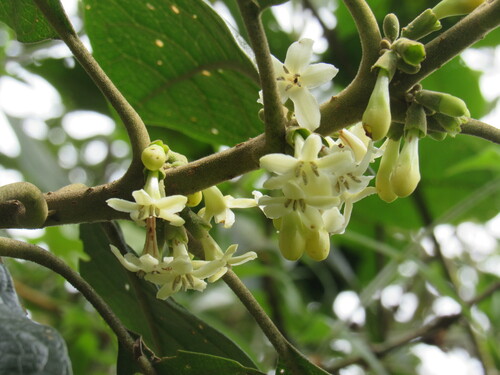
Agastache foeniculum
(Pursh.) Kuntze.
Anise Hyssop, Anise mint

(c) Sandy Wolkenberg, some rights reserved (CC BY), uploaded by Sandy Wolkenberg
(c) Alan Prather, some rights reserved (CC BY), uploaded by Alan Prather

(c) Paul Tavares, some rights reserved (CC BY-NC), uploaded by Paul Tavares
What to Eat
Edible parts: Leaves, Herb, Leaves - tea, Flowers
Leaves and flowers can be eaten raw or cooked and used as a flavouring in a wide range of dishes. Raw, they have a sweet aniseed flavour and make an excellent addition to salads. They can also be used to flavour cooked foods, especially acid fruits. One drawback is that the leaves tend to have a drying effect in the mouth and so cannot be eaten in large quantities. A pleasant-tasting tea is made from the leaves.
Where to Find It
It is a temperate plant. It grows naturally in waste ground on prairies and plains in Western North America from Ontario to Washington and south to Colorado. It does best in sunny positions and well drained soil. It can stand light frosts. In Hobart Botanical gardens. It suits plant hardiness zone 6-10.
Australia, Britain, Canada, Europe, Finland, Moldavia, North America, Scandinavia, Tasmania, USA,
How to Identify
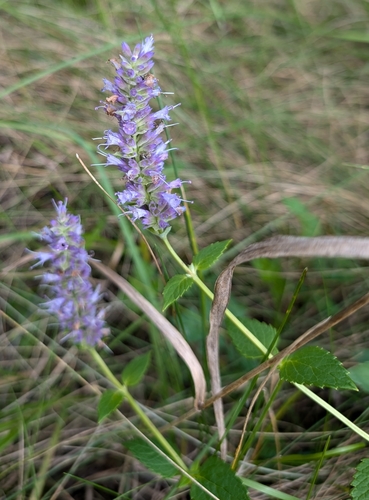
A perennial plant up to 90 cm tall and spreading to 40 cm wide. The leaves are 7.5 cm long and have coarse teeth along the edge. They are greyish green. The leaves are downy on the underside. They have a pleasant smell. They smell of anise. The stems are erect. The flowers are tiny and violet-blue. They have 2 lobes. They occur in dense spikes.
How to Grow
Plants can be grown from seed. They should just be covered with soil and germinate in 1-3 months at 13°C. They should be grown in the nursery for the first year. Plants can also be grown by dividing clumps and can be grown from basal cuttings. These root in 3 weeks.
Propagation: Seed — sow in spring in a greenhouse, just barely covering the seed. Germination usually occurs within 1–3 months at 13°C. Prick out seedlings into individual pots when large enough to handle and grow on in the greenhouse for the first year, then plant out in late spring or early summer. Division in spring is fairly simple; large divisions can be planted directly into permanent positions. Basal cuttings of young shoots can be taken in spring when shoots are about 10–15cm tall; pot up in a lightly shaded greenhouse position, where they should root within 3 weeks, then plant out in summer or the following spring.
Medicinal Uses
The leaves are cardiac and diaphoretic. An infusion of the leaves is used to treat colds, fevers, and weak heart. When allowed to cool, the same infusion is used to treat chest pains, such as those caused by lungs sore from excessive coughing. A poultice of leaves and stems can be applied to treat burns.
Other Uses
Attracts wildlife; provides invertebrate shelter and acts as a nectary. The plant is aromatic.
Wikipedia
Source ↗Agastache foeniculum (syn. Agastache anethiodora (Nutt.) Britton), commonly called anise hyssop, blue giant hyssop, Fragrant giant hyssop, or the lavender giant hyssop, is a species of perennial plant in the mint family. The plant is native to much of northern North America. It is tolerant of deer and drought, and is visited by many pollinators.
Notes
There are about 20-30 Agastache species.
Names & Synonyms
Blue Giant Hyssop, Blue Giant-hyssop, Lavender Hyssop, Licorice Mint, Wonder Honey Plant
References (17)
- Beckstrom-Sternberg, Stephen M., and James A. Duke. "The Foodplant Database." http://probe.nalusda.gov:8300/cgi-bin/browse/foodplantdb.(ACEDB version 4.0 - data version July 1994) (As Agastache anethiodora)
- Benvenuti, S. & Mazzoncini, M., 2021, The Biodiversity of Edible Flowers: Discovering New Tastes and New Health Benefits. Frontiers in Plant Science Srticle 569499.
- Bircher, A. G. & Bircher, W. H., 2000, Encyclopedia of Fruit Trees and Edible Flowering Plants in Egypt and the Subtropics. AUC Press. p 12
- Bremness, L., 1994, Herbs. Collins Eyewitness Handbooks. Harper Collins. p 138
- Brickell, C. (Ed.), 1999, The Royal Horticultural Society A-Z Encyclopedia of Garden Plants. Convent Garden Books. p 87
- Brown, D., 2002, The Royal Horticultural Society encyclopedia of Herbs and their uses. DK Books. p 105
- Cormack, R. G. H., 1967, Wild Flowers of Alberta. Commercial Printers Edmonton, Canada. p 286
- Cundall, P., (ed.), 2004, Gardening Australia: flora: the gardener's bible. ABC Books. p 110
- Facciola, S., 1998, Cornucopia 2: a Source Book of Edible Plants. Kampong Publications, p 125
- Joyce, D., 1998, The Garden Plant Selector. Ryland, Peters and Small. p 201
- Lawton, B.P., 2002, Mints. A Family of Herbs and Ornamentals. Timber Press, Portland, Oregon. p 117
- MacKinnon, A., et al, 2009, Edible & Medicinal Plants of Canada. Lone Pine. p 275
- Plants for a Future database, The Field, Penpol, Lostwithiel, Cornwall, PL22 0NG, UK. http://www.scs.leeds.ac.uk/pfaf/
- Revis. gen. pl. 2:511. 1891
- Seidemann J., 2005, World Spice Plants. Economic Usage, Botany, Taxonomy. Springer. p 11
- Vermeulen, N, 1998, The Complete Encyclopedia of Herbs. Rebo Publishers. p 27
- Wiersema, J. H. & Leon, B., 2013, World Economic Plants. A Standard Reference CRC Press. 2nd Ed. p 23