Elaeagnus triflora
Roxb.
Millaa vine

(c) Arthur Chapman, some rights reserved (CC BY-NC-SA)
(c) JODY HSIEH, some rights reserved (CC BY-NC)
(c) JODY HSIEH, some rights reserved (CC BY-NC)
What to Eat
Edible parts: Fruit
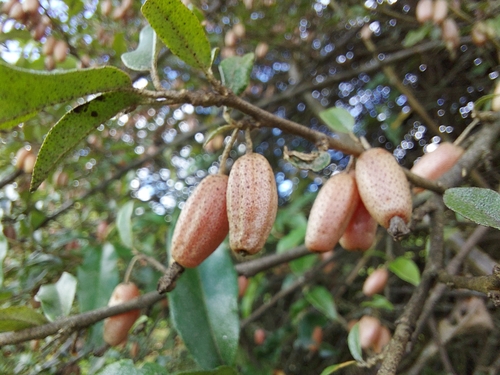
Fruit - raw or cooked. A sweet flavour when fully ripe. Juicy, with a tart-sweet flavour, they are pleasant to eat out of hand when fully ripe. Some forms are delicious. The fruit can also be used to make a highly coloured jelly. The fruits are 20 - 25mm long and contain a single large seed. Seed - raw or cooked. A flavour somewhat resembling a peanut, it is rather nice if eaten with the fruit, although the fibrous seed case would have to be spat out afterwards.
Where to Find It
A tropical plant. It grows in upland tropical rain forest. It grows up to 1,800 m above sea level. They are distributed throughout the islands of the Philippines and common in northern provinces. They grow in areas of shrub at low and medium altitudes up to 1500m. It is very salt tolerant. It can only tolerate very slight frost. It can grow on a range of soils and will grow on alkaline soils. Adelaide Botanical Gardens.
Asia, Australia, East Timor, Hawaii, Indonesia, Malaysia, Malesia, Pacific, Papua New Guinea, PNG, Philippines, SE Asia, Taiwan, Timor-Leste, USA,
How to Identify
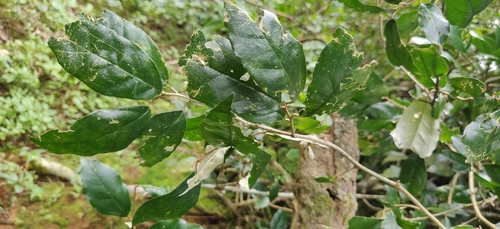
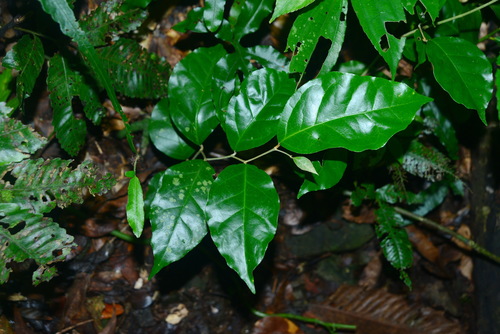
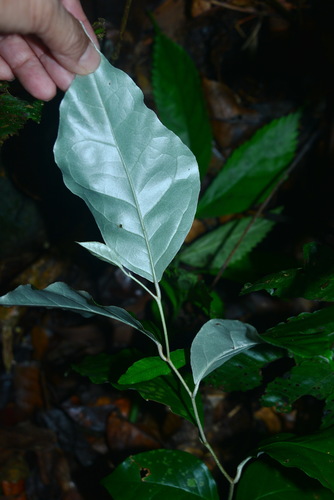
A vine or climber. It can be 10 m tall. The stems are erect but is leans of plants nearby. The leaves are pointed at both ends and carried alternately.Young shoots have silvery scales. The leaves are simple and 3-15 cm long by 3-5 cm wide. The leaves are silvery underneath. The flowers are in spikes or clusters in the axils of leaves or at the ends of branches. The flowers are 0.5 cm across. The fruit is 2 cm long by 1.2 cm wide. They hang singly or in bunches in the axils of leaves. There is one seed inside. It is 1.8 cm long by 0.8 cm wide. The flesh of the fruit is edible.
How to Grow
It can be grown from fresh seed or cuttings. It can be pruned to maintain shape.
Propagation: Seed - best sown as soon as it is ripe in a cold frame. It should germinate within a few weeks, though it may take 18 months. Stored seed can be very slow to germinate, often taking more than 18 months. A warm stratification for 4 weeks followed by 12 weeks cold stratification can help. (This information on stratification is probably not so appropriate to this species since it does not experience much frost in its native habitat). The seed usually (eventually) germinates quite well. Prick out the seedlings into individual pot as soon as they are large enough to handle and plant out when they are at least 15cm tall. Cuttings of half-ripe wood, 7 - 10cm with a heel. Cuttings of mature wood of the current year's growth, 10 - 12cm with a heel, in a frame. The cuttings are rather slow and difficult to root, leave them for 12 months. Layering takes 12 months.
Medicinal Uses
The ripe fruit is astringent. It is given to children suffering from amoebic dysentery. The flowers are astringent and cardiac.
Other Uses
Plants are very tolerant of trimming and can be grown as a fairly large, dense hedge.
Wikipedia
Source ↗Elaeagnus triflora, commonly known as millaa millaa vine, is a scrambling shrub the family Elaeagnaceae. Its native range is Malesia and Papuasia, to Taiwan in the north and the Australian state of Queensland in the south.
Other Information
The fruit are often eaten by children.
Notes
There are 45 Elaeagnus species.
Names & Synonyms
Alingaro, Areuj dudureman, Banaken, Bennaken, Gumi, Hail hail, Kenintju, Kopapey, Lingaro, Millaa Millaa, Suytuk
References (28)
- Anon., 2003, Native Plants for the Fitzroy basin. Society for Growing Australian Plants Inc. (Rockhampton Branch) p 47
- Bodner, C. C. and Gereau, R. E., 1988, A Contribution to Bontoc Ethnobotany. Economic Botany, 43(2): 307-369(As Elaeagnus philippensis)
- Brown, W.H., 1920, Wild Food Plants of the Philippines. Bureau of Forestry Bulletin No. 21 Manila. p 1230 (As Elaeagnus philippensis)
- Call, C. A., et al, 2004, Participatory Rural Appraisal in the Upland Ecosystem of Mt Malindang, Misamis Occidental, Philippines. Biodiversity Research Programme for Development in Mindanao. p 53 (As Elaeagnus philippensis)
- Chua-Barcelo, R. T., 2014, Ethnobotanical survey of edible wild fruits in Benguet, Cordillera administrative region, the Philippines. Asian Pac. J. Trop. Biomed. 4(Suppl. 1):S525-S538
- Coronel, R.E., 1982, Fruit Collections in the Philippines. IBPGR Newsletter p 9 (As Elaeagnus philippensis)
- Cherikoff, V. & Isaacs, J., The Bush Food Handbook. How to gather, grow, process and cook Australian Wild Foods. Ti Tree Press, Australia p 199
- Cooper, W & Cooper W T, 1994, Fruits of the Rain Forest. RD Press p 104
- Cooper, W. and Cooper, W., 2004, Fruits of the Australian Tropical Rainforest. Nokomis Editions, Victoria, Australia. p 157
- Cowie, I, 2006, A Survey of Flora and vegetation of the proposed Jaco-Tutuala-Lore National Park. Timor-Lests (East Timor) www.territorystories.nt/gov.au p 46
- Elliot, W.R., & Jones, D.L., 1984, Encyclopedia of Australian Plants suitable for cultivation. Vol 3. Lothian. p 384
- Facciola, S., 1998, Cornucopia 2: a Source Book of Edible Plants. Kampong Publications, p 93 (As Elaeagnus philippensis)
- Fl. ind. 1:459. 1820
- Haslam, S., 2004, Noosa's Native Plants. Noosa Integrated Catchment Assn. Inc. p 335
- Hoare, A., 2003, Food use of the Lundayeh SW Sabah. Borneo Research Council. (As Elaeagnus ferruginea)
- Jackes, B.R., 2001, Plants of the Tropics. Rainforest to Heath. An Identification Guide. James Cook University. p 50
- Jones, D. L., 1986, Ornamental Rainforest Plants in Australia, Reed Books, p 287
- Kiple, K.F. & Ornelas, K.C., (eds), 2000, The Cambridge World History of Food. CUP p 1770 (As Elaeagnus philippensis)
- Lyle, S., 2006, Discovering fruit and nuts. Land Links. p 190 (As Elaeagnus philippensis)
- Mem. Soc. Linn. Paris 3:114. 1824 (As Elaeagnus philippensis)
- Monsalud, M.R., Tongacan, A.L., Lopez, F.R., & Lagrimas, M.Q., 1966, Edible Wild Plants in Philippine Forests. Philippine Journal of Science. p 463 (As Elaeagnus philippensis)
- Nicholson, N & H., 1994, Australian Rainforest Plants 4, Terania Rainforest Publishing. NSW. p 29
- Pearson, S. & A., 1992, Rainforest Plants of Eastern Australia. Kangaroo Press p 96
- PROSEA (Plant Resources of South East Asia) handbook, Volume 2, 1991, Edible fruits and nuts.
- Rollins, C. B., 1987, The Role of the Fruit & Spice Park in Popularization and Dissemination of Tropical Fruit in South Florida. Proc. Fla. State Hort. Soc. 100:323-327
- Stanley, T. D. & Ross, E. M., 1986, Flora of south-eastern Queensland Volume 2. Queensland Government p 197
- Staples, G.W. and Herbst, D.R., 2005, A tropical Garden Flora. Bishop Museum Press, Honolulu, Hawaii. p 271 (As Elaeagnus triflora)
- Townsend, K., 1994, Across the Top. Gardening with Australian Plants in the tropics. Society for Growing Australian Plants, Townsville Branch Inc. p 173