Elaeocarpus arnhemicus
F. Muell.
Arnhem Land quandong, Bony Quandong
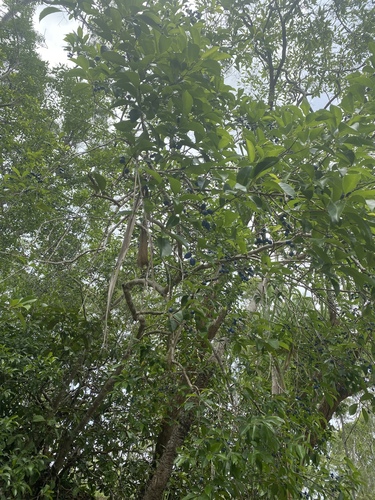
(c) aabaker, some rights reserved (CC BY-NC)
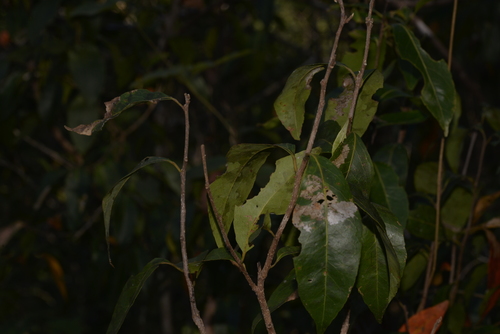
(c) Nick Lambert, some rights reserved (CC BY-NC-SA)
What to Eat
Edible parts: Fruit
The ripe fruit is eaten raw.
Where to Find It
A tropical plant. It is native to N Australia and Papua New Guinea. Plants grow naturally along stream banks in tropical places. They extend into drier areas. It often grows in rocky areas. It needs a sunny position and a well drained soil. It can tolerate some frost. It is very tolerant of drought and salt. In tropical Queensland it grows between sea level and 1000 m altitude.
Australia*, Pacific, Papua New Guinea, PNG,
How to Identify
A tall shrub or small evergreen tree. It grows 6-15 m tall and spreads 3-5 m across. The crown has a spreading pattern. The bark is pale grey and smooth. Young shoots are hairy and the stems reddish. The leaves are oblong and 3-8 cm long by 3-4 cm wide. They are blunt at the end. They are dark green above and dull green underneath. The edges of the leaves are notched. The flower racemes are 2-8 cm long and the flowers about 0.5 cm long. The flower arrangements occur in the axils of the upper leaves and the flowers are greenish white with a fringe. The fruit is 1.2-1.5 cm long with a central stone. It is oval and bright blue.
How to Grow
Plants are grown from seed. Seed do not germinate regularly. Plants can also be grown from cuttings.
Wikipedia
Source ↗Elaeocarpus arnhemicus, commonly known as elaeocarpus, blue plum, bony quandong or Arnhem Land quandong, is species of flowering plant in the family Elaeocarpaceae and is native to northern Australia, New Guinea, Timor and certain other islands in the Indonesian Archipelago. It is a tree with narrow elliptic to lance-shaped or egg-shaped leaves with serrated edges, racemes of white or cream-coloured flowers and metallic blue fruit.
Production
In Australia fruit mature November to January.
Notes
There are about 360 Elaeocarpus species mostly in the tropics.
Names & Synonyms
Dirndirnda
References (16)
- Barwick, M., 2004, Tropical and Subtropical Trees. A Worldwide Encyclopedic Guide. Thames and Hudson p 161
- Brock, J., 1993, Native Plants of Northern Australia, Reed. p 147
- Cherikoff V. & Isaacs, J., The Bush Food Handbook. How to gather, grow, process and cook Australian Wild Foods. Ti Tree Press, Australia p 199
- Coode, M.J.E., in Henty, E.E., (Ed.), 1981, Handbooks of the Flora of Papua New Guinea, Melbourne University Press, p 93
- Cooper W & Cooper W T, 1994, Fruits of the Rain Forest. RD Press p 104
- Cooper, W. and Cooper, W., 2004, Fruits of the Australian Tropical Rainforest. Nokomis Editions, Victoria, Australia. p 159
- Elliot, W.R., & Jones, D.L., 1984, Encyclopedia of Australian Plants suitable for cultivation. Vol 3. Lothian. p 384
- Jackes, B.R., 2001, Plants of the Tropics. Rainforest to Heath. An Identification Guide. James Cook University. p 51
- Jones D, L, 1986, Ornamental Rainforest Plants in Australia, Reed Books, p 141
- Lazarides, M. & Hince, B., 1993, Handbook of Economic Plants of Australia, CSIRO. p 88
- Levitt, D., 1981, Plants and people. Aboriginal uses of plants on Groote Eylandt. Australian Institute of Aboriginal Studies, Canberra. p 93
- Low, T., 1991, Wild Food Plants of Australia. Australian Nature FieldGuide, Angus & Robertson. p 91
- Morley, B.D., & Toelken, H.R., (Eds), 1983, Flowering Plants in Australia. Rigby. p 120
- Scarth-Johnson, V., 2000, National Treasures. Flowering Plants of Cooktown and Northern Australia. Vera Scarth-Johnson Gallery Association. Cooktown, Australia. p 116
- Townsend, K., 1994, Across the Top. Gardening with Australian Plants in the tropics. Society for Growing Australian Plants, Townsville Branch Inc. p 174
- Williams, K.A.W., 1999, Native Plants of Queensland Volume 4. Keith A.W. Williams North Ipswich, Australia. p 172


