Elatostema dissectum
Weddell
Gungee
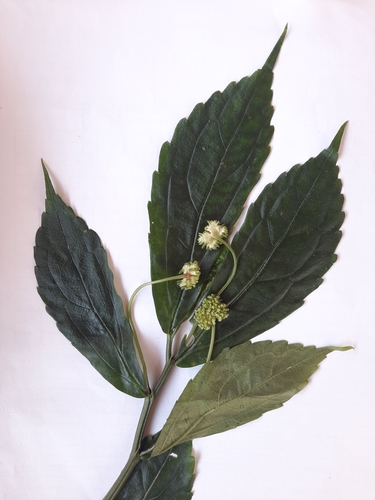
(c) Phuentsho, some rights reserved (CC BY-NC), uploaded by Phuentsho

(c) 通通, some rights reserved (CC BY-NC)
What to Eat
Edible parts: Fruit, Leaves
Young leaves are edible when cooked. The fruit is also edible, though no further details are available.
Known Hazards
Where to Find It
It is a tropical plant. It grows in mountain forests and along rivers. It western China it grows between 500-2,100 m above sea level. In Yunnan.
Asia, Bhutan, China, Himalayas, India, Indochina, Japan, Laos, Northeastern India, SE Asia, Sikkim, Thailand, Vietnam,
How to Identify
A herb that keeps growing from year to year. It can grow to 1 m tall. It does not have stinging hairs. The leaves are alternate and the leaves are obliquely oblong and 8-15 cm long by 3-5 cm wide.
How to Grow
We have very little information on this species and do not know if it will be hardy in Britain, though judging by its native range it could succeed outdoors in many parts of this country. Plants can be either dioecious or monoecious.
Propagation: Sow seed in spring in situ.
Medicinal Uses
None known.
Other Uses
None known.
Wikipedia
A perennial growing to 70cm tall with flowers from January to June. Monoecious, producing both male and female flowers on the same plant. Tolerates light sandy, medium loamy, and heavy clay soils. Grows in mildly acid, neutral, and basic alkaline pH. Thrives in semi-shade or full sun and prefers moist soil.
Notes
There are about 200 Elatostema species.
Names & Synonyms
Dong ma wang, Khlow
References (7)
- Cao, Y., et al, 2020, Ethnobotanical study on wild edible plants used by three trans-boundary ethnic groups in Jiangcheng County, Pu’er, Southwest China. Journal of Ethnobiology and Ethnomedicine (2020) 16:66
- Fern, K., 2012, Tropical Species Database http://theferns.info/tropical/
- Flora of China @ efloras.org Volume 5
- Gangwar, A. K. & Ramakrishnan, P. S., 1990, Ethnobotanical Notes on Some Tribes of Arunachal Pradesh, Northeastern India. Economic Botany, Vol. 44, No. 1 pp. 94-105
- Kunkel, G., 1984, Plants for Human Consumption.
- Plants for a Future database, The Field, Penpol, Lostwithiel, Cornwall, PL22 0NG, UK. http://www.scs.leeds.ac.uk/pfaf/
- Singh, B., et al, 2012, Wild edible plants used by Garo tribes of Nokrek Biosphere Reserve in Meghalaya, India. Indian Journal of Traditional Knowledge. 11(1) pp 166-171


