Elatostema laetevirens
Makino
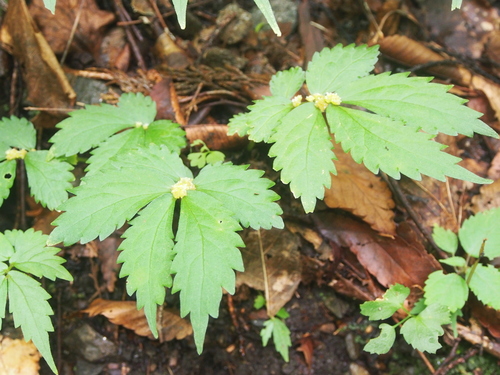
(c) Keita Watanabe, some rights reserved (CC BY-NC)

GBIF

GBIF
What to Eat
Edible parts: Leaves, Stem
Young leaves are edible when cooked.
Where to Find It
It is a temperate plant. It grows along the edges of rivers in the mountains. In Northeastern India it grows between 1,700-2,000 m above sea level.
Asia, India, Japan, Northeastern India,
How to Identify
A perennial reaching 30cm tall. Monoecious with male and female flowers on the same plant. Tolerates light sandy, medium loamy, and heavy clay soils across mildly acid, neutral, and basic alkaline pH levels. Grows in semi-shade and prefers moist soil.
How to Grow
We have very little information on this species and do not know if it will be hardy in Britain, though judging by its native range it should succeed outdoors in most parts of this country. It is likely to require woodland conditions.
Propagation: No specific information is available for this species, but sowing seed in a cold frame in spring is suggested. Once seedlings are large enough to handle, prick them out into individual pots and grow on in the greenhouse for at least the first winter. Plant out into permanent positions in late spring or early summer, after the last expected frosts. Division in spring should also be possible.
Medicinal Uses
None known.
Other Uses
None known.
Wikipedia
A perennial reaching 30cm tall. Monoecious with male and female flowers on the same plant. Tolerates light sandy, medium loamy, and heavy clay soils across mildly acid, neutral, and basic alkaline pH levels. Grows in semi-shade and prefers moist soil.
Notes
There are about 200 Elatostema species.
Names & Synonyms
References (3)
- Chen, B. & Qiu, Z., Consumer's Attitudes towards Edible Wild Plants, Ishikawa Prefecture, Japan. p 23 www.hindawi.com/journals/ijfr/aip/872413.pdf
- Plants for a Future database, The Field, Penpol, Lostwithiel, Cornwall, PL22 0NG, UK. http://www.scs.leeds.ac.uk/pfaf/
- Tsering, J., et al, 2017, Ethnobotanical appraisal on wild edible plants used by the Monpa community of Arunchal Pradesh. Indian Journal of Traditional Knowledge. Vol 16(4), October 2017, pp 626-637


