Elatostema macrophyllum
Brongn.
UrticaceaeLeaves
iNaturalist · cc-by-nc
(c) Deny Wahyudi, some rights reserved (CC BY-NC), uploaded by Deny Wahyudi
(c) Deny Wahyudi, some rights reserved (CC BY-NC), uploaded by Deny Wahyudi

iNaturalist · cc-by-nc
(c) Russell Barrett, some rights reserved (CC BY-NC)
(c) Russell Barrett, some rights reserved (CC BY-NC)

iNaturalist · cc-by-nc
(c) Russell Barrett, some rights reserved (CC BY-NC)
(c) Russell Barrett, some rights reserved (CC BY-NC)
What to Eat
Edible parts: Leaves
The leaves and growing tips are eaten as a leafy vegetable.
Where to Find It
A tropical plant. It grows wild in the highlands. In the Philippines it has been recorded at 400 m above sea level.
Asia, Indonesia, Fiji, New Zealand, Pacific, Papua New Guinea, PNG, Philippines, SE Asia, Vanuatu,
Countries: United Arab Emirates, Afghanistan, Armenia, Australia, Azerbaijan, Bangladesh, Bahrain, Brunei, Bhutan, China, Fiji, Micronesia, Georgia, Indonesia, Israel, India, Iraq, Iran, Jordan, Japan, Kyrgyzstan, Cambodia, Kiribati, North Korea, South Korea, Kuwait, Kazakhstan, Laos, Lebanon, Sri Lanka, Marshall Islands, Myanmar, Mongolia, Maldives, Malaysia, Nepal, Nauru, New Zealand, Oman, Papua New Guinea, Philippines, Pakistan, Palau, Qatar, Saudi Arabia, Solomon Islands, Singapore, Syria, Thailand, Tajikistan, Timor-Leste, Turkmenistan, Tonga, Turkey, Tuvalu, Taiwan, Uzbekistan, Vietnam, Vanuatu, Samoa, Yemen
How to Identify
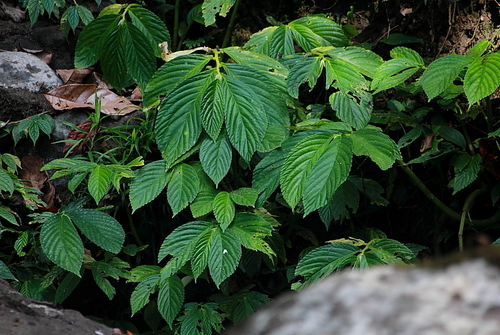
A soft, fleshy shrub of the nettle family, growing wild in tropical highlands. Found in the Philippines at elevations around 400 m.
Notes
There are about 200 Elatostema species. The porous leaves are used to extract salt.
Names & Synonyms
Ahaha memer, Assayu utan, Seni tami
References (5)
- Cabalion, P. and Morat, P., 1983, Introduction le vegetation, la flore et aux noms vernaculaires de l'ile de Pentcoste (Vanuatu), In: Journal d'agriculture traditionnelle et de botanique appliquee JATBA Vol. 30, 3-4
- Duperrey, L. I., 1826, Voyage autour du monde sur la corvette de S. M. La Coquille, pendant led annees 1922-1825, Atlas t.45
- French, B.R., 1986, Food Plants of Papua New Guinea, A Compendium. Asia Pacific Science Foundation p 343
- Hide, R. L., (Ed.) 1984, Research Report of the Simbu Land Use Project. Vol.V1 South Simbu: Studies in Demography, Nutrition, and Subsistence. p 446
- World Checklist of Useful Plant Species 2020. Royal Botanic Gardens, Kew


