Embelia philippinensis
A.DC.
Woody vine

President and Fellows of Harvard College
What to Eat
Edible parts: Leaves, Fruit, Spice
Leaves - cooked. The acid-tasting leaves are used as a flavouring for vegetables or to give a sour taste to soup. Fruit. A sweet-sour taste. The fruit is a globose berry, up to 5mm in diameter, red when ripe.
Where to Find It
A tropical plant. It grows in open and partly shaded secondary forest. They occur in the Philippines from northern Luzon to the northern provinces of Mindanao.
Asia, Malaysia, Pacific, Philippines*, SE Asia,
How to Identify
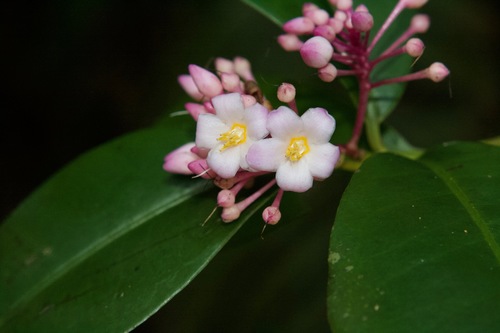
A woody vine with spiny old stems. The vines can be 4 m long and 1.5 cm across. The branches are smooth and shiny. The leaves are alternate, leathery, smooth and 7 to 14 cm long by 3-4 cm wide. The flowers are small and whitish and occur in considerable numbers in compound flower arrangements. The fruit are berry like, sour and up to 5 mm across. They are red and usually with a noticeable narrow extension of the ovary at the tip.
How to Grow
It can be grown from seed or by stem cuttings. The seeds are best planted in a nursery and then transplanted. Cuttings are taken from mature stems.
Propagation: Seed - Stem cuttings.
Other Uses
The fresh mature stems are used for temporary tying purposes.
Notes
There are about 140 Embelia species. Also put in the family Myrsinaceae.
Names & Synonyms
Bisolak, Bisudak, Dikai, Lando, Pongpong, War ilang
References (11)
- Brown, W.H., 1920, Wild Food Plants of the Philippines. Bureau of Forestry Bulletin No. 21 Manila. p 142
- Burkill, I.H., 1966, A Dictionary of the Economic Products of the Malay Peninsula. Ministry of Agriculture and Cooperatives, Kuala Lumpur, Malaysia. Vol 1 (A-H) p 934
- Chua-Barcelo, R. T., 2014, Ethnobotanical survey of edible wild fruits in Benguet, Cordillera administrative region, the Philippines. Asian Pac. J. Trop. Biomed. 4(Suppl. 1):S525-S538
- Hoare, A., 2003, Food use of the Lundayeh SW Sabah. Borneo Research Council.
- Kulip, J., 2003, An ethnobotanical survey of medicinal and other useful plants of Muruts in Sabah, Malaysia. Telopea 10(1) p 91
- Martin, F.W. & Ruberte, R.M., 1979, Edible Leaves of the Tropics. Antillian College Press, Mayaguez, Puerto Rico. p 207
- Monsalud, M.R., Tongacan, A.L., Lopez, F.R., & Lagrimas, M.Q., 1966, Edible Wild Plants in Philippine Forests. Philippine Journal of Science. p 510
- Polinag, M. A., 2003, Food from the Wilderness. Department of Environment and Natural Resources. Laguna.
- PROSEA handbook Volume 13 Spices. p 253
- Seidemann J., 2005, World Spice Plants. Economic Usage, Botany, Taxonomy. Springer. p 145
- World Checklist of Useful Plant Species 2020. Royal Botanic Gardens, Kew