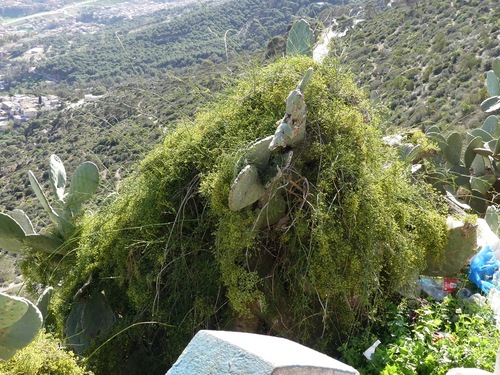
Ephedra intermedia
Schrenk & C. A. Mey.
Intermediate ephedra

(c) Юрий Данилевский (Yuriy Danilevsky), some rights reserved (CC BY), uploaded by Юрий Данилевский (Yuriy Danilevsky)

(c) Юрий Данилевский (Yuriy Danilevsky), some rights reserved (CC BY), uploaded by Юрий Данилевский (Yuriy Danilevsky)

(c) Dmitry Limonov, some rights reserved (CC BY-NC), uploaded by Dmitry Limonov
What to Eat
Edible parts: Fruit
The fruit can be eaten raw or cooked and measures about 7mm in diameter.
Known Hazards
Where to Find It
It is a temperate plant. It is a semi-desert plant. In the Himalayas it grows between 3,300-4,650 m above sea level. It grows in and near Tibet. It can grow in arid places.
Afghanistan, Asia, Central Asia, China, Himalayas, India, Iran, Middle East, Mongolia, Nepal, Pakistan, Siberia, Tajikistan, Tibet, Turkestan,
How to Identify
A shrubby plant. It grows 50 cm high. It has many branches. The stems are green and the branches are opposite or in a ring. The leaves are thin and 2-4 mm long. Male and female flowers are on separate plants. The ripe fruit or cones are oval red berries. They are 5-6 mm long. There are 2-3 seeds.
How to Grow
Requires a well-drained loamy soil and a sunny position. Established plants are drought resistant and are also lime tolerant. Dioecious. Male and female plants must be grown if seed is required. Some forms are monoecious.
Propagation: Sow seed as soon as it is ripe in autumn in a greenhouse, or in spring in a greenhouse using a sandy compost. Prick out seedlings into individual pots once large enough to handle and grow on for at least their first winter under glass. Plant out in spring or early summer after the last expected frosts, with some protection during their first winter. Can also be propagated by division in spring or autumn, or by layering.
Medicinal Uses
Members of this genus contain medicinally active alkaloids, most notably ephedrine, and are widely used in preparations for asthma and catarrh. Ephedrine has a similar effect to adrenaline in the body, acting promptly to reduce swelling of the mucous membranes and providing antispasmodic properties valuable in asthma treatment. This species contains between 0.7 and 2.33% alkaloids, of which 10% is ephedrine. Using the whole plant at much lower concentrations than the isolated constituents rarely gives rise to side-effects. The plant also has antiviral effects, particularly against influenza. The stems are a pungent, bitter, warm herb that dilates the bronchial vessels while stimulating the heart and central nervous system. They also act as an antidote and are diaphoretic, diuretic, vasoconstrictor, and vasodilator. Internally they are used for asthma, hay fever, and allergic complaints, and are combined with other herbs for a wide range of conditions. This herb should be used with great caution, preferably under the supervision of a qualified practitioner. It should not be prescribed to patients taking monoamine oxidase inhibitors or those with high blood pressure, hyperthyroidism, or glaucoma. Ephedrine is banned in many sporting events as a performance-boosting substance. The root is antihydrotic, lowers blood pressure, and dilates the peripheral blood vessels; it is used to treat night sweating and spontaneous sweating. Stems can be harvested at any time of year and dried for later use.
Other Uses
None known.
Wikipedia
Source ↗Ephedra intermedia, with the Chinese common name of Zhong Ma Huang, is a species of Ephedra that is native to Siberia, Central Asia, Iran, Afghanistan, Pakistan, the western Himalayas, Tibet, Mongolia, and China.
Notes
There are about 40 Ephedra species.
References (9)
- Ambasta, S.P. (Ed.), 2000, The Useful Plants of India. CSIR India. p 197
- Ballabh, B., et al, 2007, Raw edible plants of cold desert Ladakh. Indian Journal of Traditional Knowledge. 6(1) pp 182-184
- Flora of Pakistan. www.eFloras.org
- Hu, Shiu-ying, 2005, Food Plants of China. The Chinese University Press. p 278
- C. Meyer, Vers. Monogr. Ephedra 88. 1846
- Plants for a Future database, The Field, Penpol, Lostwithiel, Cornwall, PL22 0NG, UK. http://www.scs.leeds.ac.uk/pfaf/
- Sharma, L. et al, 2018, Diversity, distribution pattern, endemism and indigenous uses of wild edible plants in Cold Desert Biosphere Reserve of Indian Trans Himalaya. Indian Journal of Traditional Knowledge. Vol 17(1) January 2018 pp 122-131
- Urgamal, M., et al, 2014, Conspectus of the Vascular Plants of Mongolia. Mongolia Academy of Sciences Institute of Botany and National University of Mongolia Department of Biology. p 36
- Wild edible plants of Himachal Pradesh