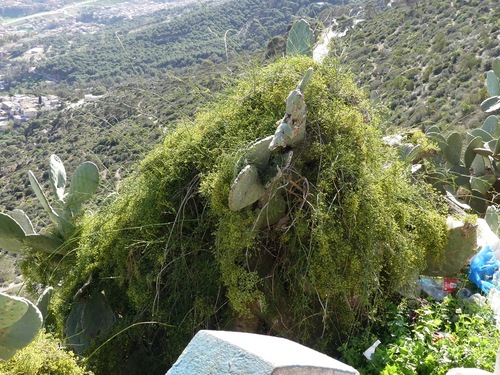
Ephedra sinica
Stapf.
Ma Huang, Chinese ephedra

(c) onidiras-iNaturalist, some rights reserved (CC BY-NC)

(c) onidiras-iNaturalist, some rights reserved (CC BY-NC)

(c) onidiras-iNaturalist, some rights reserved (CC BY-NC)
What to Eat
Edible parts: Fruit, Cone, Seeds - tea, Branches - tea
The fruit can be eaten raw or cooked.
Known Hazards
Where to Find It
It is a cool temperate plant. It grows in semi-desert places and rock-cliffs in NW China. It can grow in arid places. In Inner Mongolia.
Asia, China, Japan, Mongolia,
How to Identify
A small shrub. It has many branches. It grows 20-40 cm high. The branches are green. The leaves are opposite and brown. The pollen cones occur singly. The cones are near the ends of short side branches. The ripe cones are red and fleshy. There are 3 seeds that are oval and 3 sided. These are 5-6 mm long.
How to Grow
We have very little information on this species and do not know if it will be hardy in Britain, though judging by its native range it should succeed outdoors in many parts of this country. A small plant of this species is being grown in the Centenary Border at Hilliers Arboretum in Hampshire. It has survived at least one winter of temperatures down to below -10°c, but was not looking very vigorous when seen in September 1997. The following notes are based on the general needs of the genus. Requires a well-drained loamy soil and a sunny position. Established plants are drought resistant and are also lime tolerant. Dioecious, male and female plants must be grown in fruit and seed are required.
Propagation: Sow seed as soon as it is ripe in autumn in a greenhouse, or in spring in a greenhouse using a sandy compost. Prick out seedlings into individual pots once large enough to handle and grow on for at least their first winter under glass. Plant out in spring or early summer after the last expected frosts, with some protection during their first winter. Can also be propagated by division in spring or autumn, or by layering.
Medicinal Uses
Known in Chinese herbalism as Ma Huang, this strongly stimulant, acrid-tasting herb is considered one of the 50 fundamental herbs in that tradition. Most members of this genus contain medicinally active alkaloids, most notably ephedrine, and are widely used for asthma and catarrh. Ephedrine has a similar effect to adrenaline in the body, acting promptly to reduce swelling of the mucous membranes and providing antispasmodic properties valuable in asthma treatment. Using the whole plant at much lower concentrations than the isolated constituents rarely causes side-effects. The stems are a pungent, bitter, warm herb that dilates the bronchial vessels while stimulating the heart and central nervous system. They also act as an antidote and are diaphoretic, diuretic, pectoral, vasoconstrictor, and vasodilator, and are used internally for asthma, hay fever, and allergic complaints. The plant also has antiviral effects, particularly against influenza. Ephedra is often combined with other herbs for a wide range of conditions. This herb should be used with great caution, preferably under the supervision of a qualified practitioner. It should not be prescribed to patients taking monoamine oxidase inhibitors or those with high blood pressure, hyperthyroidism, or glaucoma. Ephedrine is banned in many sporting events as a performance-boosting substance. The root is antihydrotic, lowers blood pressure, and dilates the peripheral blood vessels; it is used for night sweating and spontaneous sweating, and is believed to have the opposite action to the stem — though it is only prescribed in cases of profuse sweating. The German Commission E Monographs approve Ephedra sinica for cough and bronchitis. Stems can be harvested at any time of year and dried for later use.
Other Uses
None known.
Wikipedia
Source ↗Ephedra sinica (also known as Chinese ephedra or ma huang) is a species of Ephedra in the plant family Ephedraceae. Native to Mongolia, northern China, and Russia, it is a shrub found on arid highland slopes, dry river beds, steppes, fields or mountain sides. E. sinica contains alkaloids, including ephedrine, which have been a basis for using the plant in traditional medicine for thousands of years. Due to concerns about alkaloid toxicity, ephedrine has been banned from the market in the European Union, United States, and many other countries.
Notes
It is used in medicine. There are about 40 Ephedra species.
Names & Synonyms
Zegergen-e
References (9)
- Bremness, L., 1994, Herbs. Collins Eyewitness Handbooks. Harper Collins. p 102
- Bull. Misc. Inform. Kew 1927:133. 1927
- https://en.wikipedia.org/wiki/List of wild edible plants in Mongolian cuisine
- Hu, Shiu-ying, 2005, Food Plants of China. The Chinese University Press. p 279
- Khasbagan, Hu-Yin Huai, and Sheng-Ji pei, 2000, Wild Plants in the Diet of Athorchin Mongol Herdsmen in Inner Mongolia. Economic Botany 54(4): 528-536
- Khasbagan, Yeruhan and Zhao Hui, 2011, Study on Traditional Knowledge of Wild Edible Plants Used by the Mongolians in Xilingol Typical Steppe Area. Plant Diversity and Resources. 33(2): 239-246
- Plants for a Future database, The Field, Penpol, Lostwithiel, Cornwall, PL22 0NG, UK. http://www.scs.leeds.ac.uk/pfaf/
- Sachula, et al, 2020, Wild edible plants collected and consumed by the locals in Daqinggou, Inner Mongolia, China. Journal of Ethnobiology and Ethnomedicine (2020) 16:60
- Urgamal, M., et al, 2014, Conspectus of the Vascular Plants of Mongolia. Mongolia Academy of Sciences Institute of Botany and National University of Mongolia Department of Biology. p 36