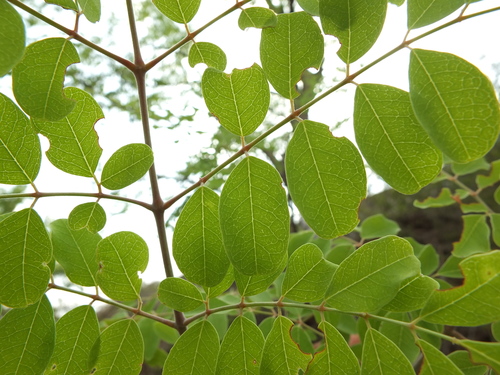
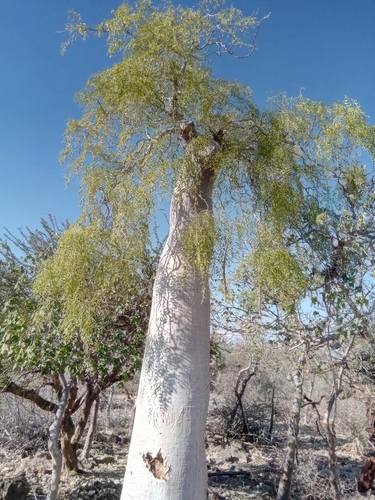
Moringa oleifera
Lam.
Horseradish Tree, Moringa

no rights reserved, uploaded by 葉子

(c) lupitaacostam, some rights reserved (CC BY-NC)

(c) 小铖/Smalltown, some rights reserved (CC BY-NC), uploaded by 小铖/Smalltown
What to Eat
Edible parts: Flowers Inner bark Leaves Oil Root Seed Seedpod Shoots
Tea. Young leaves and shoots - raw or cooked. Added to salads, cooked as a potherb and added to soups and curries. They have a mustard-like flavour. The leaves contain 7 - 10% protein. (This almost certainly refers to the dried leaf.) The leaves are very nutritious, being rich in vitamins, minerals and the sulphur-containing amino acids methionine and cystine, which are often in short supply. The young, tender seedlings make an excellent cooked vegetable. Flowers - raw or cooked. Added to salads, cooked as a potherb and added to soups and curries. They can also be used to make a tea. Seedpods. The long, bean-like pods are used in soups and curries, or made into pickles. The young pods are said to have a taste reminiscent of asparagus and can be eaten raw. The pods can be 15 - 45cm long. Seeds. The immature seeds are eaten like peas. A sweet flavour. Mature seeds, when roasted or fried, are said to resemble peanuts in flavour. An oil obtained from the seeds is used in salads and cooking. Pleasantly flavoured, it resembles olive oil and is an excellent salad oil. The oil is clear and odourless and does not become rancid quickly. The seeds from mature pods (which can be 40-50 cm long) are browned in a skillet, mashed and placed in boiling water, which causes the oil to float to the surface. The pungent root is used like horseradish (Armoracea rusticana) as a hot flavouring in foods. Even when free of the bark, the condiment when used in excess may be harmful. A reddish gum obtained from the bark is used as a seasoning. Used in a similar manner to gum tragacanth.
Where to Find It
E. Asia - Indian subcontinent.
TROPICAL ASIA: India (north), Pakistan,
How to Identify
Moringa oleifera is a deciduous Tree growing to 8 m (26ft) by 8 m (26ft) at a fast rate. See above for USDA hardiness. It is hardy to UK zone 10 and is frost tender. The flowers are pollinated by Bees, Sunbirds. The plant is self-fertile. It is noted for attracting wildlife. Suitable for: light (sandy), medium (loamy) and heavy (clay) soils and prefers well-drained soil. Suitable pH: mildly acid and neutral soils and can grow in saline soils. It cannot grow in the shade. It can tolerate drought. The plant can tolerates strong winds but not maritime exposure.
How to Grow
It grows best in areas where annual daytime temperatures are within the range 20 - 35°c, but can tolerate 7 - 48°c. The plant is quite cold hardy and is not harmed by light frosts, but it can be killed back to ground level by a freeze. It quickly sends out new growth from the trunk when cut, or from the ground when frozen. It prefers a mean annual rainfall in the range 700 - 2,200mm, but tolerates 400 - 2,600mm. Easily grown in a well-drained soil in a sunny position, tolerating a wide range of soil types. It grows best on fertile and well drained sandy soil, clay or clay loam but is in general suitable for light, medium and heavy soils thoigh it will not withstand salinity. It has a special tolerance to shallow soil and is tolerant of low fertility. Prefers a pH in the range 5.5 - 7, tolerating 5 - 8.5. Established plants are quite drought tolerant but yield much less foliage when continuously under water stress. Grows better if given shelter from strong winds. Moringa is an extremely fast-growing tree, and within 1- 3 months trees can reach 2.5 metres in height. Growth rates of 3 - 4 metres per year is not unusual for young plants Young trees raised from seed start flowering after 2 years. In trees grown from cuttings the first fruits may be expected 6 - 12 months after planting. Flowering often precedes or coincides with the formation of new leaves, and can occur throughout the year in non-seasonal climates. Constant pruning of up to 1.5 metres per year is suggested to obtain a thick-limbed and multibranched shrub. It coppices and pollards well. The sweet smelling flowers are produced throughout the year. In the warmer parts of its range the plant can produce a second crop of seeds each year. There is at least one named variety. Flowering Time: Late Spring/Early Summer. Bloom Color: White/Near White. Spacing: 8-10 ft. (2.4-3 m). Moringa oleifera is generally self-fertile. Leaves can be harvested throughout the year, while pods are typically harvested in late Summer to early Autumn. Moringa flowers in Spring to early Summer. Moringa is a fast-growing tree, often reaching maturity in about 6-8 months under optimal conditions.
Propagation: Seed - can be sown either directly, in containers or in a nursery seedbed, preferably with around 50% shade. No seed pre-treatment is required and seeds sprout readily in 1 - 2 weeks. Plants can be ready for planting out within 3 months of germination. Plants raised from seed produce fruit of unpredictable quality. Germination rates for fresh seeds are around 80%, going down to about 50% after 12 months storage, but no seeds survive 2 years of storage. Cuttings of half-ripe wood. Easy. Stem cuttings are usually preferred because they root easily. Large limbs can be planted to make an instant living fence. Branches 100 - 150cm in length, with a diameter of up to 4cm will root readily in just a few months. Shield budding is successful, and budded trees begin to bear in 6 months and continue to give a good crop for 13 years.
Medicinal Uses
Abortifacient Antiasthmatic Antibiotic Antifungal Antiinflammatory Antirheumatic Appetizer Astringent Cardiac Demulcent Digestive Diuretic Expectorant Kidney Laxative Odontalgic Rubefacient Skin Tonic Vesicant. The horseradish tree is a nutritious, diuretic, laxative herb that is expectorant, increases milk flow, controls bacterial infections and is rubefacient when applied topically. It contains a potent antibiotic. Ben oil, obtained from the seeds, has no taste, smell or colour and is exceptionally resistant to oxidation. The young leaves are taken internally to increase the milk flow in nursing mothers. The root is used as a vesicant. The alkaloid spirachin (a nerve paralyzer) has been found in the roots. The root juice is used internally in the treatment of asthma, gout, rheumatism, enlarged spleen and liver, bladder and kidney stones, inflammatory conditions. Externally, the root is used to treat boils, ulcers, glandular swellings, infected wounds, skin diseases, dental infections, snake bites and gout. The roots and bark are used for cardiac and circulatory problems, as a tonic and for inflammation. The bark is an appetizer and digestive. The gum is demulcent, diuretic, astringent and abortifacient. It is used in cough syrups and in the treatment of asthma. The bark and gum are used in the treatment of tuberculosis and septicaemia. Flowers and immature fruits are said to be a good rubefacient. A decoction of the flowers is used as a cold remedy. The seeds are effective against skin-infecting bacteria Staphylococcus aureus and Pseudomonas aeruginosa. They contain the potent antibiotic and fungicide terygospermin. Oil of Ben is used for hysteria, scurvy, prostate problems and bladder troubles. A number of compounds with medicinal properties have been isolated. The fruit and leaf contain oxalic acid, the bark moringinine, the stem vanillin, the flower kaempferol and quercetin and the root spirochin and pterygospermin. The seeds contain a glucosinolate that on hydrolysis yields 4-(alpha-L-rhamnosyloxy)-benzylisothiocyanate, an active bactericide and fungicide.
Other Uses
Cosmetic Dye Fencing Fertilizer Fibre Filter Fodder Fuel Gum Hedge Oil Pioneer Plant support Scourer Shelterbelt Soap making Soil conditioner String Tannin Weaving Wood Agroforestry uses: Moringa is often used as a multi-purpose tree in agroforestry systems. It is a fast-growing shade tree, provides green manure, and can improve soil fertility. Plants can be grown as an informal hedge, providing wind protection, shade and support for climbing garden plants. Widely used for live fences and hedges in many areas. Stakes root easily and are stable, and cuttings planted in lines are used particularly around houses and gardens. Because its shade can be controlled well Moringa oleifera is suitable for planting in alley cropping and in vegetable gardens. When trees reach 1.5 metres, farmers prune them (at 50cm from the ground or at ground level for older ones) once or twice a year. In alley cropping, an intra-row spacing of 2 metres is used. In the wet season cereals are grown between the lines, in the dry season vegetables. Because the tree is fast growing and readily colonizes areas such as stream banks and savannah, it makes a very good pioneer species for establishing a woodland garden. It is able to provide food after just a few months and also providing shelter to help other plants to establish. Other Uses The oil obtained from the mature seed and pods, known as 'oil of ben', has been used to lubricate watches and other fine machinery[63 , 238 , 287 , 303 ]. It is also used in perfumery, artist's paints, soaps and ointments. It is yellowish, non-drying, has good keeping qualities but eventually turns rancid. The powdered seeds are used to clarify sugar cane juice. A suspension of the ground seed is used as a primary coagulant. It can clarify water of any degree of visible turbidity. At high turbidity, its action is almost as fast as that of alum, but at medium and low turbidity, good clarification is obtained if a small cloth bag filled with the powdered seeds is swirled round in the turbid water. To prepare the seed for use as a coagulant, remove the seed coat and wings. The white kernel is then crushed to a powder, using a mortar or placing it in a cloth and crushing it with a stone. The powder should be mixed with a small amount of water, stirred, then poured through a tea strainer before being added to the turbid water. The seed cake residue from oil extraction can also be used for water purification. The seed contains a protein (cationic polyelectrolyte) that acts as a flocculant in water purification. It also contains a non-protein flocculant that is more effective in purifying low-turbidity water. The bark, when beaten, produces a fibre used to make small ropes and mats. A study on the production of rayon-grade pulp from M. Oleifera by a prehydrolyzed sulphate process in India shows that it is suitable as a raw material for the production of high alpha cellulose pulp for use in cellophane and textiles. When the tree is injured, the stem exudes a gum that is used in calico printing. The bark is used for tanning. The wood yields a blue dye. The crushed leaves are used to clean pots, pans and walls. The press cake left after oil extraction from the seeds can be used as a soil conditioner or as fertilizer. The wood is very soft, corky and light, and is useful only for light construction work. It is pulped as a source of rayon and cellophane. The soft and light wood burns smoke-free and is an acceptable firewood for cooking but makes poor charcoal. It has a density of 0.5-0.7 and yields approximately 4600 kcal/kg.
Names & Synonyms
Horseradish Tree, Moringa, Drumstick Tree, Ben Oil Tree, Benzoil Tree, Achajhada, Agati, Alinga, Benoil tree, Benzolive-tree, Boro ni idia, Buah kelentang, Elmakka, Kachang kelok, Kachang kelu, Kachang kelur, Kelor, Kilor, La mu, Lembugai, Lopa, Ma-rum, Malunggay talbos, Marongghi, Marum, Marungi, Merunggai, Midhosaragavo, Mronge, Mrum, Mulaga, Munaga, Munga arak, Mungna, Murinna, Murruggai, Murunga, Murungai, Murunkai, Nanquera, Nugge, Oil of Ben Tree, Pemanggai, Ramunggai, Rawag, Rembugai, Sahijan, Sahjna, Saijan, Saijana, Sainjan, Sainjna, Sajana, Sajina, Sajina, Sajyon, Sanjna, Saragavo, Saragvo, Segta, Seijan, Seringuane-singa, Shajna, Shanjna, Shekta, Shevgi, Shobhanjana, Shorjona, Sigru, Sijan, Sital chini, Sloek morom, Soanjna, Sohjna, Sonjna, Tellamunaga, Thingbe, Wasabi no-ki-no-ha, West Indian ben, Wimdi boundu, Zogale, agamago, ak?iva, alim, amaris, argentiga, babatsi, bagaelean, baganlua, bagaruwar masar, bahala, bahola, barambo, bararuwar maka, behen tree, behenbaum, ben aile', ben ailee, ben ailée, ben and benoil- tree, ben-oil-tree, benzolive-tree, bred mouroung, brede morongy, brede mouroungue, brède mouroungue, chamwamba, chigban wawa, danga, drum stick tree, drum-stick tree, drumstick tree, drumstick tree|murunga, drumsticktree, ewe igbale, ewe ile, gawara, gigandjah, habbah ghaliah, habiwal hausa, halim, horse radish tree, horse-radish tree, horseradish tree, horseradish-tree, horseradishtree, idaga manoye, kangaluni, konamarade, maranga, marum, marunga, meerrettichbaum, meringgai, mirongo, mlonge, mlongo, mlonje, mocaka, moringa a graines tripteres, moringa ailée, moringueiro, mouroungue, mronge, mrongo, mulaga, mulaya chetta, munaga, munaga aku, munaga chettu, munga, mungna, munika, muringa, muringa elai, muringai, muringai virai, muringnga, muringueiro, muringya, murinna, murungai, murungai iali, murungai ilai, mzunze, mocaka, na-sha, neegge, never die, nugge, nugge beeta, nugge ele, nugge kand chakke, nuggekoyimara, nuggemara, néverdié, oil of ben tree, okwe, okwe-beke, oyibo, paraíso, paraíso blanc, pferderettichbaum, rini maka, ruwag, sahajan, sahajana, sahenjana chaal, sahijana, saijna, sajana, sajina, sajna, sajne, sajyon, sangoa, sanjano, saragave, saragavo, saragavo parna, sargavo, segat sala, segata, segata pana, sehjan, sehjana, sekato, sevaga, shajoma, shegatabeeja, shevaga, shewga, shewgachi pane, shigru, shipka hali, shobhanjana, shuka halinka, sigru, sohajana, sohaniana, sohanjana, sohijan, sohjna, sonjna, tiksnggandha, tishnagandha, tree of life, tik??agandha, tik??agandha, west indian ben, yevu-ti, yevuti, zakalanda, zogall, zogall-gandi, zogallagandi, sigru (leaf), sigru (root bark), sigru (seed), sigru (stem bark), sobhañjana, sakhapatra, sobhañjana.