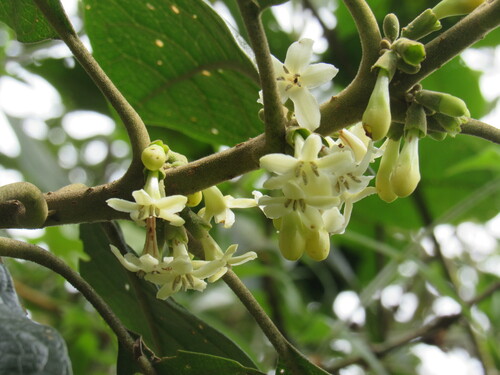
Calamintha sylvatica
Bromf.
Calamint, Woodland calamint

Diny Schotanus

Diny Schotanus

Diny Schotanus
What to Eat
A sweet and aromatic herb tea is made from the leaves. Very refreshing. Leaves - used as a flavouring in cooked dishes. Pleasantly pungent and strongly aromatic, the flavour is said to resemble a cross between mint and marjoram.
Where to Find It
Western Europe, including Britain, from France and W. Germany south to Spain, Algeria and N. Syria.
TEMPERATE ASIA: Iran (north), Lebanon, Turkey, Russian Federation-Ciscaucasia (Ciscaucasia), Armenia, Azerbaijan, Georgia, Russian Federation (Dagestan) EUROPE: United Kingdom (south), Austria, Switzerland, Hungary, Ukraine, Albania, Bulgaria, Greece, Italy (incl. Sicily), Romania, Serbia, France (incl. Corsica) AFRICA: Algeria (north)
How to Identify
Calamintha sylvatica is a PERENNIAL growing to 0.6 m (2ft) by 0.5 m (1ft 8in). See above for USDA hardiness. It is hardy to UK zone 6 and is not frost tender. It is in flower from July to September, and the seeds ripen from September to October. The species is hermaphrodite (has both male and female organs) and is pollinated by Bees, insects. It is noted for attracting wildlife. Suitable for: light (sandy) and medium (loamy) soils and prefers well-drained soil. Suitable pH: mildly acid, neutral and basic (mildly alkaline) soils and can grow in very alkaline soils. It can grow in semi-shade (light woodland) or no shade. It prefers dry or moist soil.
How to Grow
Succeeds in a well-drained dry to moist neutral to alkaline soil and a sunny position. Likes semi-shade. Succeeds in a woodland garden. Bees love the flowers of this plant.
Propagation: Seed - sow spring in a greenhouse and only just cover the seed. It usually germinates in 2 weeks at 21°c. Prick out the seedlings when they are large enough to handle and, if they grow sufficiently, plant them out into their permanent positions in the summer otherwise wait until the following spring. Division in spring. Very easy, larger clumps can be planted direct into their permanent positions. It is best to pot up smaller clumps and grow them on in a cold frame until they are well rooted before planting them out in the summer. Basal cuttings in May or June. They should be rooted in a sandy compost. Harvest the shoots when they are about 10 - 15cm long with plenty of underground stem. Pot them up into individual pots and keep them in light shade in a cold frame or greenhouse until they are rooting well. Plant them out in the summer.
Medicinal Uses
Aromatic Diaphoretic Expectorant Stomachic. Calamint was commonly used as a medicinal herb in medieval times, though is little used by modern herbalists. It has very similar properties to lesser calamint (C. nepeta) though is milder in its actions. It is sometimes cultivated as a medicinal herb for household use. The whole plant is aromatic, diaphoretic and expectorant. The leaves are harvested in July as the plant comes into flower and are dried for storage. An infusion is beneficial in cases of fevers, flatulent colic and weaknesses of the stomach, it is also used to treat depression, insomnia and painful menstruation. Its expectorant action makes it a good cough and cold remedy and it is of value for treating mild respiratory infections. It is best mixed with other herbs, especially yarrow (Achillea millefolium) and Thyme (Thymus vulgaris). Calamint should not be prescribed for pregnant women since in excess it can cause a miscarriage.