Eragrostis parviflora
(R. Br.) Trin.
Weeping lovegrass

(c) HarleyB, some rights reserved (CC BY-NC), uploaded by HarleyB
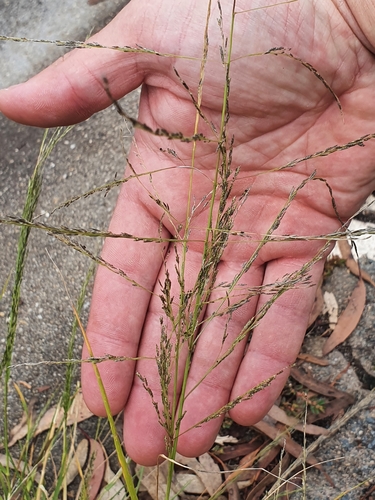
(c) HarleyB, some rights reserved (CC BY-NC)
What to Eat
Edible parts: Seeds ?
Where to Find It
It grows on quartzite and granite soils. It can grow in mud. It grows in subtropical locations.
Australia*, Tasmania,
How to Identify
A grass that grows in tufts. It can grow from seed each year or keep growing for a few years. It grows 30-90 cm high. The leaves are mostly near the base. The leaf blades are narrow and 1-3 mm wide. The flowers are green. The grain is oblong and smooth.
Nutrition Score: 52/100
| Part | Moisture | kJ | kcal | Protein | Vit A | Vit C | Iron | Zinc |
|---|---|---|---|---|---|---|---|---|
| Seed | 12.6 | 1370 | 328 | 12.4 | — | — | — | — |
Wikipedia
Source ↗Eragrostis parviflora is a widespread species of grass known as weeping lovegrass. Growing to 1.3 m (4 ft 3 in) metres tall, it may be found in many parts of Australia and New Caledonia. Leaves are strongly ribbed, hairless or with marginal hairs; the leaf blade may be flat or inrolled.
Notes
There are about 300 Eragrostis species.
References (5)
- Cancilla, D., 2018, Ethnobotanical and Ethnozoological Values Desktop Assessment - Eliwana Project. p 11
- Lamp, C.A., Forbes, S.J. and Cade, J.W., 1990, Grasses of Temperate Australia. Inkata Press. p 164
- Lazarides, M. & Hince, B., 1993, Handbook of Economic Plants of Australia, CSIRO. p 92
- Mem. Acad. Imp. Sci. St.-Petersbourg, Ser. 6, Sci. Math. 1(4):411. 1830
- Paczkowska, G. & Chapman, A.R., 2000, The Western Australian Flora. A Descriptive Catalogue. Western Australian Herbarium. p 105


