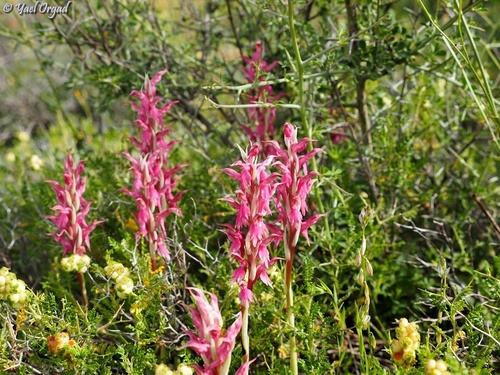
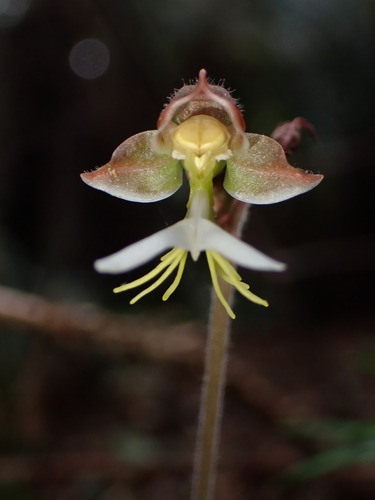
Eriochilus cucullatus
(Labill.) H.G. Reichb.
Parson’s Bands, Pink Autumn Orchid, Autumn orchid

(c) Matt Tudor, some rights reserved (CC BY-NC), uploaded by Matt Tudor

(c) Lynda McPherson, some rights reserved (CC BY-NC), uploaded by Lynda McPherson
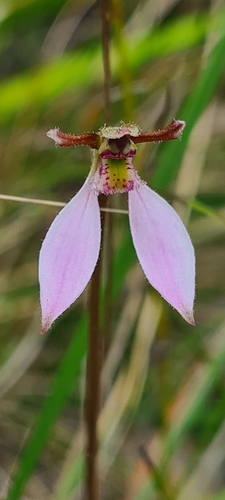
no rights reserved, uploaded by Vale Jenny Conolly
What to Eat
Edible parts: Tubers, Root
The tubers are edible, though harvesting them kills the plant.
Where to Find It
It is a temperate plant. It can grow in subalpine regions, open forests, heathlands and coastal scrubs.
Australia*, Tasmania*,
How to Identify
A small ground orchid. It has a tuber. There is only one leaf. The leaf is 0.5-4 cm long by 0.3-0.8 cm wide. It may not be completely developed at flowering time. The flower stem is thin and wiry. It can be 5-25 cm high. There can be 5 flowers. Each flower is 2 cm across. They are mostly white but can be blue or pink. It produces nectar.
How to Grow
Plants are grown from tubers. Seeds sometimes grow in sprinkled around the base of established plants.
Wikipedia
Source ↗Eriochilus cucullatus, commonly known as parson's bands, or leafless parson's bands, is a plant in the orchid family Orchidaceae and is endemic to Australia. It is a common and widespread, slender ground orchid with a single leaf and up to five small white to pale pink flowers. It grows in all Australian states except Western Australia and the Northern Territory.
Production
The tuber is dormant during spring and summer.
Notes
There are about 6 Eriochilus species.
Names & Synonyms
References (13)
- Bodkin, F., 1991, Encyclopedia Botanica. Cornstalk publishing, p 396
- Caton, J.M. & Hardwick, R. J., 2016, Field Guide to Useful Native Plants from Temperate Australia. Harbour Publishing House. p 286
- Collier, P., 1993, Orchids of Tasmania. Plant Identikit. Society for growing Australian Plants. Tasmania. p 87
- Cronin, L., 1989, The Concise Australian Flora. Reed. p 71
- Dashorst, G.R.M., and Jessop, J.P., 1998, Plants of the Adelaide Plains & Hills. Botanic Gardens of Adelaide and State Herbarium. p 204
- Elliot, W.R., & Jones, D.L., 1984, Encyclopedia of Australian Plants suitable for cultivation. Vol 3. Lothian. p 469
- Gilfedder, L et al, 2003, The Nature of the Midlands. Midlands Bushweb. PO Box 156 Longford, Tasmania. p 106
- Holliman, J., (Ed.), 2002, Orchids. Botanica's Pocket. Random House, Australia. p 274
- Jones, D., Wapstra, H., Tonelli, P., and Harris S., 1999, The Orchids of Tasmania. Miegunyah Press, MUP, Victoria, Australia. p 146
- Lim, T. K., 2015, Edible Medicinal and Non Medicinal Plants. Volume 9, Modified Stems, Roots, Bulbs. Springer p 41
- Minchin, R.F., Tasmanian Wildflowers. A Field Guide. Volume one. Regal Publications, Launceston p 42
- Tasmanian Herbarium Vascular Plants list p 74
- Woolmore, E et al, 2002, King Island Flora: A Field Guide. p 96